
Definition of Brand loyalty – This occurs when consumers have a strong preference for a particular type of good or brand. It means that the consumer will be willing to make repeat purchases and is much less likely to experiment with other goods.
| What is Brand Loyalty? | |
| Consumers repeatedly choose the same brand over alternatives because of trust, satisfaction, habit or emotional attachment. | |
| Causes of Brand Loyalty | Effects of Brand Loyalty |
|---|---|
| • Consistent quality • People want reliability and no uncertainty • Strong branding & reputation • Emotional connection • Rewards & loyalty schemes | • Repeat purchases & higher lifetime value • More market power • Stable demand for the firm • Word-of-mouth promotion • Competitive advantage and market share |
Examples of Brand Loyalty

Some brands are instantly recognised. Are there any brands in this picture that people might not recognise instantly?
Why we Like Brand Loyalty
The attraction of brand loyalty for consumers is
- Less time having to think what to buy
- Guaranteed minimum standards
- Advertising gives assurance firm has strong resources. Heavily advertised goods create a feeling of security whereas non advertised goods have a lot of uncertainty – they may be better but they may be a lot worse.
- Consumers often think (perhaps subconsciously) that if the firm spends such a lot of money on advertising then the firm must be successful and the goods must be worth buying. Why would a firm spend a lot on advertising if it was no good?
Brand loyalty for Apple macs
Not all brand loyalty has to be for heavily advertised goods. Apple spends a small % of turnover on advertising for its products such as Apple macs. Some fashion brands such as …. don’t spend anything on advertising at all. Part of their mystique is the lack of commercialisation.
Brand Loyalty for Smartphones
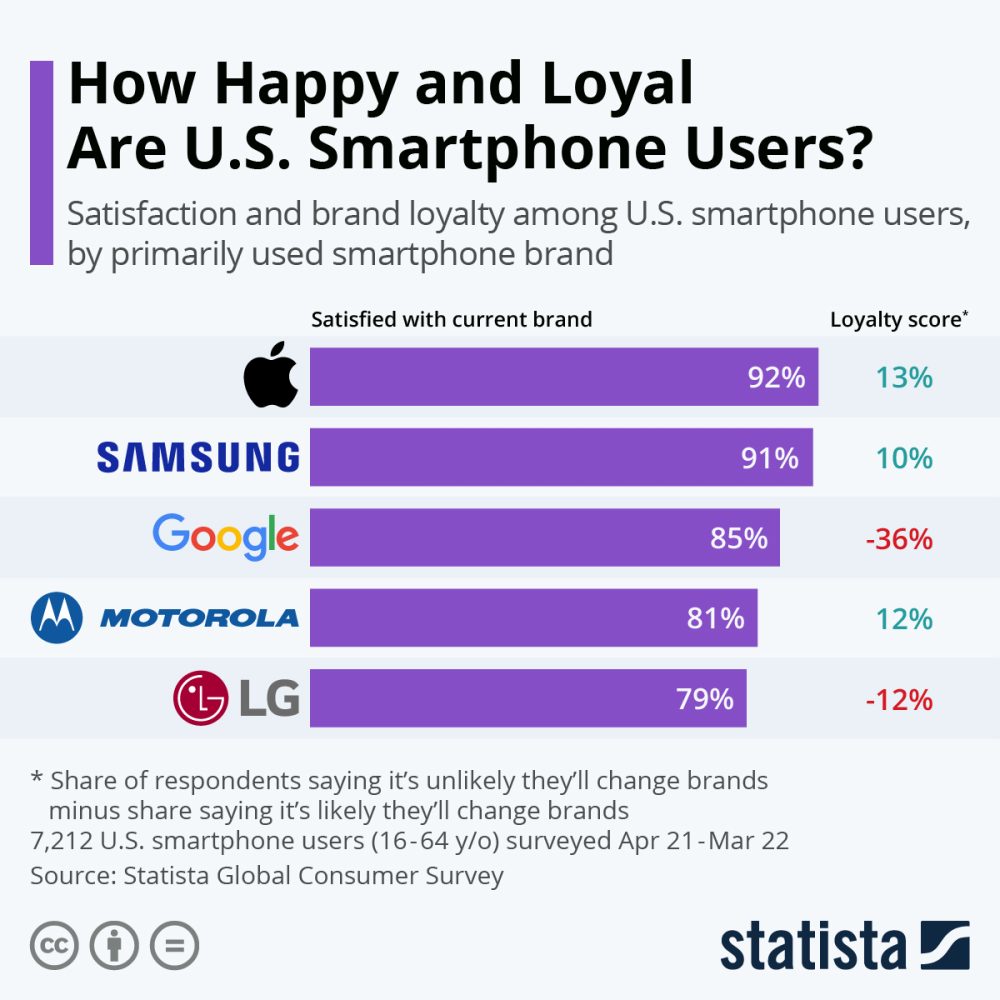
Does this survey surprise you? Google may have very strong brand loyalty for search engines, but when it comes to phones, it seems Google users are ready to leave.
Apple, unsurprisingly, has the highest loyalty – this perhaps explains why they are more expensive than their rivals.
Costs of Brand Loyalty
- Higher prices for consumers because firms gain market power (degree of monopoly power) when demand is inelastic.
- Less dynamic efficiency. Reduced incentive for firms to innovate or improve quality since loyal customers are less likely to switch.
- Less contestable. Barriers to entry increase as new firms struggle to overcome established brand recognition.
- Allocative inefficiency. Market inefficiency occurs when consumers stick to a brand even when better or cheaper alternatives exist.
- Costs of advertising leads to higher prices. Firms face high ongoing marketing and advertising costs to maintain loyalty schemes and brand image. Reports show Coca-Cola spends around US $5 billion per year on advertising (2-3% of its revenue)
- Potential for anti-competitive behaviour such as exclusivity deals or tying/bundling. Coca-Cola sell shops fridges on condition they don’t stock rivals
- Loyalty may mask product weaknesses, causing firms to misjudge market conditions.
- Ads can be annoying!
Related
About The Author
