
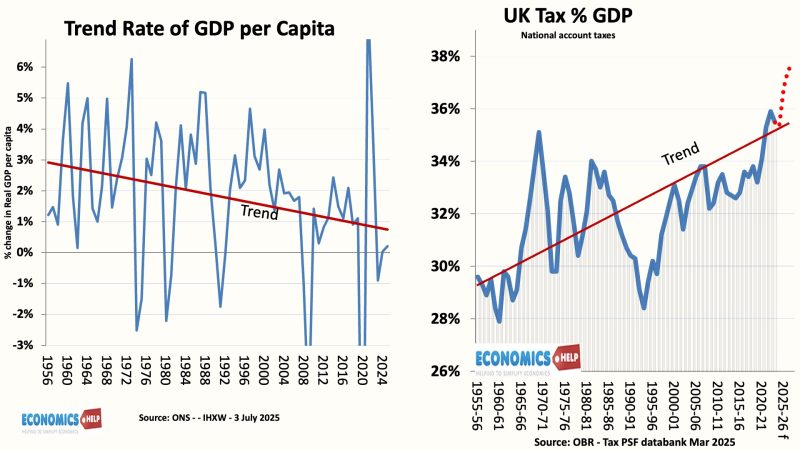
This is the UK economy since the 1950s, the trend rate of GDP per capita has fallen from 3% to less than 1%. The tax share of GDP has risen from 29% towards 38%. The British economy is on shaky ground. Productivity has flatlined, growth is stalling, and the government’s fiscal plans may be about to unravel.
For decades, Britain’s productivity grew at around 2% a year, enabling higher wages, higher living standards, and more money for public services. But since the financial crisis productivity has barely grown. This is where the economy could have been if the post-war trend growth had been maintained.
After a flash estimate for August showed productivity falling 0.8%, there is is growing speculation that the OBR will have to downgrade its productivity growth in the upcoming budget. Why does this matter? If there is just a 0.3 percent point downgrade, then that leaves the chancellor with a £26 billion black hole. If there is a 0.5 percentage point blackhole, that is £44 billion. That’s a lot of tax. To put it into context, George Osborne’s austerity budget of 2010 involved a £40bn contraction.
And productivity isn’t the only problem. The broader economy is showing signs of weakness: Growth in the past three months has dropped back closer towards zero. The labour market is softening – vacancies are down, unemployment is up, and PAYE data shows fewer people in work. Recent tax rises, like higher National Insurance, are adding to business costs and discouraging hiring.
It means the UK economy is showing signs of being an outlier in terms of both inflation, well above the OECD average and also now in terms of the labour market. It is an unwelcome headache for a chancellor at a time when confidence is relatively low and taxes as a share of GDP are already at a record high.
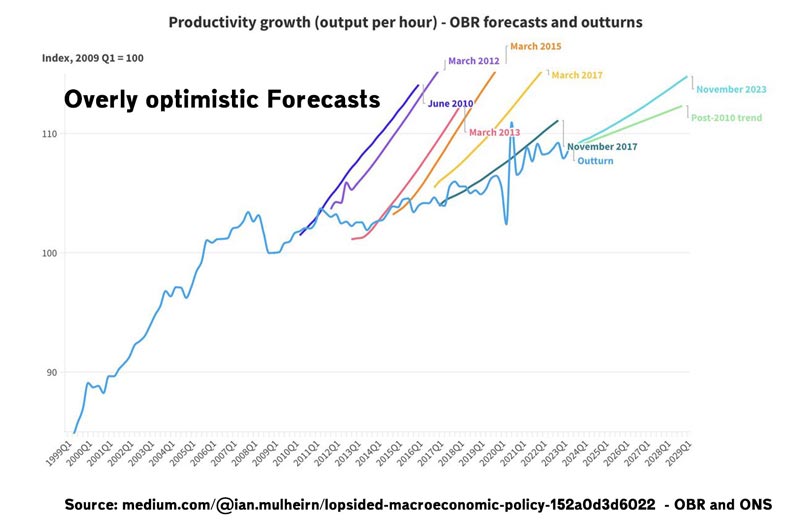
There is good reason for considering a productivity downgrade. Past OBR forecasts have consistently been downgraded after the event. It would require quite an optimistic take to feel that this is the moment when the economy is finally showing signs of a turnaround.
Some optimists argue the bad news was already baked in.. The ONS actually expected a weak start to the year, and the dismal figures are in line with expectations. Also, the Bank of England usually much more pessimistic than the ONS have slightly increased their expectations for the economy. In their August report, they mentioned.
Potential productivity growth… [has] been somewhat less weak”
I think that “somewhat less weak” is what counts as good news for the UK economy these days.
Also, if you are a glass-half-full kind of economist, you could argue that past poor productivity was partly related to crises like austerity, Brexit, Covid and the gas shock. Without this kind of shock, plus slightly higher government investment and falling labour market inactivity, it could start to modestly improve. Maybe firms will increasingly find a way to use AI in a way which increases productivity.
However, until you see more evidence in the actual data this remains hopeful rather than realistic, if the OBR were cut its forecast to match the consensus among economists, it would deliver a £20bn blow to the Chancellor’s financial headroom. Enough to create more bad headlines in the budget and a blow to growth.
Ultimately, trying to predict productivity growth over the next four years is a real judgement call, and the OBR will probably be conscious of the political costs of a downgrade given the government’s fiscal targets. You could argue it is unsatisfactory so much relies on essentially a judgment call about predicting something highly uncertain over the next 5 years. But, that’s where the economy is at.
The problem is that with inflation stubborn, the government will feel there is relatively limited room for manoeuvre with regard to borrowing. Already, this is a record year for gilt sales, with rising bond yields around the world, and dismal long-term fiscal forecasts, it is much harder to borrow than say last decade.
Economic growth in the first half of 2025 was 1.1%, which is respectable, but with the threat of more tax rises coming, a global trade war and falling real wage growth, there is likely to be weaker demand in the second half of the year.
Way Out?
Of course, you might ask, isn’t there a way to get out of this spiral of stagnation? The real prize would be to find a way to boost productivity growth. The government will hope that planning reform could play a role. If it’s easier to build, construction can help boost economic growth, and in theory start to moderate the immense cost of housing which does so much to hold back living standards. However, the planning reforms have been somewhat watered down, and construction is struggling to get going with other factors such as building regulations, weak demand and high stamp duty slowing down the housing market.
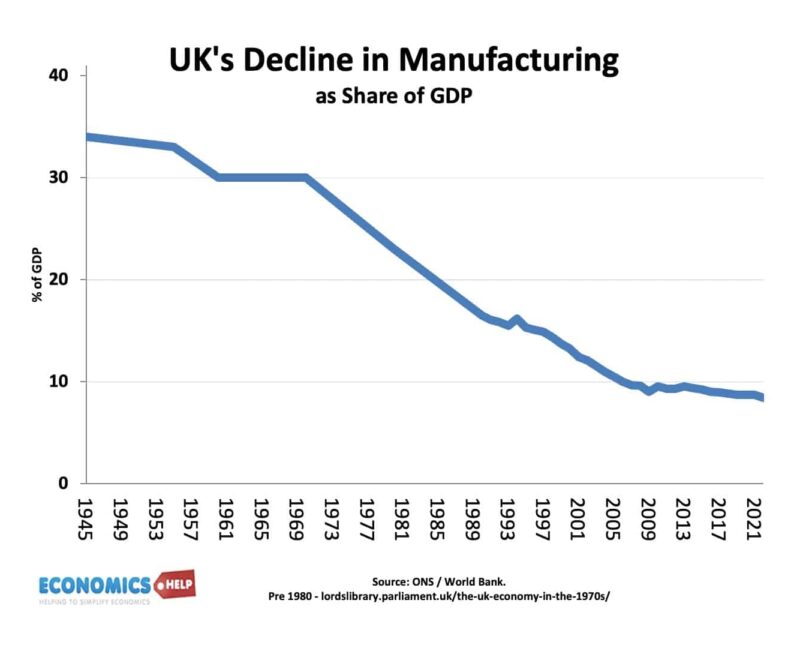
The government have announced a new industrial policy, at a time when the biggest downward factor in growth last month was in industrial production. It continues the trend of deindustrialisation, with the manufacturing sector having shrunk from 16% of GDP in 1900 to just 8% today. A big cost has been high electricity prices, but the government shrank away from the kind of reforms tax changes, regional pricing which would significantly reduce prices. Ineos’s boss has made noises about pulling all his investment from the UK on the basis of the UK’s unstable fiscal regime. To be fair, the UK is hardly an outlier in terms of unstable fiscal regimes.
The other big decline was in pharmaceuticals a sector traditionally strong in the UK. There is disquiet amongst US pharmaceutical companies about the NHS drug pricing regime, which is able to get significantly lower prices than in the American health care industry. And it is worrying that big pharma firms have held back from investment in the UK. This is something the economy needs. The problem is that attracting pharma investment with big rise in costs would be a big blow to the NHS.
The other issue is that with taxes going up, what is the best way to tax? Certainly taxing NI contributions is one of the more growth unfriendly options, directly hurting employment, alternatives include a windfall tax on bank profits, reforming capital gains tax, taxing property directly rather than through stamp duty.
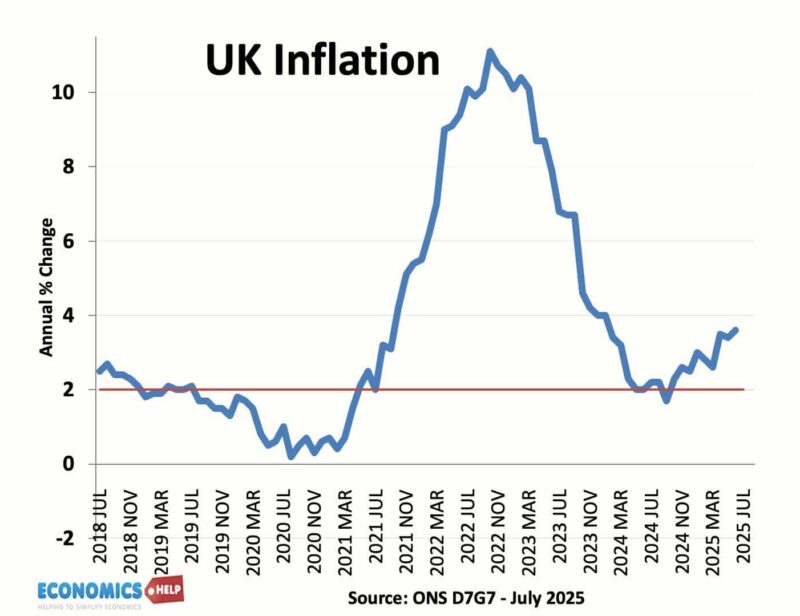
Inflation has definitely become another headache and again forecasts of falling inflation have been pushed back. Whilst it partly reflects one-off factors like a rise in utility bills, the high inflation itself is pushing up inflation expectations. This can make inflation harder and more costly to bring down. After a brief period of real wage growth, inflation of 3.8% is eating into real wage growth, meaning that workers are once again being squeezed. The boss of Barclays argued the government need to limit the pay rise of public sector workers to bring inflation down. By the way, it’s easy to call for pay restraint when your own pay doubles to £10.5million a year. But, public sector workers had a decade of falling behind the private sector, and feel they need an element of catching up RMT workers recently went on strike on the London Underground after rejecting a 3.4% pay rise.
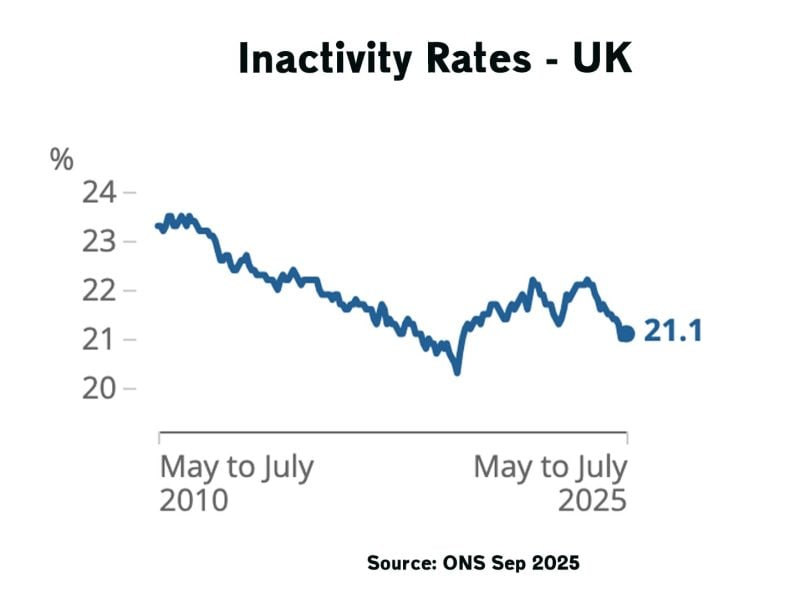
There is some good news on the economy. Rates of economic inactivity are coming down. It is still higher than pre-covid, and there is the usual uncertainty about economic data. But, high rates of inactivity are a major constraint on the economy and also the government’s budget. Despite this, there is still a major rise in health-related benefits to come. Finding a way to limit the growth of health benefits is still an objective for the labour market. It requires reform based on evidence rather than just meeting short-term fiscal targets. Also, although there are fears of tax rises in the autumn, in a way British consumers are ready for it, by pre-emptively increasing their savings in anticipation. Therefore, actual tax rises may not be as damaging as expected.
About The Author
