
 Adjusted for purchasing power parity, China’s economy has overtaken the United States, and the gap continues to grow. But for an economy dependent on exports, a trade war is a big deal in 2024 Chinese exports to US were over $500bn, but so far, China has largely shrugged off the rollercoaster of US tariffs. Exports to US may be down 27%, but China is finding new export markets. As a share of global GDP the US is in decline, and China is on the rise.
Rare Earths
When Trump announced the April tariff shock, China retaliated by implementing rare earth export controls. This, combined with a stock market crash,h caused Trump to back down and reduce tariffs. Rare earths and magnets are critical ingredients in global supply chains, essential for everything from fighter jets like the F-35 to cars and electronics industry. But, even after US reduced tariffs back down to 35%, the interesting thing is China didn’t fully reciprocate – it kept export controls in place, Meaning the US could only buy rare earths though short-term conditional arrangements. But last week, China introduced even more stringent rare earth restrictions. In response, Donald Trump threatened 100% tariffs. However, 80% of US rare earth materials come from China and without them, many industrial processes would grind to a halt. However, the US threat of 100% tariffs caused another adverse market reaction with stocks and the US dollar down with analysts again fearing the latest tariff threat could backfire on the US. Realising the importance of rare-earths, the US had backed down and the new tariffs were rolled back. It has certainly given the Chinese leadership growing confidence they hold all the aces, the feeling that the US tends to always back down and the chokehold China has. However, there is a danger that China could also be over-reaching and actually hiding several economic weaknesses.
Problems Facing China
Now whilst China seems to be in a dominant position, it is worth pointing out several weaknesses to the economy. The property market has been a classic bubble and bust, leading to several zombie firms and a rise in local government debt that bet on rising property values. Prices would have fallen more but for government price controls. Secondly, the ultra-competitiveness of Chinese manufacturing is partly due to excessive competition and involution of industry, which leads to extreme price wars, overcapacity and falling returns.

Local governments have incentives to support excess investment for the prestige of new investment and more firms, but this weak profitability could lead to big fall in private investment in the coming years, especially with weak domestic demand. Falling prices is also causing deflation, which can lead to rising real debt burdens and falling consumer spending. Chinese Economic growth has slowed down this year, and that’s assuming statistics are not overstating actual output.
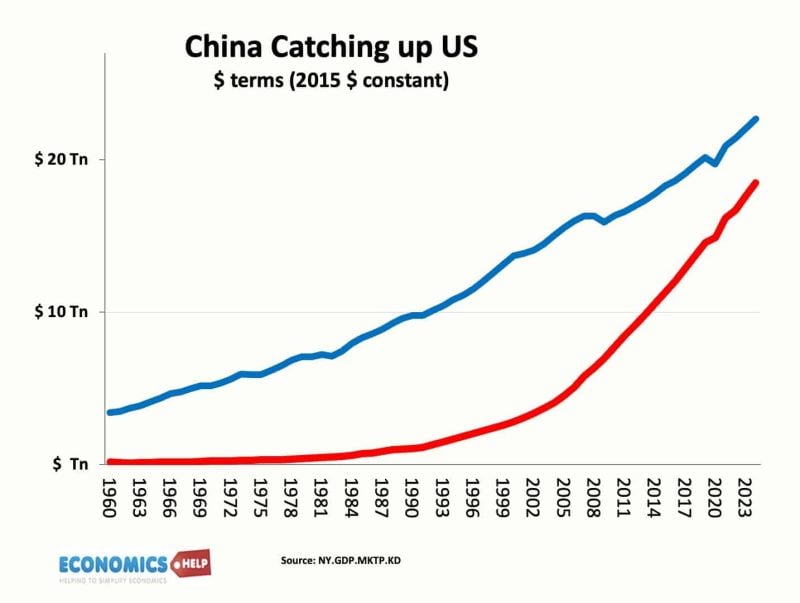
Also if we compare economies using raw dollar size, China is still less than the United States and in recent years, there are signs of Chinese growth rates starting to falter. The long-held assumption China will overtake the US in raw dollar terms is actually disputed for several reasons: China has a falling fertility rate, its population is ageing, and is now in population decline. By 2050, the share of the population over 65 will rise to 26% from 12%. Already China has a problem with excess domestic saving, a rate of 24.% per capita in 2024 compared to 4.6% in the US.
Also, going back to rare earths, it is true China has a current monopoly on the refinement of rare earths, but the Chinese threats are encouraging frantic efforts to diversify with greater production in Australia and the development of new refinement facilities. Greenland is also becoming a major player, it would be ironic if Greenland could come to the US’s rescue.
China is playing a trump card, but this will only stimulate competition to bring down China’s monopoly. The question is how long will it take. Also, reliance is not just one way. China is still relatively reliant on high-end semiconductors, with the US blocking the export of Nvidia’s most advanced AI chips. However, although this ban will slow down China it is not as critical as rare earths.
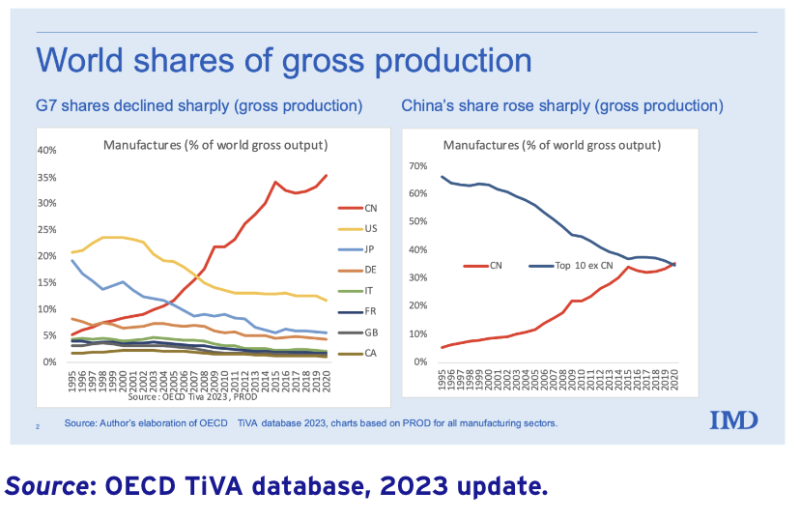
Yet, whatever might happen in the future, the statistics for China’s growing dominance of manufacturing are startling. China’s share of global export containers is over 36%. Despite the trade war, China’s trade surplus is on track to exceed $1trn this year. Despite domestic problems, it has carefully cultivated supply chains with raw materials suppliers from Africa to Latin America. As President Trump found to his cost, a near monopoly in the production of raw earth earths gives it powerful leverage over trade deals. Nor is China reliant on the US, emerging economies are buying fast. China is dominating the production of industrial magnets, the new wave of renewable technology, batteries, electric cars and solar panels. Its car industry is the fastest growing in the world and its goal of being the dominant manufacturer seems to be in place.
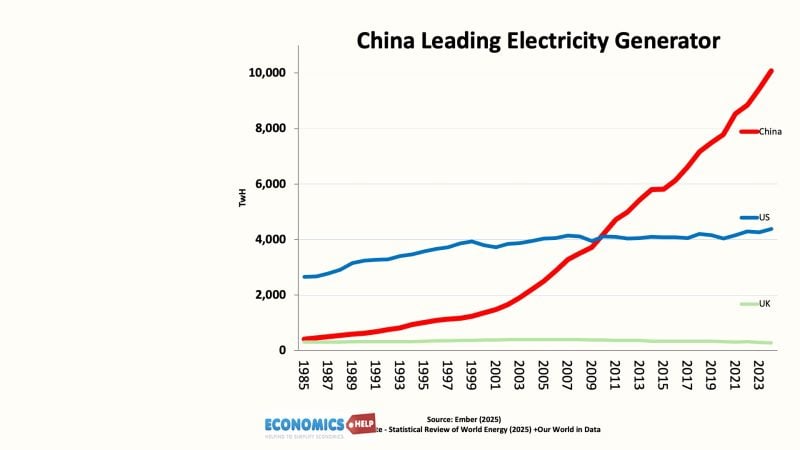
If we look at electricity production, we can see in stark terms the strength of the Chinese economy in terms of industrial power. When it comes to new renewable energies, China is leading the way, by 2030, it will accounting for 50% of all renewable energy. The United States by contrast, is turning its back on renewable energy with projects cancelled.
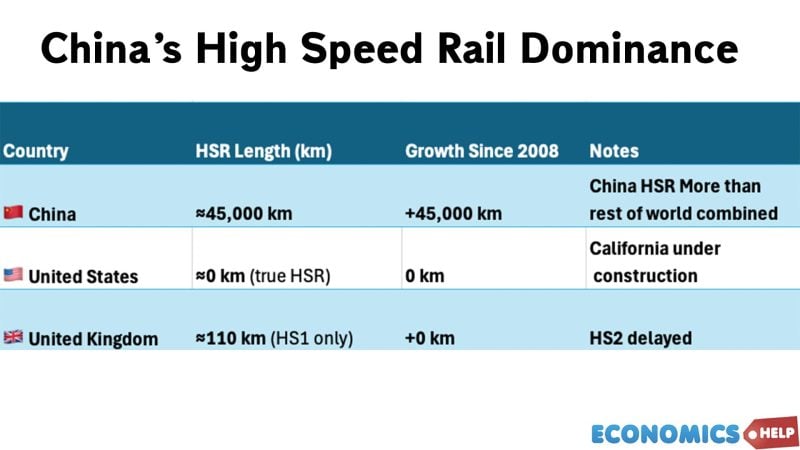
Whilst the UK and US struggle to build high-speed railway, China has built 45,000 km since 2008, more than the rest of the world combined. Also, whilst China is a leader in renewables, it is also a leader in coal production and CO2 emissions.
Energy
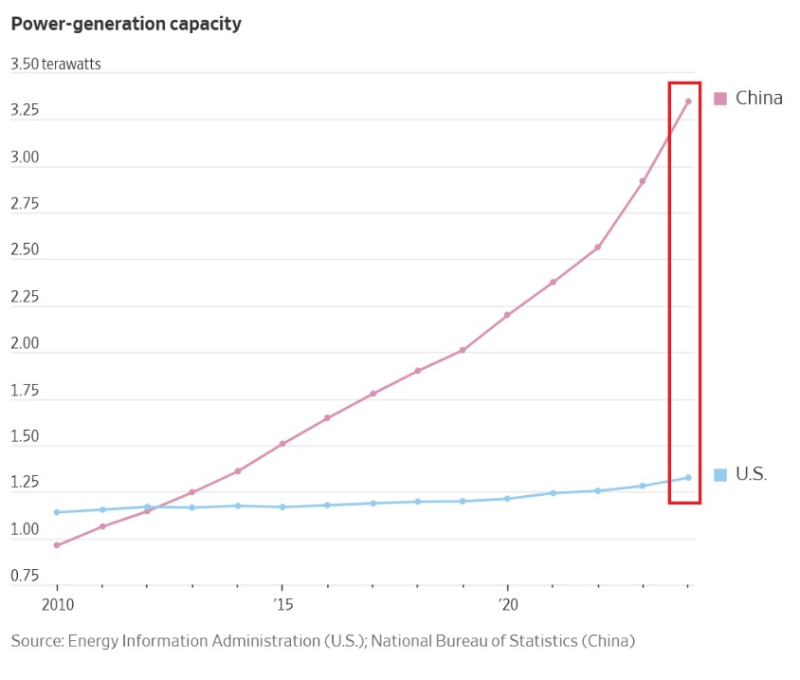
China is winning the power race – using both fossil fuels and massive expansion of renewables like solar and wind.
China has made itself indispensable in a key aspect of industrial production and feels it has a trump card in rare earths. There is great unease about China’s dominance of global manufacturing, but at the same time, countries are seeking Chinese investment in new industries like batteries and renewable energy. Also, whilst a reliance on cheap Chinese exports is damaging the domestic industry.

It is very difficult to switch. If you ever try to buy goods, not made in China, it is pretty difficult. For example, the price of a home solar power system would be at least 50% more expensive if you buy from Europe or US rather than China. If Chinese imports were suddenly curtailed, it could increase the inflation rate by 2%, enough to cause significant discomfort. Also, even if clothing says made in Vietnam, there is a strong chance a large part was manufactured in China before being sent to Vietnam for final assembly.
Sometimes we hear China is on the verge of collapse, other times that it is dominating the world economy. What’s the truth? Well, it is still the dominant manufacturing giant. Its monopoly on rare earths also gives it considerable bargaining power. But, this will not last forever and some of the weaknesses of the Chinese economy will start to catch up with it. However, the idea that we are going to end China’s manufacturing and start producing textiles and toys in the US is fanciful to say the least
Sources:
- https://www.telegraph.co.uk/news/2025/08/24/china-economic-peak-population-gdp-threat-taiwan-invasion/
- https://chinapower.csis.org/tracker/china-manufacturing/
- https://www.economist.com/international/2025/09/23/a-made-in-china-plan-for-world-domination
- https://sustainabilitymag.com/articles/how-china-will-lead-the-green-energy-expansion
- https://pmc.ncbi.nlm.nih.gov/articles/PMC10311713/?utm_source=chatgpt.com
- https://thecritic.co.uk/dont-panic-about-rare-earths/
- https://cepr.org/voxeu/columns/china-worlds-sole-manufacturing-superpower-line-sketch-rise
About The Author
