
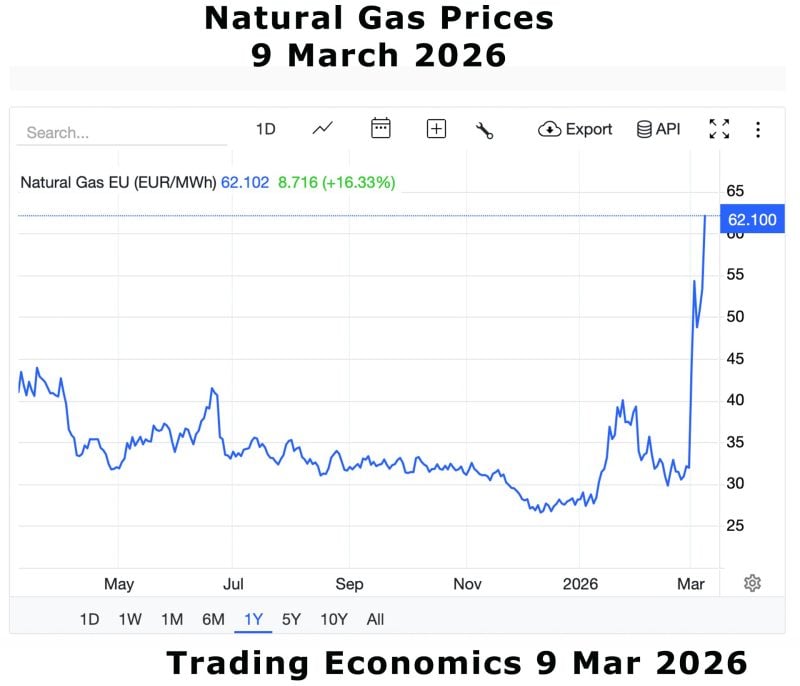
With oil and gas prices soaring, why is the UK choosing to import oil and gas rather than maximise its own North Sea oil and gas? Supporters of more drilling argue that increasing North Sea energy production would reduce household bills, protect jobs, increase tax revenues and improve energy security. Critics argue it is a fantasy that bills would fall, renewables are now cheaper and drilling any new fossil fuels is incompatible with goals to reduce global warming. It is a highly polarised debate, but what are the actual facts?

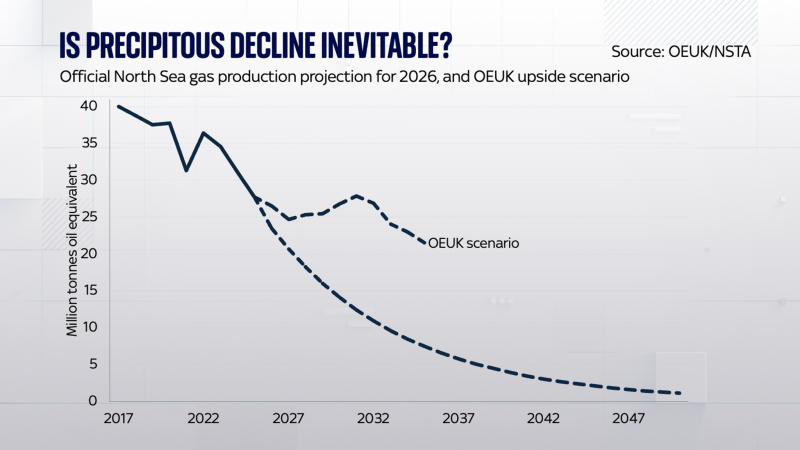
The first rather unwelcome reality is that the North Sea is a mature basin, and production has been steadily falling. Gas reserves are only around 19% of 1997 levels. Even in the best-case scenario, the UK would not be able to be self-sufficient. But, it could still make a useful contribution and reduce import dependency
Easy to get reserves are limited. But as Ed Conway reports North sea producers claim there is a more optimistic scenario where more difficult to access gas is produced.
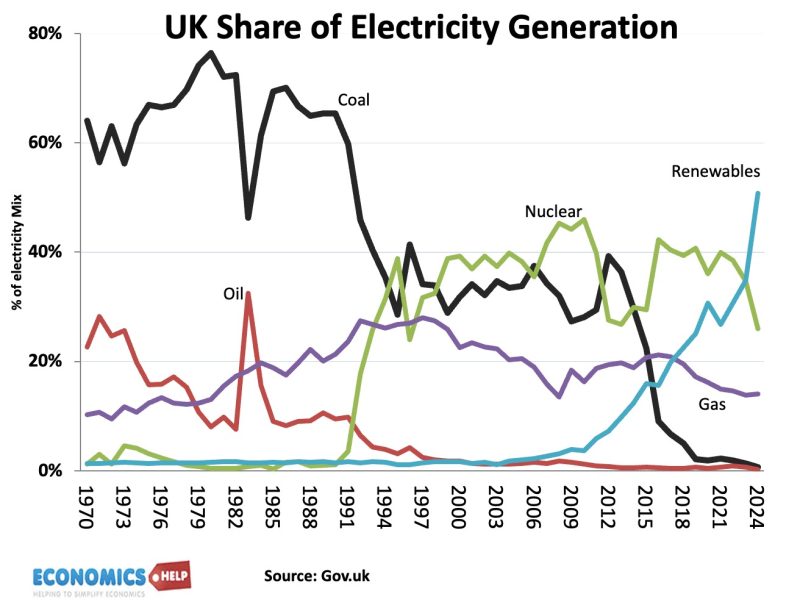
But does it make economic sense to extract? New development for oil could cost £40-£70 a barrel, so only profitable if oil prices remain high. Gas is more profitable, with an estimated cost of £20 a barrel for existing fields but £35 to £64 for new fields. But gas has been trading at a markup on oil, an average of £100-£170 in past two years. So, natural gas is potentially more profitable and also very important to UK energy needs. Back in 2022, gas set the price of electricity in 98% of the time. (though that was less in 2025 – approx 87%)
Would Drilling Lower Household Bills?
However, would increasing gas supply from the North Sea translate into lower household bills? With the UK’s privatised energy market, the answer is no. The increase in UK supply of gas would make no difference to global supply, and global prices would be unaffected.
Tax revenue
However, it would be a mistake to say there are no benefits. The North Sea has provided £400bn of tax revenue and is predicted to raise another £19bn. With more production, the government would receive more tax revenue. If this extra tax revenue was earmarked for general bill reduction, researchers at the University of Oxford suggest it would reduce bills by £16 to £82 in annual savings per household. Just a few percent.
Environmental benefits of drilling
However, that increase in tax revenue is better than nothing. Because if we don’t produce domestic natural gas, we will rely on importing from Norway, US and Qatar. For those concerned about the environmental impact of drilling. Importing liquified natural gas from across the world has a 30% higher carbon footprint. LNG is more energy intensive than direct pipeline. There is an ideological opposition to new drilling but the result, is we end up with higher carbon footprint from importing. Not only do we miss out on tax revenue. Also, greater energy imports are a factor in a larger trade deficit. A bigger current account deficit puts downward pressure on Sterling, raises import prices and has to be financed by foreigners buying UK assets. From a balance of payments perspective, it is more desirable to produce own energy where possible.
Are Fossil Fuels history?
Now, critics of drilling might argue that fossil fuels are the past. Developments in modern technology mean that renewables have become much cheaper and now wind and solar is much cheaper than natural gas and coal.
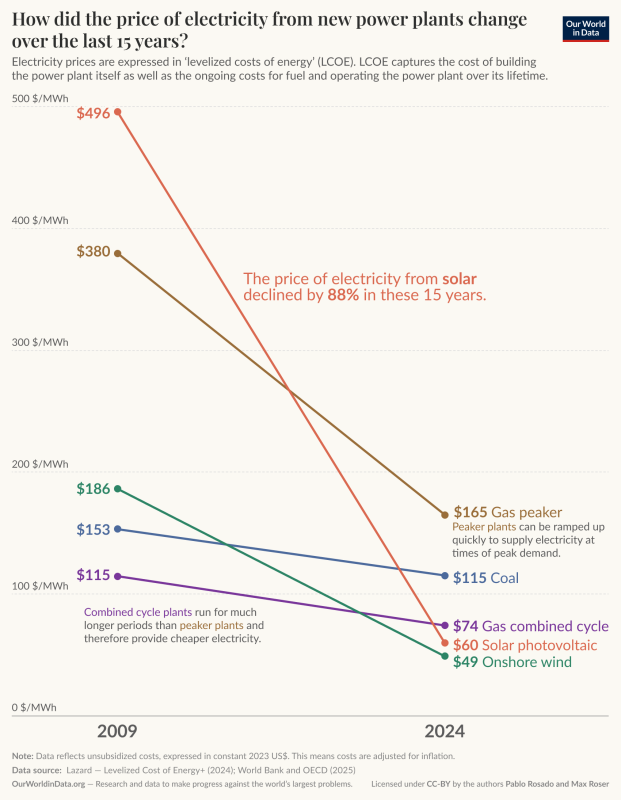
The problem is that this graph is misleading to the actual costs of getting electricity to where it is needed. The UK produces a lot of wind energy, which is wasted because when its very windy, there isn’t the demand or capacity to get to where it is needed. What has happened in recent years is the cost of managing the grid has substantially increased, and electricity costs are increasingly fixed costs.
The Oxford Smith School Report says households would benefit from switching to renewable electricity, but to get there, they state they do not include the costs of intermittency, and assume renewable energy can provide electricity all the time. But, intermittency is the whole problem with wind. Even though wind supply has massively increased, even in 2030, the UK will be heavily reliant on gas.
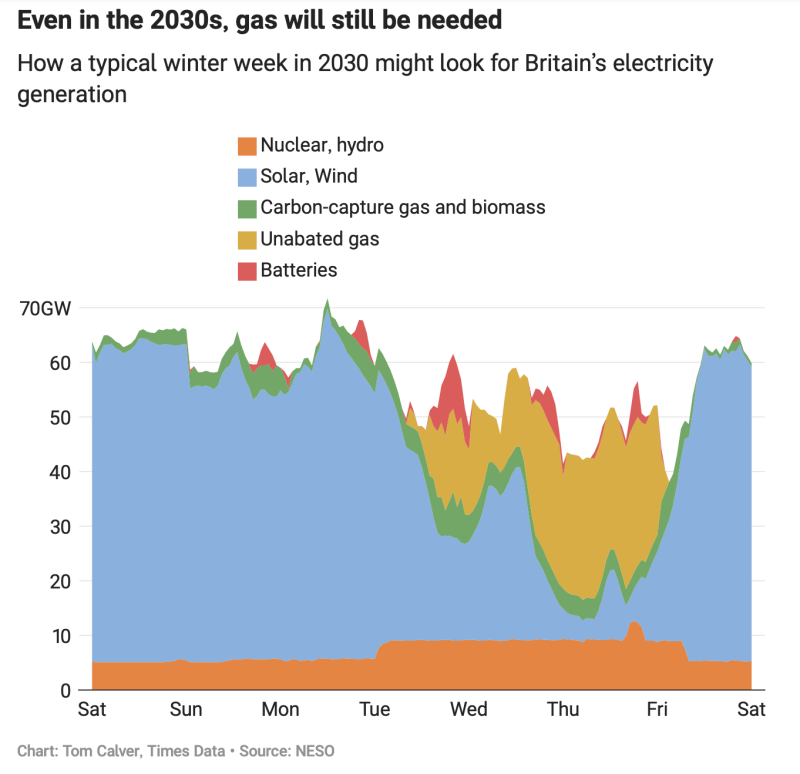
This is modelling for a typical week in 2030. When it’s windy, renewables work OK, but then on still days, there is a huge shortage that can only be filled by fossil fuels, of which gas is the cheapest and cleanest. You can’t solve this shortage by building more wind turbines or solar power.
Renewables can Work (if it is sunny…)
Now, a good point is people may say, how come the likes of Spain, Texas and California are investing so much in solar. Renewables in Spain are providing 55-57% of energy and they now have lower electricity prices than many EU countries. So why not just replicate Texas and Spain? The simple answer is why do Brits like to go on holiday to Spain in the winter months? There’s more sun. I think this winter, poor old Aberdeen had a record-breaking 21 days without a single moment of sun. You can’t run a power grid on solar and wind in a UK winter. The truth is that when it comes to renewables, the UK is at a geographical disadvantage. Wind has actually become more expensive in recent years. Solar is getting cheaper, but it is less workable in the UK. Some countries like Norway have huge share of renewable energy and cheap prices, but this is due to hydropower which is very consistent.
UK will find it hard to get absolute net Zero – but is already quite close
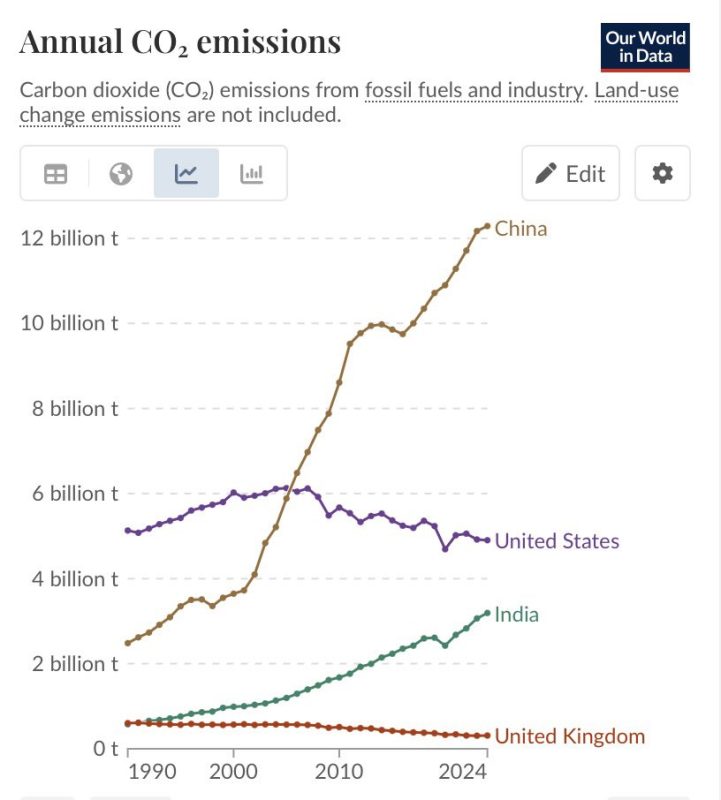
Given the UK’s relative disadvantage in producing renewables, it will make it relatively harder for the UK to get to net zero without more improvement in storage capacity and alternatives. The UK’s bigest contribution to global warming was ending coal, which is the dirtiest energy source.
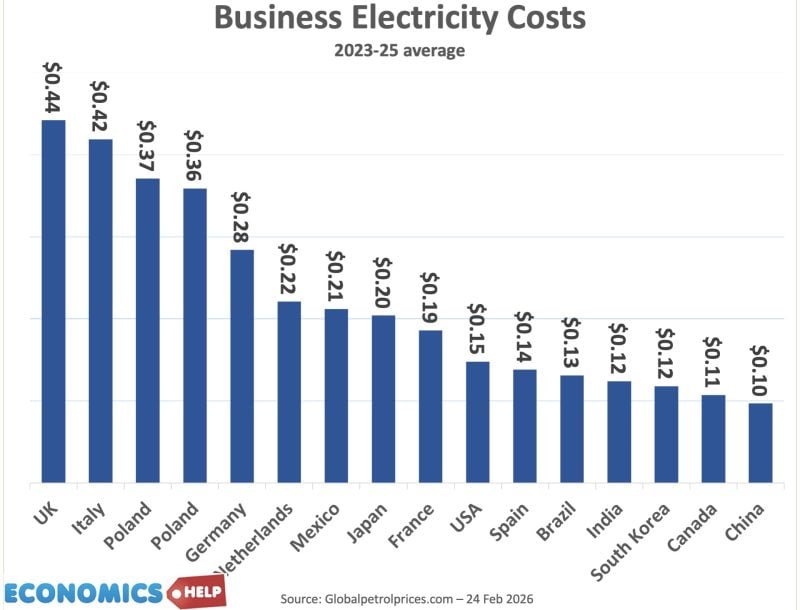
But, if the UK allows electricity prices to remain the highest in the world, industry will continue to decline, and we will just export production to China, which still uses considerable coal power. It is fair to say solar capacity has frequently exceeded economic forecasts it is one technology which really benefits from scale, but it’s just a shame the UK isn’t 1,000 miles further south.
A good question is, why not just build more battery capacity to store wind for those still days?
At the moment, UK grid batteries can provide electricity for around 1 hour. They are not designed to provide power for days, which is what the UK needs. The hope is that battery technology will massively improve for long-term storage, but at the moment, it is not feasible in the quantities needed. Again, battery technology continues to improve, so there is hope in the long-term, it will be a solution, but not for a while.
Reduce Demand
A final point, some environmentalists argue that the solution is not to reduce electricity demand. But this is too simplistic. Quick example, when it is very sunny in summer, we have too much solar power generated so we pay solar farms to turn off electricity production. The great complement for solar power is people using air conditioners. Greater use of AC, would actually make solar more profitable. But, there is a hair-shirt environmentalism, which says you should use AC, it’s bad for the environment, but ironically we just end up wasting solar energy when it is abundant.
In recent years, a growing share of electricity costs are investment and capital investment, the decline in electricity consumption is increasing the average cost. If electricity consumption continues to fall, it’s a real problem because ironically, it will make electricity more expensive. The one situation where reducing demand should be definitely encouraged is when it’s a cold, still February winter day. Exactly the time people usually want to use more.
So to answer the question. Should the UK give more licenses to drill oil and gas? I would say yes. It’s not a panacea, and gas prices won’t fall, but the increase in tax revenue and reduction of imports is desirable. Tax revenue could be used to support the transition to better grid management and make renewables more effective. I support achieving net zero eventually, but you can’t get there by just building more wind turbines and solar panels. The UK is disadvantaged by its geography and should make use of its natural gas until better technology comes along in the future.
Sources
- independent.co.uk/news/uk/home-news/energy-bills-north-sea-drilling-b2939522.html
- smithschool.ox.ac.uk/sites/default/files/2026-03/North_Sea_Rapid_Analysis_March2026_OxfordSmithSchool.pdf
- post.parliament.uk/north-sea-oil-and-gas/?utm_source=chatgpt.com
- ft.com/content/568039e3-4707-4ad7-98b7-fb0df57d4667thetimes.com/article/02275718-a3c8-45eb-9c39-0ce83dc108ae?shareToken=6cfceab2fecaf0de2aa4abcad733e11c
- Time to reconsider drilling – Sky News
About The Author
