
The Circular flow of income diagram models what happens in a very basic economy.
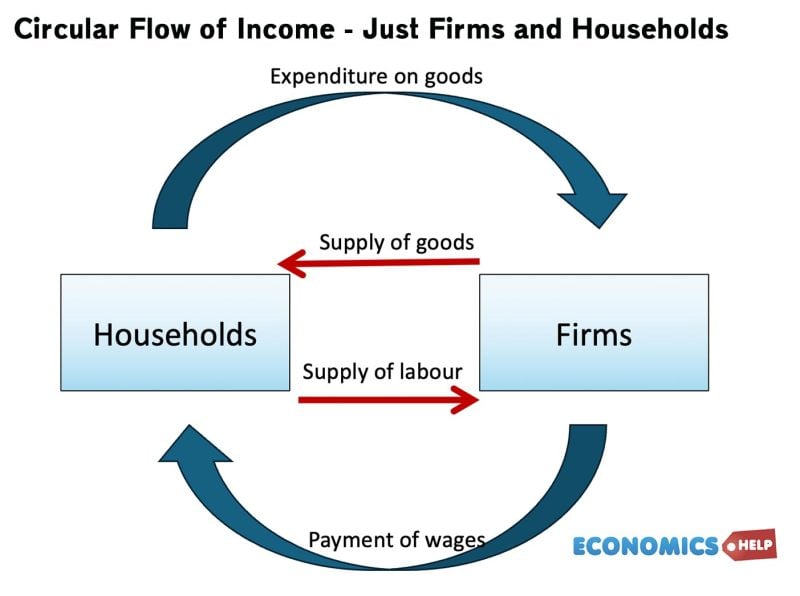
In the very basic model, we have two principal components of the economy:
- Firms. Companies who pay wages and dividends to workers. Firms produce output.
- Households. Individuals who consume goods and receive wages from firms.
Two way flow
- When firms pay workers wages. We can say households are supplying their labour to firms
- When households purchase goods from firms. There is a flow of goods and services from firms to households
This circular flow of income also shows the three different ways that National Income is calculated.
- National Output. The total value of output produced by firms.
- National Income. (profit, dividends, income, wages, rent) This is the total income received by people in the economy. For example, firms have to pay workers to produce the output. Therefore income flows from firms to households.
- National Expenditure. Total amount spent on goods and services. For example, with wages from work, households can then buy goods produced by firms. Therefore, the spending goes back to firms.
This represents a simple economic model; it is a closed economy without any government intervention.
Factors of production
In the above example, we assume households supply labour, but there are other factors of production too.
Households
- Provide factors of production (labour, land, capital, enterprise)
- Receive wages, rent, interest and profit
- Spend income on goods and services
Firms
- Hire factors of production
- Pay incomes to households
- Produce goods and services for sale
More realistic Circular Flow of Income in open economy with government
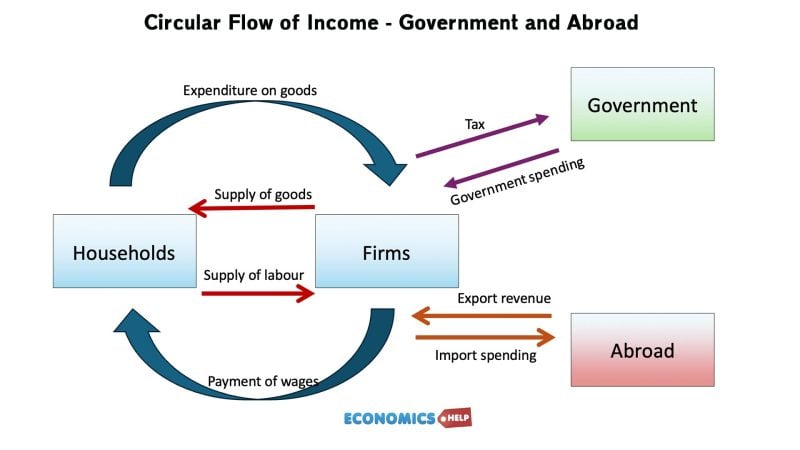
In the real world, it is more complicated. We also add two more components:
- Government. The government taxes firms and consumers, and then spend money, e.g. health care and education.
- Foreign sector. We sell exports abroad and buy imports. Therefore, there is a flow of money between one country and the rest of the world.
Again there is a two way flow
- Imports – money flows from domestic economy to abroad. The imported goods come into the country
- Exports – Money flows into the domestic economy from abroad. The exported goods flow abroad.

Withdrawals (W) into Circular Flow of Income
Withdrawals are items that take money out of the circular flow. This includes:
- Savings (S) (money not used to finance consumption, e.g. saved in a bank)
- Imports (M) (money sent abroad to buy foreign goods)
- Taxes (T) (money collected by government, e.g. income tax and VAT)
Injections (J) into Circular Flow of Income
Spending that puts money into the circular flow of income.
- Investment (I). Money invested by firms into purchasing capital stock.
- Exports (X). Money coming from abroad to buy domestically produced goods.
- Government spending (G). Government welfare benefits, spending on infrastructure.
Equilibrium in the Circular Flow
The economy is in equilibrium when:
- Injections = Leakages
- I + G + X = S + T + M
Change in equilibrium
- If injections > leakages → economic growth
- If leakages > injections → fall in national income
Link to the Multiplier
An increase in injections (e.g. higher government spending) can lead to a multiplied increase in national income, depending on the size of leakages.
This is the multiplier effect – an initial injection leads to bigger final increase in real GDP
Related
About The Author

Thanks for guiding
i wish to learn more
Thank you so much
Thank for guiding me through need more
I learnt a lot from this site. Thanks for such a clear and concise explanation.