
Summary
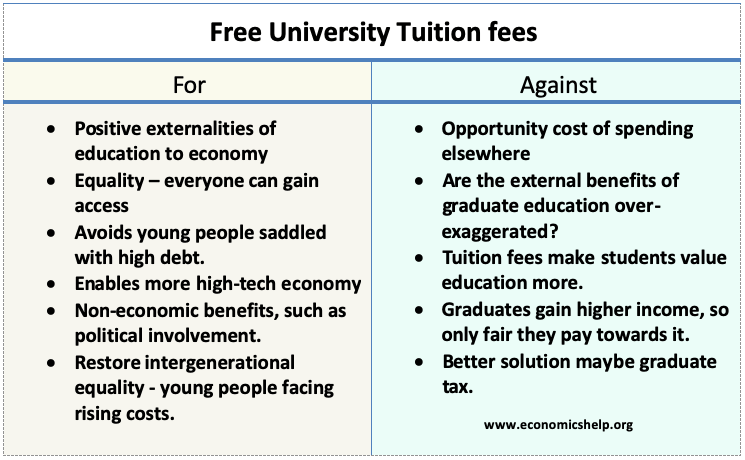
Education has positive benefits for the rest of society. If university education is left to market forces, there may be under-provision, and the economy may suffer from a lack of skilled graduates. Furthermore, in a free market, higher education would become the preserve of wealthy families who can afford to send their children to university. Therefore there is a strong case for the government providing higher education free at the point of use.

However, others argue the positive externalities of higher education are limited, and the prime beneficiaries of a university degree are the graduates who can command a higher paying job. If the external benefits of many degrees are limited, government spending may be misallocated in offering relatively expensive university education. Rather than fund 3-4 year university degrees, governments may be able to get a better return from spending money on primary education and vocational training – training which is more relevant to the needs of the economy.
More details
In recent years, the UK government has sought to increase the amount students pay for studying at university. In the UK, the government have phased out grants and introduced top-up fees. With tuition fees and rising living costs, students could end up paying £50,000 for a three-year degree, and leave university with significant debts.
Some argue this is a mistake. Charging for university education will deter students and leave the UK with a shortfall of skilled labour – and arguably this will damage the long-term prospects of the UK economy. Furthermore, charging to study at university will increase inequality of opportunity as students with low-income parents will be more likely to be deterred from going to university.
Arguments for free university education
- Positive externalities of higher education. Generally, university education does offer some external benefits to society. Higher education leads to a more educated and productive workforce. Countries with high rates of university education generally have higher levels of innovation and productivity growth. Therefore, there is a justification for the government subsidising higher education.
- Equality. There is also a powerful argument that university education should be free to ensure equality of opportunity. If students have to pay for university education, this may dissuade them. In theory, students could take out loans or work part-time, but this may be sufficient to discourage students from studying and instead may enter the job market earlier.
- Increased specialisation of work. The global economy has forced countries, such as the UK to specialise in higher-tech and higher value-added products and services. The UK’s biggest export industries include pharmaceuticals, organic chemicals, optical and surgical instruments, and nuclear technology (see: what does the UK produce?). Therefore, there is a greater need for skilled graduates who can contribute to these high-tech industries.
- Education is a merit good. One characteristic of a merit good is that people may underestimate the benefits of studying and undervalue higher education. Government provision can encourage people to study.
- Young people facing rising costs. In recent years, we have seen a rise in the cost of living. House prices and rents have risen faster than inflation. This means young people are struggling to meet living costs – even in work. The thought of student debt on top of high living costs, may dissuade people from studying. Free tuition fees is a way to restore the income inequality across generations.
- Non-economic benefits of education. It is tempting to think of university education in purely monetary terms. But graduates can also gain skills and awareness of civic institutions which offer intangible benefits to society.
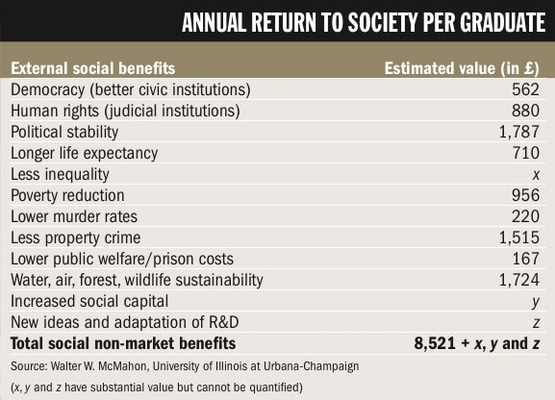
Source: Times Higher Education
Higher Learning, Greater Good: The Private and Social Benefits of Higher Education (2009) Professor McMahon examined the “private non-market benefits” for individuals of having degrees.
This includes better personal health and improved cognitive development in their children, alongside the “social non-market benefits”, such as lower spending on prisons and greater political stability.
- If you wished to evaluate this point, we could ask – is it university education which causes these civic virtues or is it because university education is dominated by middle classes who are more likely to have better health e.t.c. already?
Arguments against free university education
- Opportunity cost. If we spend billions on free university education, there is an opportunity cost of higher taxes or less spending elsewhere. Arguably, there is a greater social benefit from providing vocational training – e.g. so people could become plumbers, electricians e.t.c. There is often a real shortage of these skills in an economy. The UK Commission for skills and education report significant skills shortages in the basic ‘core generic skills’ such as literacy, numeracy and communication skills. These skill shortages are prominent in industries like building, health care, plumbing, social care and construction. The problem is not a shortage of graduates with art degrees, but a shortage of lower-level vocational skills. (See: BBC – skills shortage in the UK) Therefore, there is a case for charging students to study at university – allowing higher public spending to tackle more basic skill shortages.
 Can we afford to spend more on education when spending on the state pension is going to soar as a share of GDP due to ageing population? You could argue that if young people are smaller share then they need to be more productive
- Do we have too many graduates? In recent decades there has been a rapid rise in the number of graduates. But many graduates are now leaving university to take jobs which don’t require a degree. A study by the ONS found that nearly 50% of workers who left university in the past five years are doing jobs which don’t require a degree. (Telegraph link) Therefore, it is a mistake to continue to fund the public expansion of university education because the economy doesn’t need more graduates as much as other vocational skills.
- Higher quality of education. The rapid rise in university numbers means that greater pressure is being put on university resources. Since the government is struggling to increase real spending, there is a danger that university education and research may suffer, causing UK education to lag behind other countries. If universities can charge students, it will help maintain standards, quality of teaching and the reputation of UK universities.
- Makes people value education more. If people have to pay to go to university, you could argue that they would value education more. If higher education is free, it may encourage students to take an easy three years of relaxation.
- Signalling function of higher education. Arguably, higher education acts as a signal to employers that graduates have greater capacity. As a consequence, people who gain a degree, end up with a relatively higher salary. Therefore, if they financially gain from studying at university, it is perhaps fair they pay part of the cost. This is especially important for middle-class families, who send a higher proportion of people to higher education.
- Are degrees what firms need/want? Arguably, many skills shortages are in areas like vocational skills, builders, plumbers, technicians. But, there is a surplus of students with humanities degrees, which an era of AI are seeing diminishing returns.
 Can we afford to spend more on education when spending on the state pension is going to soar as a share of GDP due to ageing population? You could argue that if young people are smaller share then they need to be more productive

Another issue is whether we need 50% of 18-year-olds to go to university. The increase in student numbers is a significant contributory factor to the increased financial pressures on universities. Rather than encouraging students to automatically go to university (as some schools do), it may be better to encourage more students to take vocational training and avoid three years of academic study. If less went to university, it would mean the cost per student would be relatively lower.
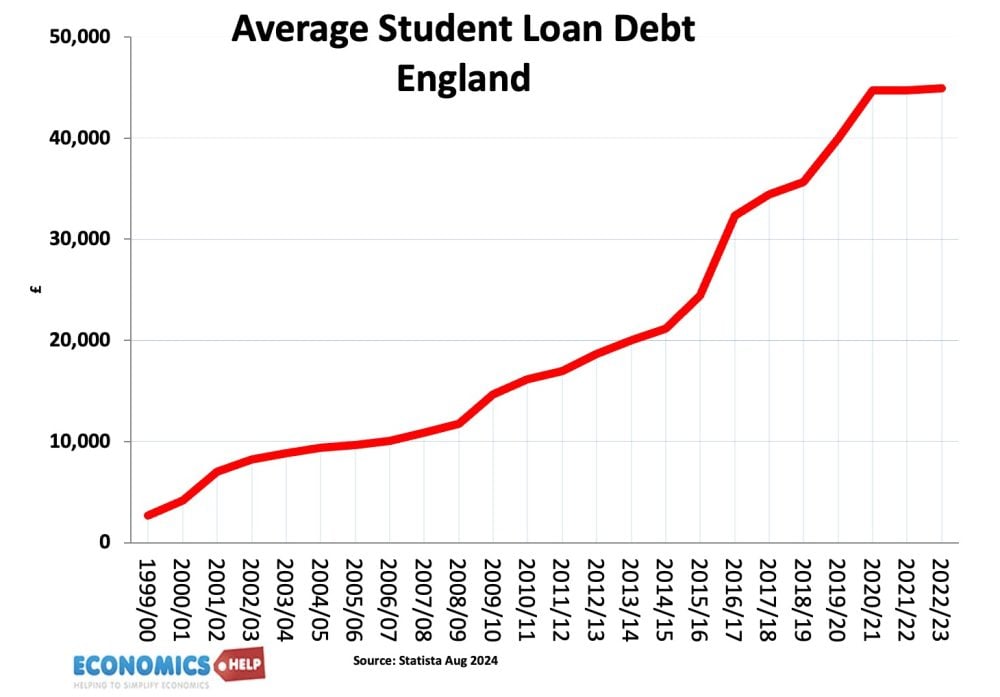
Another issue is how do you charge students for going to university? If students leave university with large debts, this has negative consequences. But, if we finance university education through a graduate tax paid when graduates get a decent income then it may be less of a disincentive.
About The Author

Opportunity Cost. If we spend billions on free university education there is an opportunity cost of higher taxes or less spending elsewhere. Arguably, there is a greater social benefit from providing vocational training – e.g. so people could become plumbers, electricians e.t.c. There is often a real shortage of these skills in an economy. The UK commission for skills and education report significant skills shortages in the basic ‘core generic skills’ such as literacy, numeracy and communication skills. This skill shortages are prominent in industries like building, health care, plumbing, social care and construction. Generally, the problem is not a shortage of graduates with art degrees, but lower level vocational skills. (See: BBC – skills shortage in the UK) Therefore, there is a case for charging for university, but greater public spending to tackle this lower level skill shortages.
hi I just want to say many kids their talents are because of poverty.They work useless jobs cause of their parents can’t afford the fees
No question! Free high education means people more wise and open eyes. Full democracy only will be possible with full educated people…then, we must invest in education, allways, even if jobs are not there for everybody!!!
I just wanted to add the anecdotal point that the people who say too many kids go to University generally don’t mean their kids shouldn’t go to University. They mean other people’s kids shouldn’t go. Particularly the poorer ones.
Also, the fewer people go to university the greater the signalling power of a degree becomes. If everyone has a degree, it is hard to get a premium wage. But, if only a small % get a degree, then the scarcity of degrees is likely to push up wages for graduates.
ILY thanks
This analysis, dare I call it that, leaves out the fact that if students don’t have to pay for tuition, that means they don’t come out of University with debt. Without debt they have money to put back into the economy that they wouldn’t otherwise be able too. And a less educated population is more easily manipulated by the elites who then can wield the leavers of power without question. Which has occurred with neo-liberal globalization and economics. In just about every single western country, since the 1980’s we have seen the disparity between the rich and the poor rise to levels not seen since the great depression of the 1930’s. I don’t think it’s a coincidence that this rise began happening in the Reagan/Thatcher/Friedman era of deregulation, corporate tax cuts, and defunding of public institutions, such as Universities and Colleges. The evidence of the failure of these neo-liberal ideologies is readily apparent in the apt Occupy movements analysis of 1% holding inordinately more wealth and power than the 99%. And adequate public funding of Universities, rather than massive amounts of money poured into militarism and security supported by the fear economy, ensures higher education is kept at a high standard. Instead of relying on corporate donations to University departments, which enables them dictate the curriculum and thus ensure the indoctrination of students into neo-liberal ideology, especially the indoctrination of economic students into outdated economic models that are not appropriate for a finite planet that cannot sustain overpopulation and unlimited growth. Again the evidence of the failure to adopt progressive and fair economic models is readily apparent in just about every single problem we have today. These so called experts deal in compartmentalization of these issues, everything is connected this is reality and we are dealing with peoples lives and dignity. I don’t know on what ethical grounds restricting a certain segment of the population from participating in higher education is based on, but it sure is faulty. And if you make College free as well, than people have a choice. Trade schools should be partially funded by industry, as they immediately benefit from students coming out with the specific knowledge of each individual industry.
And people who are poor are not poor because they want to be, they are poor because most are born into it, don’t have the tools to get out of it, and face many barriers. Others are mostly just lucky to be born into the middle class or wealth, placing barriers is not an incentive for the majority. When you eliminate barriers for people, you give them opportunities to enrich and forward their lives. As I just mentioned, a barrier to them rising up out of poverty is that they don’t have the same tools as the privileged, because public education is being defunded by neo-liberal economics, and in Canada private and religious schools are funded by the tax payers, by eliminating this sort of funding more funds can be put towards better public education. But the 1% don’t want that, then their power would be challenged by a better educated population.
I’ll be surprised if this get’s posted.
Why?