
Definition The Balance of Payments shows a country’s transactions with the rest of the world. It notes inflows and outflows of money and categorises them into different sections.
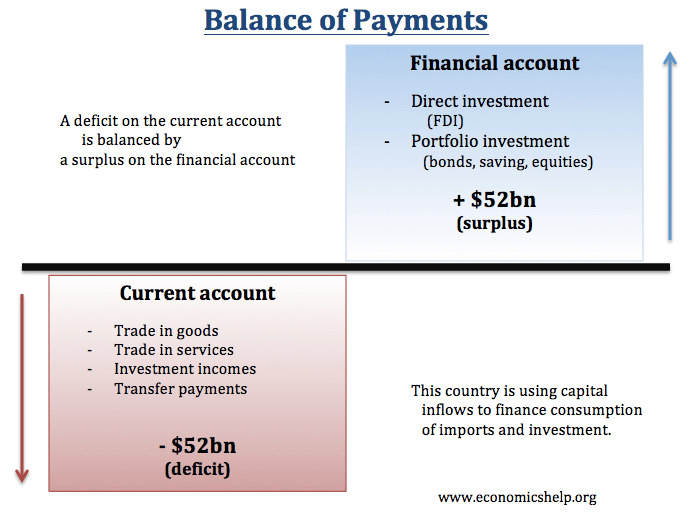
A current account deficit on the balance of payments means a country is importing more goods and services than exporting.
The two main sections of the Balance of Payments are:
- Current Account. – Trade in goods/services/investment incomes/transfers)
- Financial / Capital account. – Foreign direct investment, capital flows, portfolio investment
Balance of payments equilibrium
In a floating exchange rate, the current account will mirror the financial account.
If there is a deficit on importing goods – there will be a surplus on the financial account.
Further reading – equilibrium in balance of payments
Current Account Balance of Payments

The current account measures:
- Net export-imports for goods (trade balance) – used to be called trade in visibles.
- Net export-imports of services – used to be trade in invisibles. Examples including paying for insurance, tourism.
- Primary balance – Investment incomes. For example, a UK firm that invested in Japan, if profit comes back to the UK, this counts as a credit on current account
- Secondary income e.g. government transfers. For example, if the UK send money to the EU, this is a debit on the current account
When people refer to a balance of payments deficit, they usually mean a current account deficit
Further reading – Current account balance of payments
Trade in Goods
The current account comprises the trade balance (which is trade in goods) and also includes the balance for trade in services.
Example – UK

This shows the UK was running a large trade deficit in goods during 2024

By comparison, the UK was running a large surplus in services.

This shows the current account balance of payments.
- Large deficit in goods and primary income – partially outweighed by surplus in services. leaving a net deficit.
Financial Account (Capital) Balance of Payments
The financial account measures inflows of capital, both short-term and long-term. this includes
- Foreign direct investment
- Purchase of securities by investors
Further reading – financial/capital account
Definition of Balancing Item
This is an item used when preparing accounts to cover up imbalances between two figures which should balance. Often when preparing accounts there are slight discrepancies between payments and annual income. The balancing item is used to offset the difference without having to alter the initial calculations. There is a balancing item in the Balance of Payments accounts
Balance of Payments Crisis
This occurs when the current account deficit cannot be maintained. It means there will be a fall in foreign exchange reserves as the country can no longer attract sufficient capital flows to finance the current account deficit.
The solution to a balance of payments crisis is usually to devalue the currency and slow down consumer spending on imports, usually by causing a recession.
Russia experienced a balance of payments crisis in 1998, leading to devaluation of Rouble.
Related
- Causes of current account deficit
- Policies to reduce a current account deficit
- UK Current account deficit
About The Author
