
The term “moron risk premium” refers to the extra yield investors demand on government debt when they believe that a government’s fiscal, economic or political policy-setting is sufficiently erratic, irresponsible or unpredictable that it creates elevated risk—not necessarily of default, but of adverse market reactions or destabilisation.
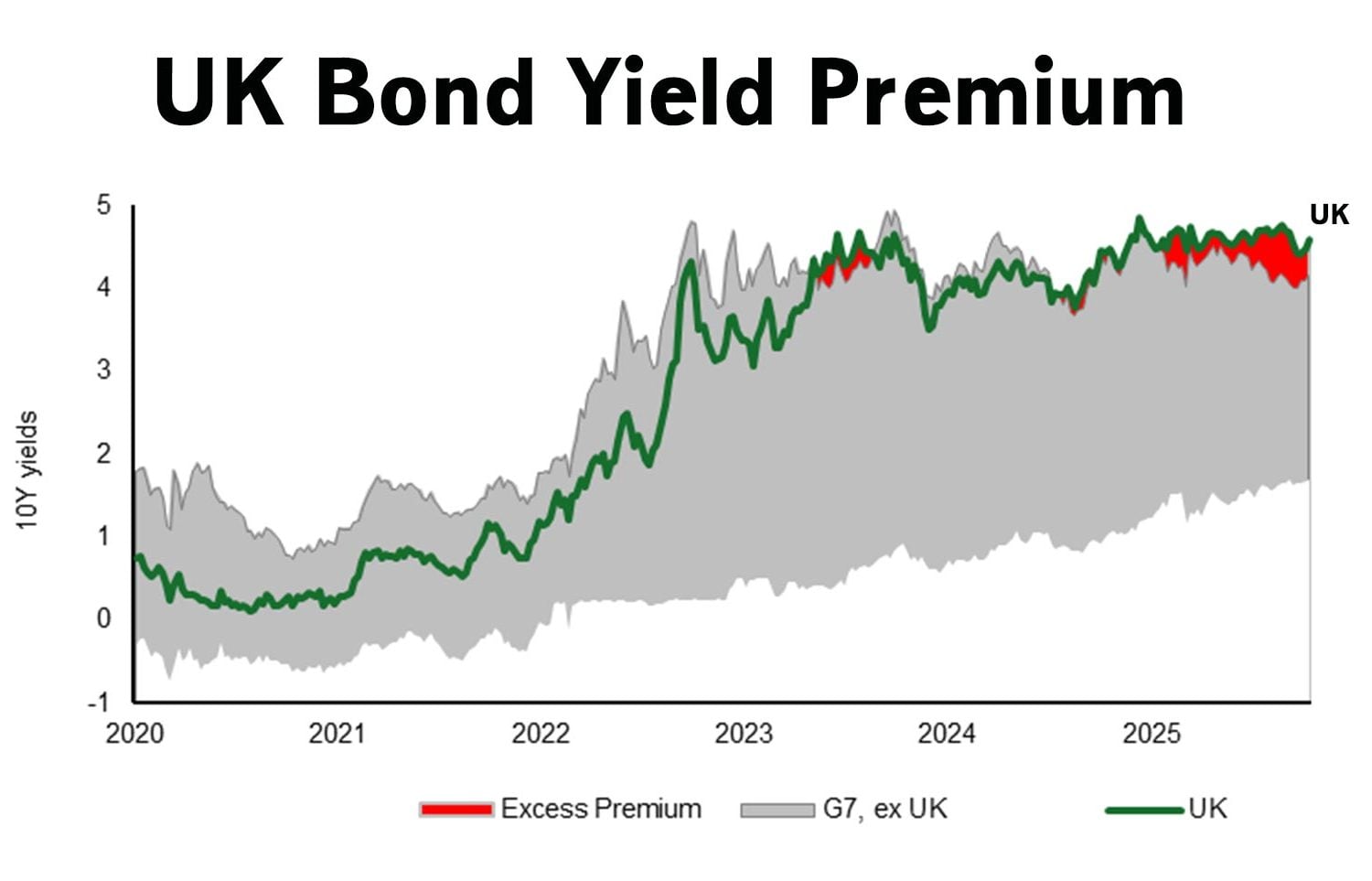
The UK used to have bond yields close to the G7 average, but after the Liz Truss mini budget of 2022 the relative risk premium rose. By 2025 UK bond yields are the highest in the G7. This is partly due to UK having higher inflation and higher bond yields, but also fiscal policy is seen as erratic, non-serious, prone to u-turns

Why it occurs
Government bond yields reflect compensation for several risks, such as:
- Inflation risk
- Default risk
- Interest rate expectations
- Global risk appetite
- The moron risk premium adds another layer: policy credibility and decision-making risk.
If investors believe that key decisions are being made without proper scrutiny, data, or medium-term planning, they may conclude they need a higher return for holding that country’s debt.
Typical triggers
Situations that can create this premium include:
- Announcing large unfunded tax cuts or spending increases with no plan to pay for them. (e.g. Truss Mini budget of 2022, £100bn of unfunded tax cuts at a time of high inflation
- Avoiding or bypassing independent fiscal watchdogs (e.g., a budget office).
- Sudden removal of respected officials (central bank leaders, treasury heads). Possibly US if President removes Fed independence.
- Institutional conflict between government and central bank.
- A pattern of U-turns, unexpected reversals, or inconsistent economic messages. e.g. UK in 2025 after u-turns on major policies by UK chancellor.
- Policies that appear motivated by short-term politics rather than long-term economics.
Economic effects

When this risk premium rises, it can lead to:
- Higher interest rates on government borrowing
→ More taxpayer money goes toward debt servicing. - Knock-on effects on the wider economy
- Higher mortgage rates (especially in countries where mortgages track government bond yields)
- Higher corporate borrowing costs
- Falls in business investment confidence
- Currency depreciation
- If global investors sell assets, the currency can weaken, adding imported inflation.
- Tighter future budget constraints
- Governments may have to cut spending or raise taxes just to restore credibility.
Why the term matters

The phrase gained attention because it captures an important idea:
- Even rich, stable economies can face rising borrowing costs if markets think their leaders are making avoidable mistakes.
It shows that:
institutions (budget rules, central bank independence, fiscal watchdogs) matter;
credibility can be lost quickly but takes time to rebuild;
financial markets respond not only to numbers, but to judgement and competence.
Evaluation points
Strengths of the concept
- Helps explain sudden spikes in yields not fully justified by fundamentals.
- Highlights role of institutions and responsible fiscal planning.
- Encourages transparency and long-term thinking.
Limitations
- Hard to measure precisely; separating it from inflation or default risk is subjective.
- May be overused as a political label rather than analytical tool.
- Bond market reactions can sometimes be over-done or based on incomplete information.
- It may be mistook for more normal reaction such as expectations of higher interest rates.
Featured in this video
About The Author
