
A useful tool for students is the idea of an ‘economist toolkit’. This is essentially a few key ideas that can be used to help answer different questions.
Let us consider a question. – Discuss the impact of an increase in interest rates?
Macro-Economic Toolkit
This question is quite open-ended. First of all, consider the impact on:
- Aggregate Demand
- Aggregate Supply
- A suitable AD/AS diagram

Increased interest rates cause a fall in AD.
Then consider how an increase in interest rates affects the main objectives of government:
- Economic growth
- Low Inflation
- Low Unemployment
- Low current account deficit/surplus
- Stable Exchange Rate
- Government borrowing
For example, an increase in interest rates will tend to cause lower growth, lower inflation and higher unemployment. Higher interest rates will tend to cause an appreciation in the exchange rate. If unemployment increases government borrowing may worsen.
Evaluation Toolkit
The next part of the answer is to evaluate the impact. This is to consider different points of view and the significance of any likely impact. When considering potential points for evaluation, you can always consider:
- Time Lags.
- Other components of AD
- State of the economy
- How significant is a factor?
- Different economic views e.g. Monetarist v Keynesian.
- Supply-side effects.
- Are there better alternatives?
For example
- Time lag. The impact of an increase in interest rates may take time. For example, if the Bank of England increases the base rate, it will not affect people on fixed rate mortgages. However, when they re-mortgage in a couple of years time, they will face higher interest rates. It takes roughly 18 months for changes in interest rates to have a full effect.
- Other components of AD. An increase in interest rates should reduce AD, however, if there is strong global demand for UK exports, then AD may not fall and the economy continues to grow. Also if confidence is very high, then even if interest rates increase, people may continue to keep spending and be unaffected by higher interest rates. Although, if interest rates rise long enough and stay high, you would expect people to eventually start reducing spending.
- The State of Economy. E.g. in recession, an increase in interest rates would reduce spending considerably, in a boom people may be confident just to pay more for borrowing.
- Different people will be affected in a different way. Certainly, higher interest rates increase the cost of borrowing, and increase mortgage interest payments. Therefore, households with large debts and mortgages will be adversely affected by higher interest rates. However, net savers may actually benefit from higher interest rates. This is because with higher interest rates they will receive high net interest payments on their savings.
- If inflation is caused by cost-push factor, e.g. high wage claims, then higher interest rates may not be the best policy, because a further fall in AD, would lead to big fall in real GDP.
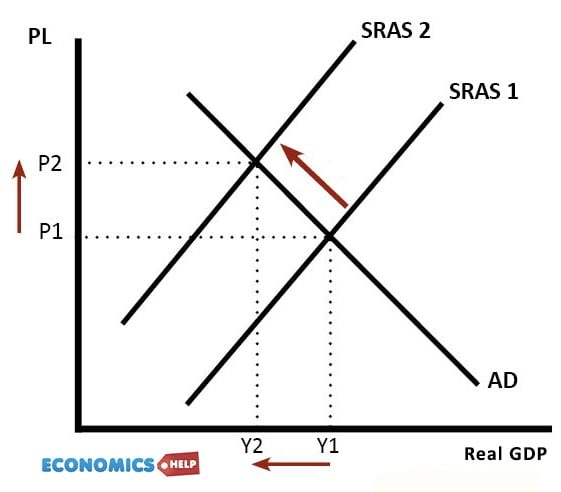
In this case, supply side policies to tackle supply constraints, e.g. deregulation, more flexible energy supply may be better long-term policies to reduce inflation. The only problem is that to reduce rising energy prices could take a considerably long-time.
The Impact of an increase in interest rates depends on where the economy is. Consider this diagram.
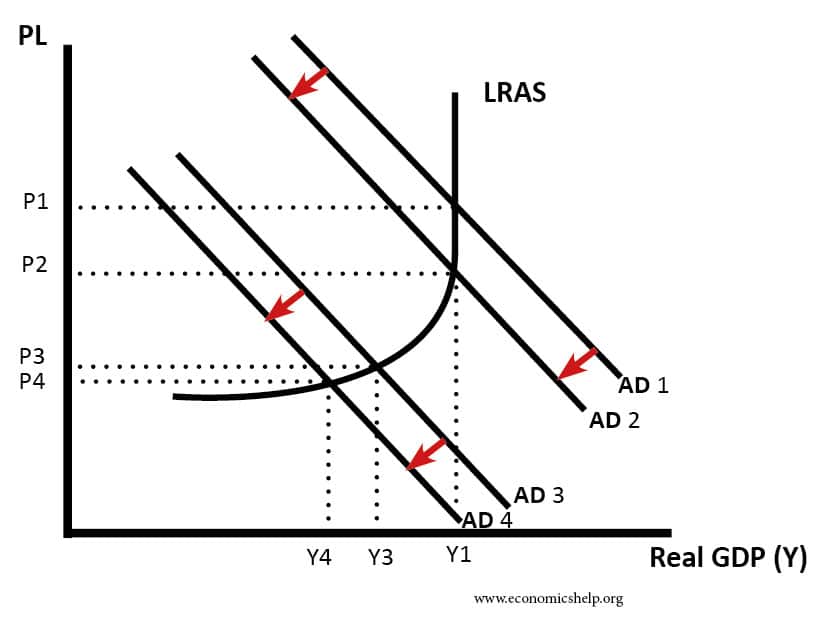 The fall in AD depends on state of the economy.
- How significant is a factor? In UK interest rates are very significant because people with variable mortgages pay a large % of income on mortgage repayments.
- Supply Side Impacts. Higher interest rates will also reduce investment. If interest rates remain high for a considerable time then it will lead to lower investment and this may cause lower productivity growth in the economy.
For more details see: Essay on impact of Increase in interest rates
Other Examples
If the question was different, e.g. Discuss the impact of an increase in government spending.
You could also use a similar tool kit.
- Discuss impact on AD and AS
- Discuss impact on macro economic objectives
- Use same evaluation tool kit.
- Time lag
- Depends on other components of AD
- Depends on state of economy
- How significant the factor will be.
- Different views, e.g classical economists will be more sceptical of higher government spending.
- Supply side effect of higher government spending (e.g. depends what they spend money on)
1 thought on “Macroeconomics Evaluation – A-level”
Comments are closed.