
Readers Question: what are the pros and cons of price control?
Summary
Price controls can take the form of maximum and minimum prices. Price controls can also be used to limit price increases as a way to try and reduce the rate of inflation.
- Maximum prices can reduce the price of food to make it more affordable, but the drawback is a maximum price may lead to lower supply and a shortage.
- Minimum prices can increase the price producers receive. They have been used in agriculture to increase farmers’ income. However, minimum prices lead to over-supply and mean the government have to buy surplus.
- In times of inflation, there is an argument that price controls could help reduce inflation. For example, if inflation is 20%, the government may attempt to bring in price controls, where prices are allowed to rise by only 8%.
Price controls as a way to control inflation
- When inflation is increasing, the monetary authorities can set a legal price limit on the amount prices can rise. In theory, this will limit price increases and keep inflation under control without resorting to higher interest rates.
- If prices are rising due to bigger profit margins (e.g. firms have monopoly power) then setting limits on price increases can ensure prices don’t rise, without causing a shortage of the good.
- If prices are increasing and supply is inelastic, then price controls should not affect supply. E.g. if the supply of housing is fixed, rent controls can reduce prices without reducing supply.
- In times of war and rationing, price controls aim to stop firms profiting from the shortage and keeping prices affordable for all consumers, otherwise, the price of limited goods, such as food will skyrocket with many consumers being unable to afford them.
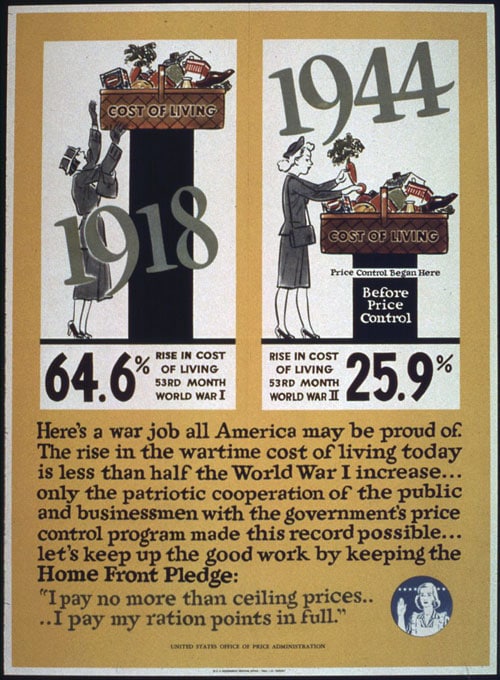
- In the United States, between 1941 and 1947, The Office of Price Administration was responsible for keeping inflation under control by limiting prices. This period of price controls did help to reduce inflation compared to the First World War. There were also price controls during the Nixon administration and during the Korean War.
- Price controls don’t have to be for all goods, but can be focused on those which are considered essential, e.g. food, rent.
- Price controls are best used for a specific time period, e.g. when there is pent-up demand and supply chain shortages. For example, at the end of a way or in 2022 at the end of the Covid pandemic.
Problems with price controls as a way to control inflation
- Price controls do nothing to tackle the underlying reason for inflation. For example, if inflation is caused by excess demand, the demand will still be there, but the price controls will only make goods more attractive. If inflation is caused by a shortage of goods and cost-push factors, the shortage is not resolved by keeping price limits lower.
- Lack of incentive. Price controls can reduce the incentive for firms to increase supply. For example, if prices are rising due to supply bottlenecks. The rise in prices will create an incentive for firms to increase supply. However, if the government pursue price controls, then this incentive to increase supply is reduced. Therefore, far from solving the problem, price controls can make the shortage last for longer.
- Shortage. The price controls of the 1970s led to queues and shortages of meat and gasoline.
- Wasteful activity. Price controls can lead to wasteful economic activity as people wait in line to get the limited goods. This increases the cost of the good. If you earn $15 an hour but spend 30 minutes in a queue, the gasoline is an extra $7.50
- Bureaucracy and interference. With price controls, there is wasteful spending on government bureaucracy. The WWII price administration office gained 15,000 employees and firms complained that the agency was not just setting prices but increasingly being descriptive of which goods they could sell.
- Black market – another problem of price controls is that it is likely to cause growth in the underground economy. When demand is artificially reduced, there will be a temptation for people to buy at an artificially low price and sell at a higher price on the black market to those who cannot queue.
- Lower output. With price controls, firms will have less incentive to produce goods, leading to lower employment. A study by Paul Evans found that WWII price controls were successful in keeping prices 30% lower than otherwise, but with a 12% reduction in employment and 7% lower output. See Journal of Political Economy (1982)
Evaluation of price controls to deal with inflation
- Price controls are more effective if combined with rationing, but rationing itself has costs and difficulties.
- Price controls targeting to very specific cases of price gouging can be more effective.
- Generally, price controls will have unintended consequences, the most notable is that keeping prices lower will lead to lower supply and the shortage of the good may last for longer.
Maximum prices
A maximum price means firms are not allowed to set prices above a certain level. The aim is to reduce prices below the market equilibrium price.
Advantages of maximum prices
- The advantage is that they will lead to lower prices for consumers.
- This may be important if the supplier has monopoly power to exploit consumers. For example, a landlord who owns all the property in an area can charge excessive prices. Maximum prices are a method to bring prices closer to a ‘fair’ and ‘competitive equilibrium.
- Maximum prices are usually reserved for socially important goods, such as food and renting.
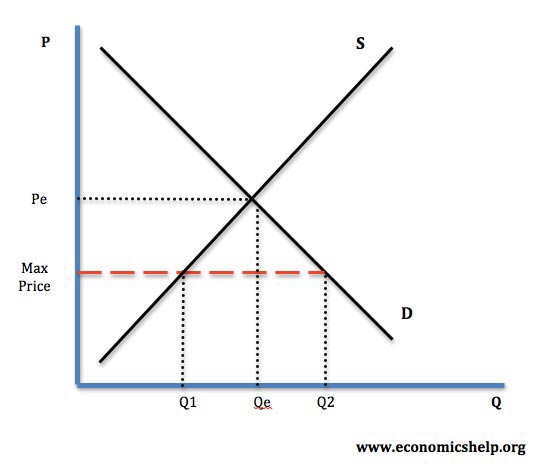
The equilibrium price is Pe. A maximum price leads to demand of Q2, but a fall in supply to Q1.
The disadvantage of max prices
- The disadvantage is that it will lead to lower supply. If firms get a lower price, there may be less incentive to supply the good, and the number of properties on the market declines.
- A maximum price will also lead to a shortage – where demand will exceed supply; this leads to waiting lists. In housing it could lead to a rise in homelessness.
- A maximum price can lead to the emergence of black markets as people try to overcome the shortage of the good and pay well above the market price.
Examples of maximum prices
- Food. During the second world war, the price of goods was fixed and goods were rationed. However, this encouraged people to sell on the black market through inflated prices.
- Football games. Tickets for football games and concerts are often set at a maximum price. (e.g. if left to the market, equilibrium prices would be much higher). e.g. at current prices, the F.A. Cup final could sell many more tickets than 80,000. The advantage of setting these maximum prices is that it keeps football affordable for the average football supporter. It is argued that if prices were set solely by market forces, it would be just the wealthy who could afford to go to games. The disadvantage is that it means some who want to go to the game can’t because there is a shortage of tickets.
- Housing. The government may set a maximum price for renting to keep housing affordable.
- However, a maximum price may reduce the supply of housing leading to homelessness.
- However, if landlords have monopoly power and supply is very inelastic. In this case, a maximum price can make renting cheaper without reducing supply
More on maximum prices
Minimum Prices
Minimum prices are used to give producers a higher income. For example, they are used to increase the income of farmers producing food.
The EU had a Common Agricultural Policy (CAP) which aimed to increase the income of farmers by setting minimum prices.
Diagram Minimum Prices
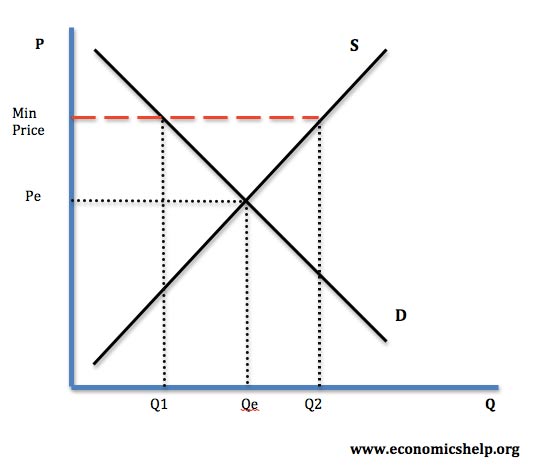
The equilibrium price is Pe. A minimum price leads to an increase in supply to Q2, but fall in demand to Q1.
The Disadvantage of Minimum Prices
- Higher prices for consumers. We had to pay more for food.
- Higher tariffs necessary on imports. To keep minimum prices, the EU also had to put tariffs on food to keep prices artificially high.
- Minimum prices encourage oversupply and are inefficient. The CAP encouraged farmers to produce food that no one actually wanted to eat. This included using more chemicals to increase yields
- We had over-supply of food no-one wanted to eat. The EU spent up to 70% of its budget on buying surplus food. (butter mountains, wine lakes)
Conclusion
Generally, price controls distort the working of the market and lead to oversupply or shortage. They can exacerbate problems rather than solve them. Nevertheless, there may be occasions when price controls can help for example, with highly volatile agricultural prices.
- A better solution to maximum prices may be to increase the supply of housing.
- A better solution to minimum prices may be to offer subsidies to farmers who promote some environmental benefit to society – rather than through prices.
See also:
Thaxs for the content,,but if applicable, kindly drop me the justifications of price controls
Additionally, The different types of prices..
It is my coursework so your help will be of virtue to me!!
The example of the F.A. Cup Final doesn’t work, as you can only sell the number of tickets limited to the capacity of the stadium, which is actually 90,000
So basically your saying is that price controls are more dependent on benefitting corporations than the citizenry allowing for greed to determine economic futures, profits and do on
In a free society, prices are set by free markets. Prices are signals for markets. They help producers decided what they should or should not be manufacturing and to what scale. When demand for a product increases and prices rise, those higher prices encourage them to produce more and encourage competition to join in production.
In a non free society, prices are set by government. If the government controls prices it essentially controls businesses and production. This is not freedom or free markets.
could you please explain the advantage of having a minimum price set for suppliers?