
A list of different types of economic goods.
Income Elasticity of Demand and types of Goods
Income elasticity of demand measures the responsiveness of demand to a change in income.
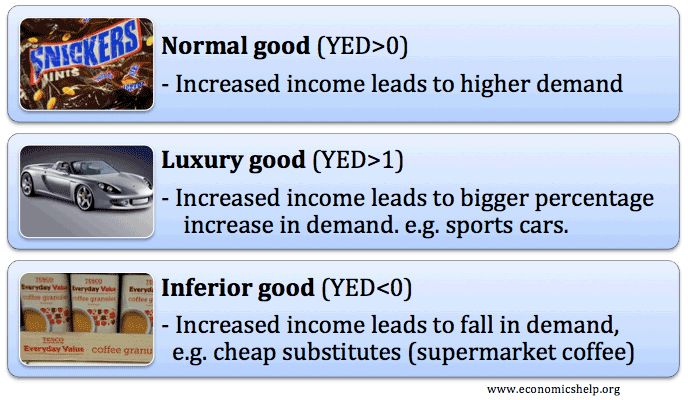
- Definition Inferior Good: An inferior good means an increase in income causes a fall in demand. It has a negative YED. An example, of an inferior good is Tesco value bread. When your income rises you buy less Tesco value bread and more high quality, organic bread.
- Definition Normal Good. This means an increase in income causes an increase in demand. It has a positive YED. Note a normal good can be income elastic or income inelastic.
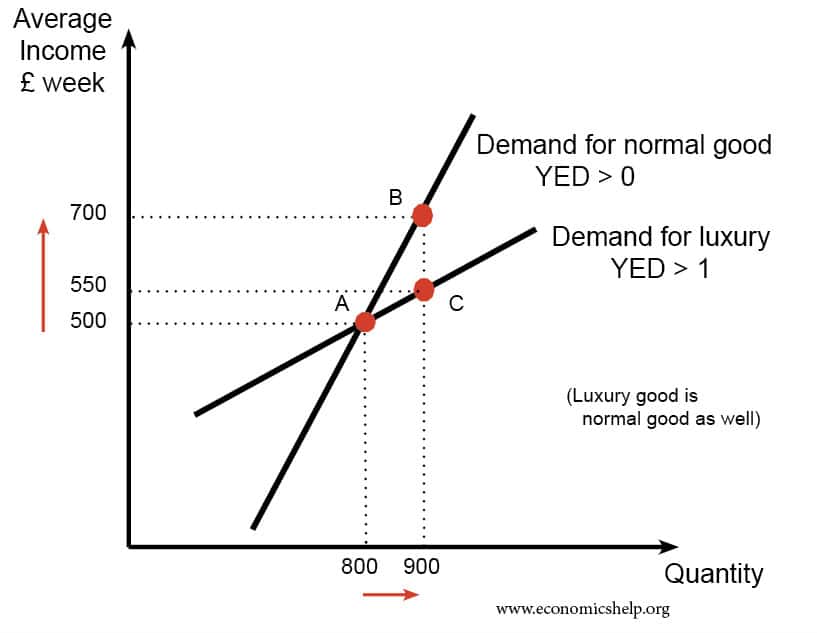
- Definition Luxury Good. A luxury good means an increase in income causes a bigger % increase in demand. It means that the YED is greater than one. For example, high Definition TV’s would be luxury. When income rises, people spend a higher % of their income on the luxury good. (Note: a luxury good is also a normal good, but a normal good isn’t necessarily a luxury good)
Other Types of Goods
- Complementary Goods. Goods which are used together, e.g. TV and DVD player. see: Complementary goods
- Substitute Goods. Goods which are alternatives, e.g. Pepsi and coca-cola. See Substitute goods.
- Giffen Good. A rare type of good, where an increase in price causes an increase in demand. The reason is that the income effect of a rise in the price causes you to buy more of this cheap good because you can’t afford more expensive goods. For example, if the price of wheat rises, a poor peasant may not be able to afford meat any more, so has to buy more wheat. See: Giffen goods
- Veblen / Snob Good. A good where an increase in price encourages people to buy more of it. This is because they think more expensive goods are better. See: Veblen good
Market Failure
- Public Goods – goods with characteristics of non-rivalry and non-excludability, e.g. national defense. See: Public goods
- Merit Goods. Goods which people may underestimate benefits of. Also often has positive externalities, e.g. education. See: Merit goods
- Demerit Goods. Goods where people may underestimate costs of consuming it. Often has negative externalities, e.g. smoking, drugs. See: Demerit goods
- Private goods – goods which do have rivalry and excludability. The opposite of a public good See: Private goods
- Free Goods – A good with no opportunity cost, e.g. breathing air.


name of two complementary goods find in a high five shops?
can i know how about shampoo? i having a assignment & i wanted to find out shampoo belongs to what group?
economic good
consumer good
non-durable(perishable) goods
final good
Skvělá práce, jen tak dál!!!
what is different goods?
Thanks diamondlyrgirl very helpfull and clear explanation
yes this was really nice explained …
@Anonymous: Complementary goods are goods that go together – for example, coffee and sugar, if the demand for coffee increases, the demand for sugar will increase as well. Because some people consume them together.
As for substitute goods, these are the products that compete each other’s demand. Like Coke and Pepsi, if the demand for Coke(the drink not other Coke…) increases which might be caused by a decrease in the price of Coke or an advertisement or any other causes, the demand for Pepsi decreases because people don’t consume two sodas together.
what about supplementary goods?? what do you mean by this??can you please answer it and give some examples…thank you
That was a good explanation on the types of goods wid nice Egs.
I agree with Wasi. Thanks for the help.. but what are complementary and sustitute goods?
can some1 help me on hw to tackle Economics questions lyk the writing skills,tips and etc coz i find t hard sometimes?
the categories of Good
i need to know the different type of Goods in economy by description how it is divided ? from which perspective
1.i need some examples of luxurious goods and normal goods
2.the differences between luxurious goods and normal goods.[5]
,,i need more information about economics goods and examples of types of goods,,,
1.I want to know the detailed types of consumer goods with examples and explanations.
2.What would a straight line PPF indicate
Opportunity costs are constant, Eg. Each time you have to give up 1 eggs to buy 2 tomatoes. The opportunity cost for 2 tomatoes is 1 egg (forgone cost). The same goes vice versa on the same curve…You have to give up 2 tomatoes for 1 additional egg. The opportunity cost for 1 eggs are 2 tomatoes (forgone cost). Check out what the opportunity costs says about the prices of goods (in terms of other goods).
that was the answer to question 2.
what are the types of goods?
i want some more about economic goods,intermediate goods,and finished goods…..thank you.
Economic goods are goods that u pay before u get them like bread,clothes.
Pls can i have a text book to read from your site
More details as well as examples on NORMAL GOODS
more details about these types of goods and their examples
more details about these types of goods
Me too having same problem. In 5 seminars we have to completed one book with assignments. Thats crazy. Economics…uwakssss…..yaksss….I dont know wat is DD, SS, Cost structures……devada……
Is there any difference in this question ” Enumerate and define types of goods sold in a store.” ?
i really wanted know more about private,public,free and merit goods not luxury,normal and inferior goods.that makes absolutley no sence at all. well by the thnx for ur answer.
Manufacturing
Manufacturing is the use of machines, tools and labor to make things for use or sale. The term may refer to a range of human activity, from handicraft to high tech, but is most commonly applied to industrial production, in which raw materials are transformed into finished goods on a large scale. Such finished goods may be used for manufacturing other, more complex products, such as household appliances or automobiles, or sold to wholesalers, who in turn sell them to retailers, who then sell them to end users – the “consumers”.
Manufacturing takes turns under all types of economic systems. In a free market economy, manufacturing is usually directed toward the mass production of products for sale to consumers at a profit. In a collectivist economy, manufacturing is more frequently directed by the state to supply a centrally planned economy. In free market economies, manufacturing occurs under some degree of government regulation.
Modern manufacturing includes all intermediate processes required for the production and integration of a product’s components. Some industries, such as semiconductor and steel manufacturers use the term fabrication instead.
The manufacturing sector is closely connected with engineering and industrial design. Examples of major manufacturers in the United States include General Motors Corporation, Ford Motor Company, Chrysler, Boeing, Gates Corporation and Pfizer. Examples in Europe include Airbus, Daimler, BMW, Fiat, and Michelin Tyre.
Types of Goods
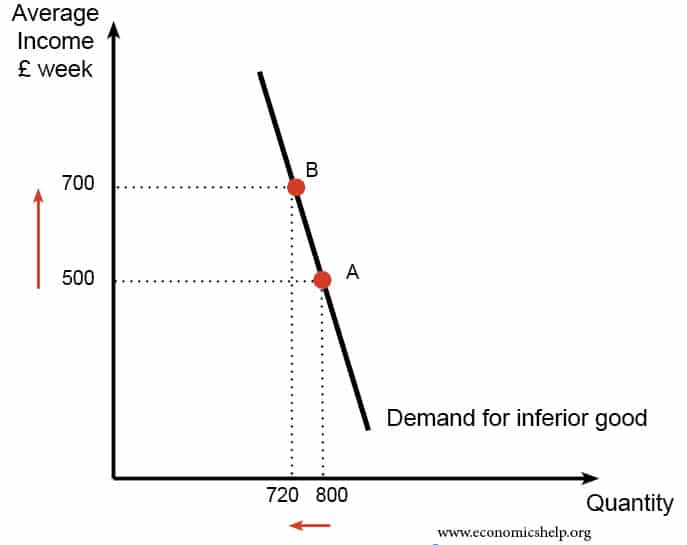
Definition Inferior Good: An inferior good means an increase in income causes a fall in demand. It has a negative YED. An example, of an inferior good is Tesco value bread. When your income rises you buy less Tesco value bread and more high quality, organic bread.
Definition Normal Good- This means an increase in income causes an increase in demand. It has a positive YED. Note a normal good can be income elastic or income inelastic.
Definition Luxury Good-A luxury good means an increase in income causes a bigger % increase in demand. It means that the YED is greater than one. For example, high Definition TV’s would be luxury. When income rises, people spend a higher % of their income on the luxury good.
Explain different type of goods and its behavior according to the change of elasticity..
what are the roles played by money in an economy?
the roles played by money in an economy?
how to study economics for exams it is very diffucult for me to understand the topics what my teachers teach becaue she teaches too fast and finishes one topic in one class and will not explain the important points at all can you please help me out to study for the exam point of view sir please.
most people like me for instance…tend to find a problem on how other countries have a good economic growth while others stragle alot. i believed that the course of that is when a country exports more than it imports. Argumentatively, is well known fact that all the resources are scarce but what accually is scarce about them regardless of the nature because is never enough for humans. is it possible for all the countries to have the stable economic growth to monotor and innovate a common currency hance poverty reduced???????
Speculative demand – potential buyers are interested not just in the satisfaction they may get from consuming the product, but also the potential rise in market price leading to a capital gain or profit
Giffen Goods – special type of inferior good may exist, which disobeys the “law of demand”. When the price of a Giffen Good decreases, the demand for that good decreases. This would have to be a good that is such a large proportion of a person or market’s consumption that the income effect of a price increase would produce, effectively, more demand. The observed demand curve would slope upward, indicating positive elasticity.
Complementary goods – are said to be in joint demand e.g. fish and chips, DVD players and DVDs, iron ore and steel. People generally purchase both goods together therefore a rise in the price of a complement to Good X should cause a fall in the demand for X and therefore good Y- A change in the demand for these goods will directly affect the demand for their complementary goods.
The extent to which a change in the price of one good leads to a change in the demand for a complement is determined by the cross-price elasticity of demand.
where is others types
what are the effects elasticity on consumer goods and capital gods giving examples of the consumer and the capital goods?
What are the definitions for Giffen,Bads and Complement Goods?