
Productivity is the output per input in a period of time
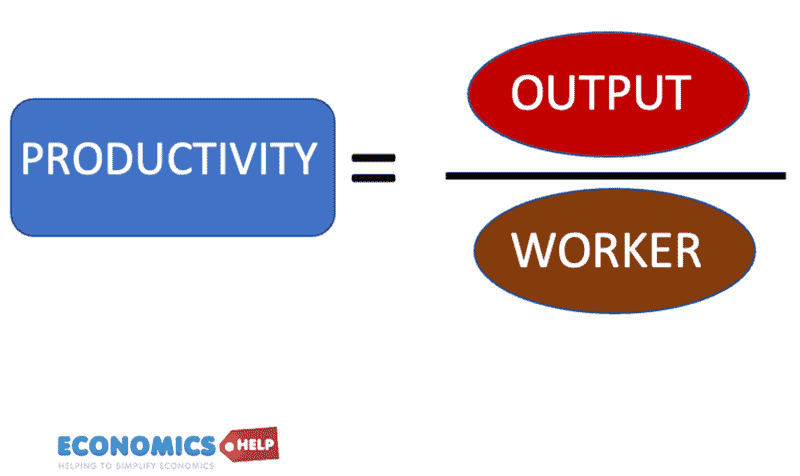
- Labour productivity measures the output per worker in a period of time.
- If productivity rises, firms can produce more with the same number of workers. This enables
- Higher wages for workers
- Increased output for the economy
- A reduction in costs. A firm can produce the same quantity with fewer workers, leading to lower average costs. This can lead to lower prices or at least keep prices low.

Labour productivity in the UK. From 2003 Q1 to 2008 Q1 the index of labour productivity rose from 92 to just under 100. A rise of 8.6%.
What determines Labour Productivity?
- Human capital – workers with higher levels of education, skills, training and good health are able to produce more in the same amount of time.
- Levels of Capital – the quantity and quality of capital available, such as modern machinery, ICT systems and automation, which allow workers to complete tasks more quickly and accurately.
- Technological progress – innovations such as software, robotics and AI enabling more efficient production processes and reducing waste.
- Business organisation – good management, clear incentives, teamwork and lean production methods can eliminate bottlenecks and motivate workers.
- Quality of Infrastructure —such as transport networks, broadband quality and reliable energy supply—affects how efficiently firms can operate and how much time is lost to delays.
- Levels of investment in research and development – the presence of innovative industrial clusters can generate knowledge spillovers, helping firms adopt better methods and raise productivity over time.
Evaluation of labour productivity
- Increasing productivity is only part of the equation. There must be demand for the product.
- Increasing labour productivity might require expensive investment in capital. The cost savings from higher productivity need to be higher than the capital investment.
- If real wages rise, it becomes more important to increase labour productivity.
- If wages are low and capital is expensive, firms may place less emphasis on labour productivity and choose more labour intensive methods of production
UK Labour productivity and trend rate

Related
About The Author
