
The UK economy showed more signs of slowing down with the slowest quarterly growth since the mini recession of 2023. Growth actually fell in September after a flat August.
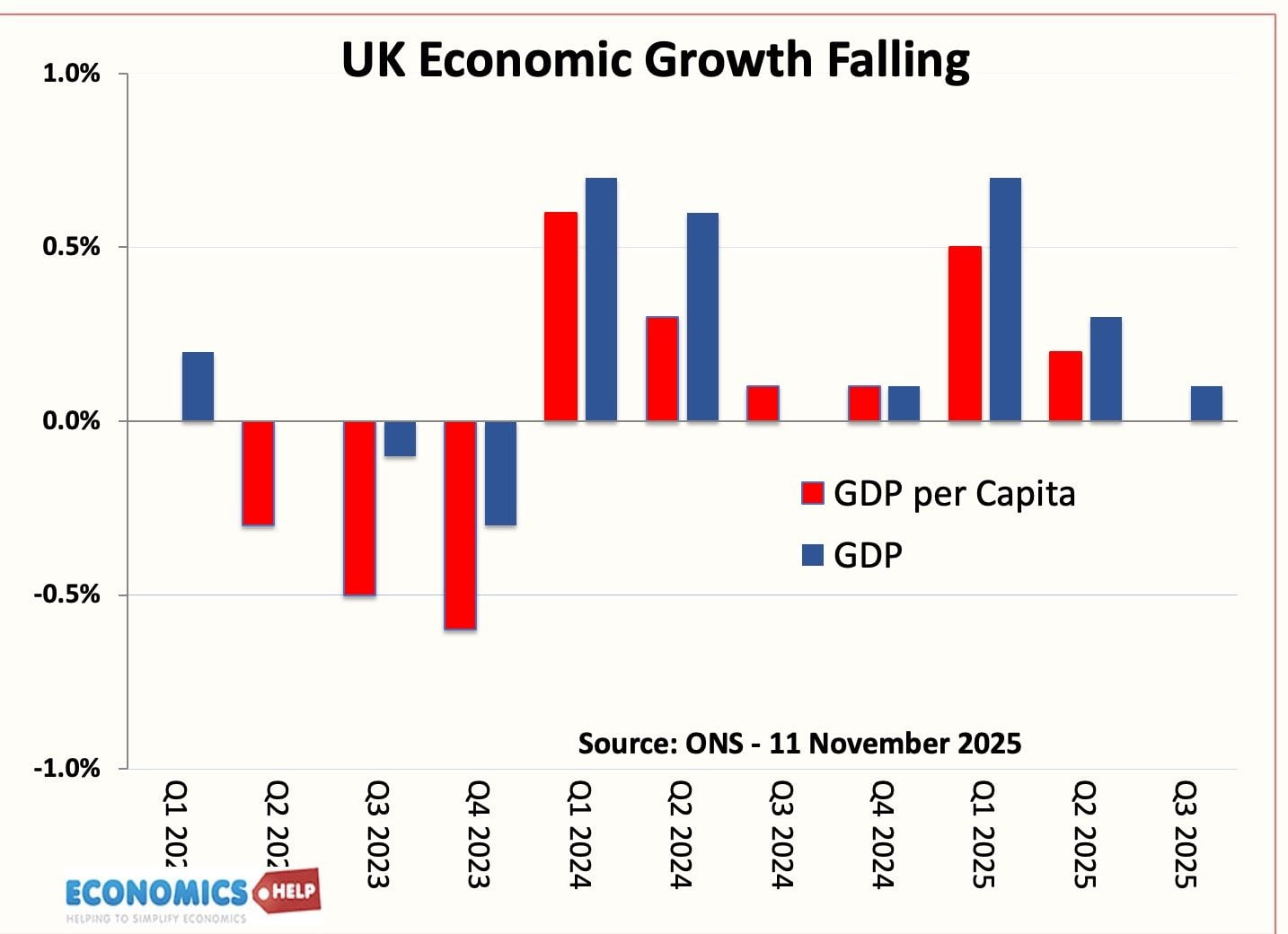
It means in 2025, there has only been positive growth in three of the 11 months. Adjusted for population, real GDP growth is even more disappointing, with a continued stagnation, with real GDP per capita failing to recapture the pre-COVID peaks.
ONS stated a key reason for the negative growth last month was the cyber attack on Jaguar Land Rover, which contributed to big fall in industrial production and car production in particular. There was also a fall in pharmaceuticals, which tends to be erratic, however, there are clear signs that consumers and businesses are holding back due to deteriorating circumstances and the anticipation of the upcoming budget.

Earlier this week, there was more bad news with unemployment jumping to 5%. By historical standards, this is quite low, but if we look closer at levels of under-employment, the number of people wanting to work more hours, this is rising close to levels last seen in the post-crisis recession, it indicates a real squeeze in living standards.

And of course at the same time as people wanting more hours, another ongoing problem is rise in inactivity due to health conditions.
Investment
The growth in GDP was mainly driven by gross fixed capital formation or investment, which is at least one area of the economy that needs boosting, with many of the UK’s problems at least partly attributable to low investment in recent years.

Though there is a circular argumment in that firms claim they are reluctant to invest because the economy is weak, and profit margins low. Breaking that cycle is a difficult challenge. The government have marginally increased public sector investment by relaxing borrowing rules, but it is not boosting investment sufficiently to make a material difference to economic growth.
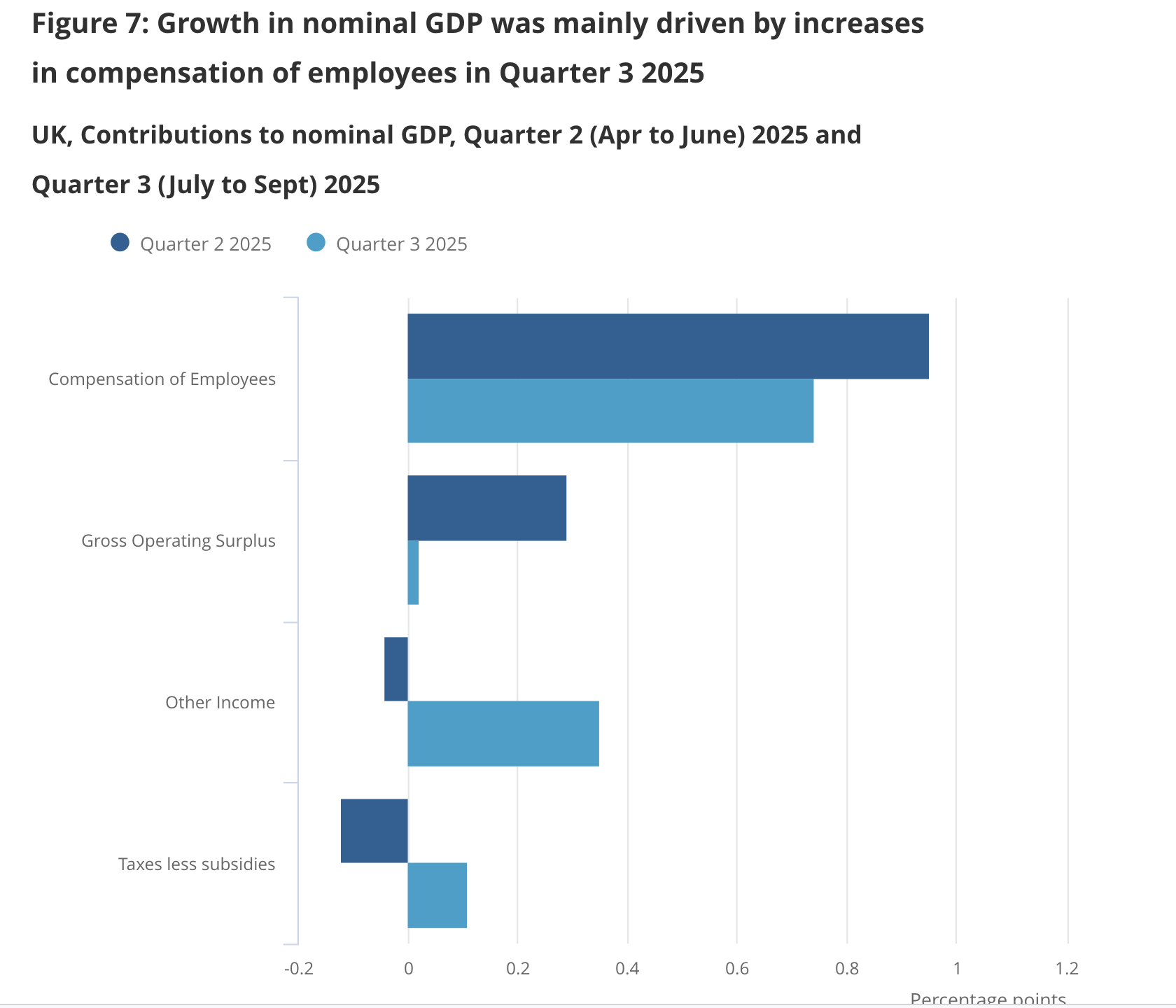
If we look at the consumption side of GDP, the big driver is compensation of employers. It is up 8.3% over the last 12 months. Now, if you are a worker, you may be mystified about this big boost in employer compensation. But, actually, what is happening is that employer contributions include the rise in national insurance contributions, which rose 4.3% compared to the rise in wages of 0.8%.
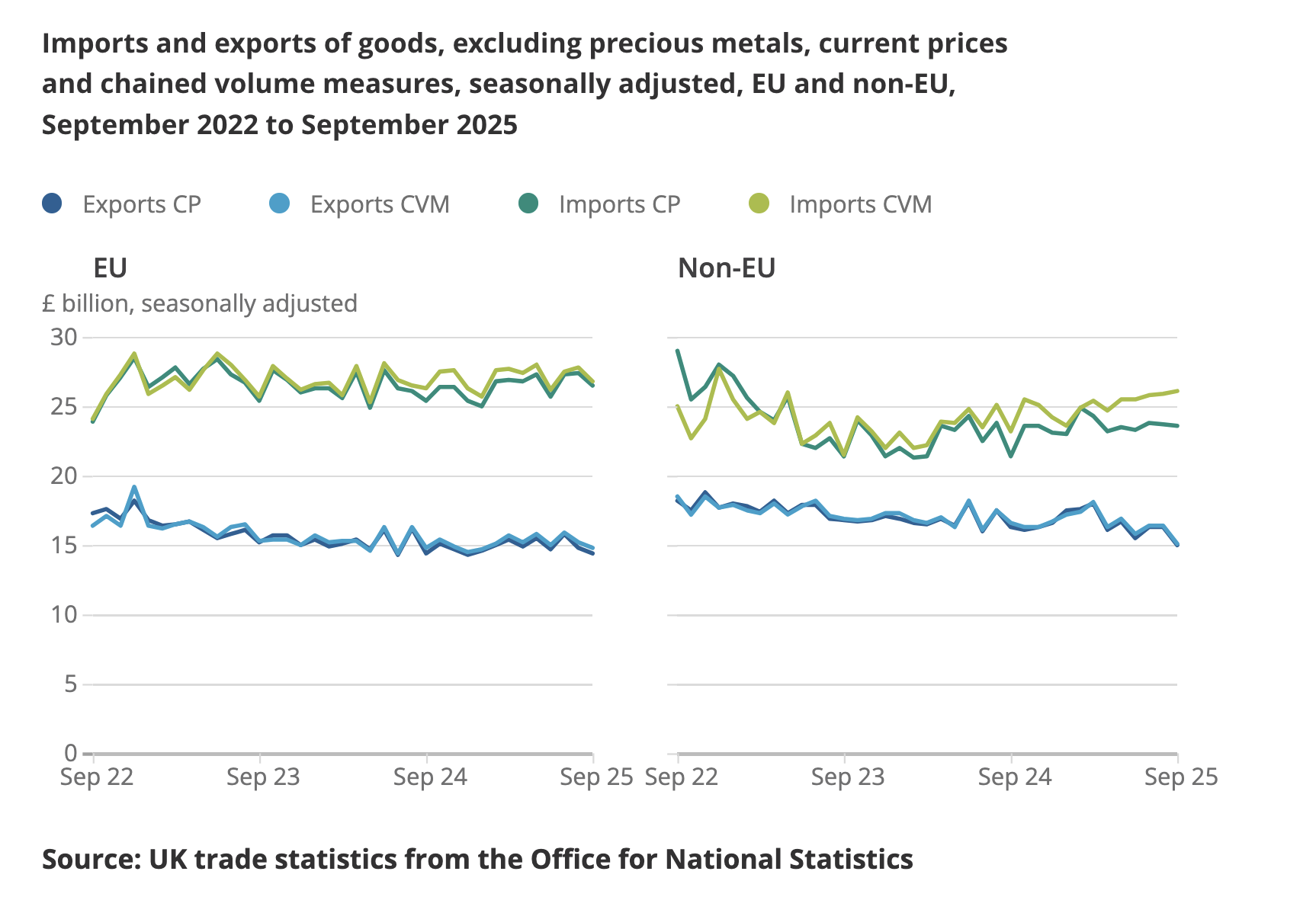
Another area of weakness in the UK economy has been the export sector. This shows the deterioration in exports to the EU from £17bn in 2022 to £15bn in 2025. It is not just Brexit-related difficulties, with exports to non-EU countries also falling by a similar amount. It means that despite a weak economy low growth on spending, the UK’s current account deficit is around 3% of GDP. This means the value of imports of goods and services is greater than exports and we need to finance this deficit by attracting capital flows. These are things such as American firms buying British firms or gulf states buying up property in London or foreign investors buying British bonds to fund the UK budget deficit. A current account deficit isn’t necessarily a bad thing, we’ve had one for a long-time, but it does reflect a long-term weakness in manufacturing export capacity and also many assets being sold to foreign buyers, which means in the long-term a stream of dividends and income will leave the country.
Housing Market Woes

The slowing economic momentum and budget speculation is also having a negative impact on the housing market. Since a mini crash in 2022, house prices have recovered in nominal terms, but are now starting to flatten out.

However, the latest survey from Riics shows tentative signs of house prices falling. Excluding Northern Ireland and Wales, prices are falling in most regions in the past 3 months. The Riics survey tends to be a more update to snapshot of the housing market that other house price indexes which take a longer time to produce.
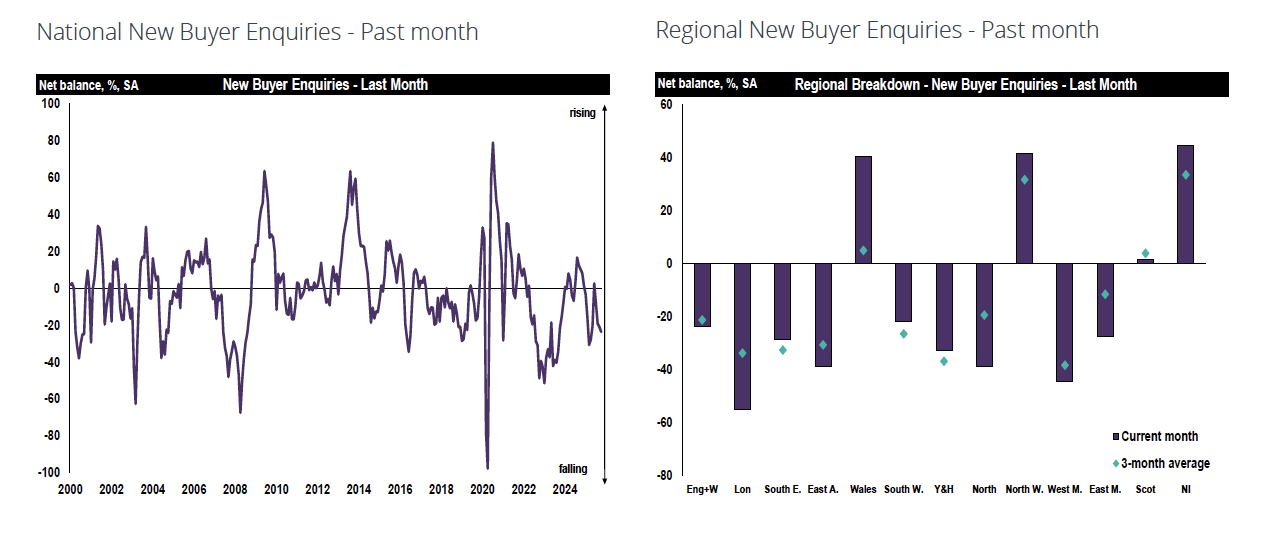
Whatever the prospect of house prices, there seems to be a clear wariness of entering the housing market at the moment. New buyer enquiries have fallen. The big question is how much of this is driven by pre-budget nerves and how much is driven by larger fundamentals. An optimistic take is that people are waiting to see what happens in the budget. There has been so much speculation about potential new taxes on the housing market that many prefer to wait and see. But, I think housing taxes may change less than some fear. I can’t see any rise on most households, though nor do I see a big cut in stamp duty beloved of economists and housing experts. However, a pessimistic take is that the weakening economy and rise in unemployment suggest the housing market is once again being squeezed as high rates of unaffordability plus declining confidence make consumers wary of taking out a mortgage.
How Far Will Interest Rates be Cut?
On the housing market, at least, I am less pessimistic; a slowing economy is likely to enable the Bank of England to cut interest rates. Mortgage rates have already been falling in recent years, and rates could fall even more. Also, even when unemployment rises, and the economy slows down, it doesn’t always have such a negative effect on the housing market. House prices rose throughout the 2010s, despite very weak real wage growth. It might seem counterintuitive, but wealth played a role; also a big driver was ultra-low rates, making it cheaper to buy. However, this optimistic take on the housing market, will need to see inflation actually fall, rather than just relying on forecasts that it will. But, I would stick my neck out and see that inflation will fall soon. This graph shows two things input prices and output prices. The input prices is the cost of raw materials like oil and food, this inflation rate was only 0.8%. The big drop in input prices was driven by cheaper oil, though food inflation remains quite high. But, generally, if this input inflation remains low, you would expect it to feed through into headline inflation soon.
So the bad news is that the economy is slowing. And the good news is that the economy is slowing so we can cut interest rates and at least some people who have a mortgage will see a small decline in mortgage payments. Whilst rates may fall by the end of the year, how far will rates fall? Usually, you would expect interest rates to be around 1-2% above inflation. So if we did see inflation fall to the target of 2%, you might expect interest rates of around 3 to 3.5% which suggests only very limited room for rate cuts. However the ECB have already reduced their deposit rate to 2%, which suggests the old era of ultra-low interest rates could return. If the UK enters into another stagnation like the 2010s, then it is quite possible we will follow suit with big cuts in rates. But this itself is problematic with ultra low rates distorting the economy and being better for some groups than others.
But hopefully it won’t come to that. Perhaps out of the hat, the chancellor will be able to pull a magic rabbit which will return confidence, optimism and hope to the UK economy. Tax cuts for all, more investment and a return to the kind of growth that characterised the post-war period. I do like to finish on a postive note, but I think even the greatest optimist would feel this is stretching credulity to its farthest stage. At least within the constraints of the current economic world view, it is hard to see anything over than significant tax rises falling in areas, which will have some negative effect on growth. However, the best we can hope for is that the uncertainty is somehow brought to an end, and firms will regain confidence to increase investment and construction.
About The Author
