
The long-run trend rate of growth is the average sustainable rate of economic growth over a period of time. It could also be termed as the ‘underlying trend rate of economic growth’ The long-run trend rate is determined by growth in productive capacity (AS). It is the rate of growth which is consistent with low inflation.
Actual growth can be quite volatile with booms and busts taking the growth rate away from this underlying trend rate. In the UK, in the post-war period, the long-run trend rate is approximately 2.5% – but we had many periods of boom and bust.
Since 2009, the UK long-run trend rate has slowed down due to lower investment, lower productivity and rising inactivity.
Graph Showing Long Run Trend Rate
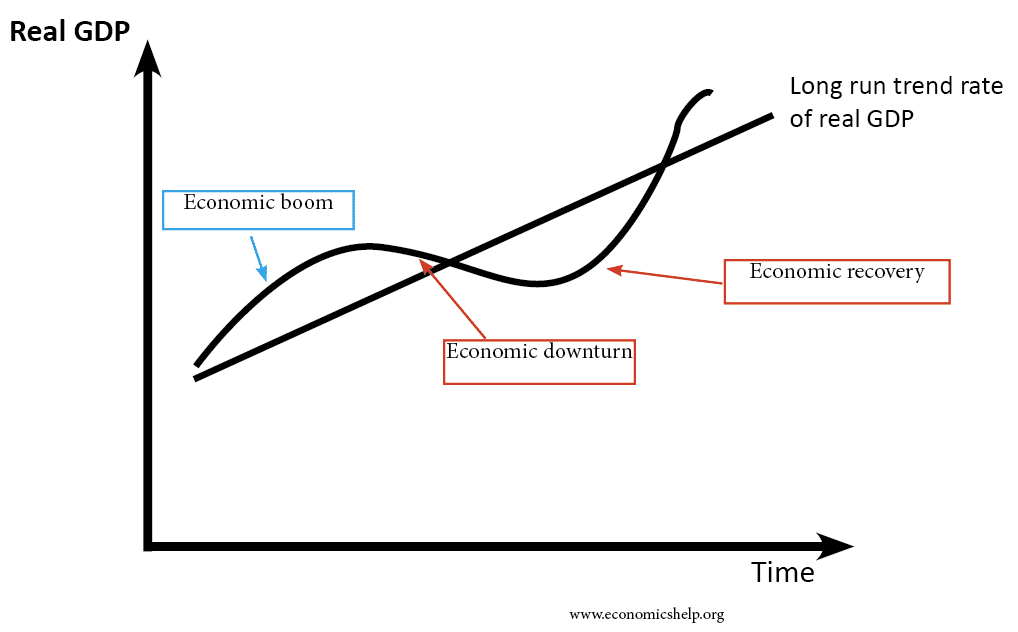
This graph shows the actual growth rate is fluctuating above and below the long-run trend rate.
- If growth is above the long-run trend rate we say there is a positive output gap (inflationary pressures – boom)
- If growth is below the long-run trend rate, this creates a negative output gap (spare capacity or bust)
Economic Growth Rates and Long-Run Trend Rate

This shows UK real GDP growth since 1955. Until 2009, the economy tended to grow at around 2.5% a year
Annual Growth Rate

This graph also gives an indication of the underlying trend rate. The average quarterly growth rate is around 0.6 – 0.7%. (annual growth rate of 2.5%) In the late 1980s, we had growth well above the underlying trend, rate – but this led to recession of 1990-1991. Since 2008, the trend rate of growth has slowed down.
What determines the Long Run Trend Rate of Growth?
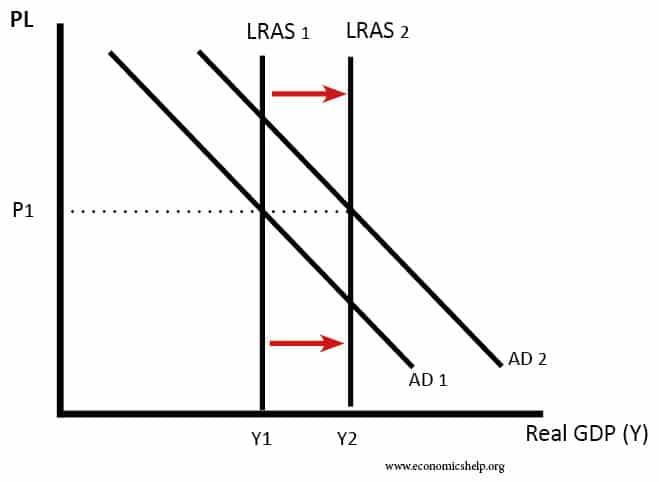
Graph showing increase in LRAS and AD.
The long-run trend rate of growth is essentially determined by the growth in productive capacity – the growth in Long-Run Aggregate Supply.
Factors Affecting Long-Run Trend Rate of Economic Growth
- Technological improvements and technological sophistication. For example are firms investing in new technology such as Artificial Intelligence and automation?
- Labour productivity – output per worker – which depends on education, training and skill levels.
- Availability of resources – easy access to power and natural resources can provide stimulus to economic growth.
- Investment levels and efficiency of investment
- Scope for productivity gains from privatisation
- Labour market flexibility.
- Levels and quality of infrastructure – communication/transport.
- Entrepreneurial spirit – Are people willing to set up and develop new business? This may depend on the confidence of people in the long-run performance of the economy.
Some countries like China may have a high long-run trend rate because their productive capacity is increasing at a faster rate than in UK.
Boom and Bust Cycles
If the actual growth is above the long-run trend rate, then it implies that demand is exceeding the growth of productive capacity. In this case, we tend to get inflation and a worsening of the current account. This inflationary growth tends to be unsustainable and is often followed by an economic downturn.
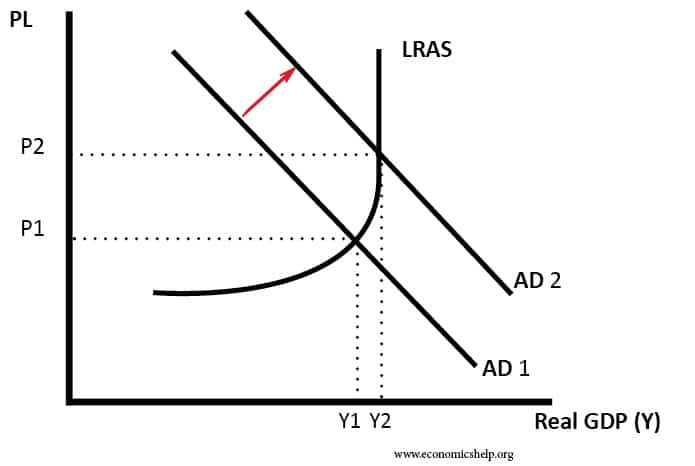
Inflation from an increase in AD.
Economic Growth below the Long Run Trend Rate
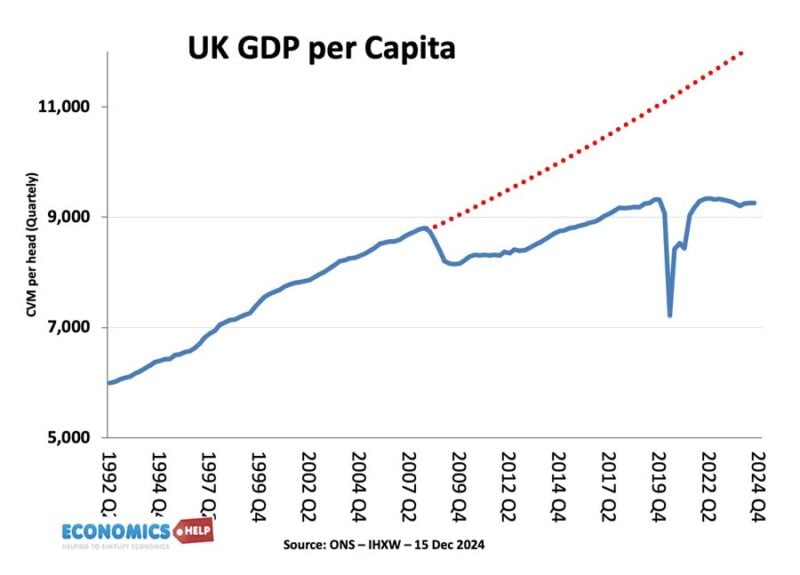
In 2008-24 we have had an experience of economic growth being persistently below the long-run trend rate. In other words, actual growth hasn’t caught up with the trend rate.
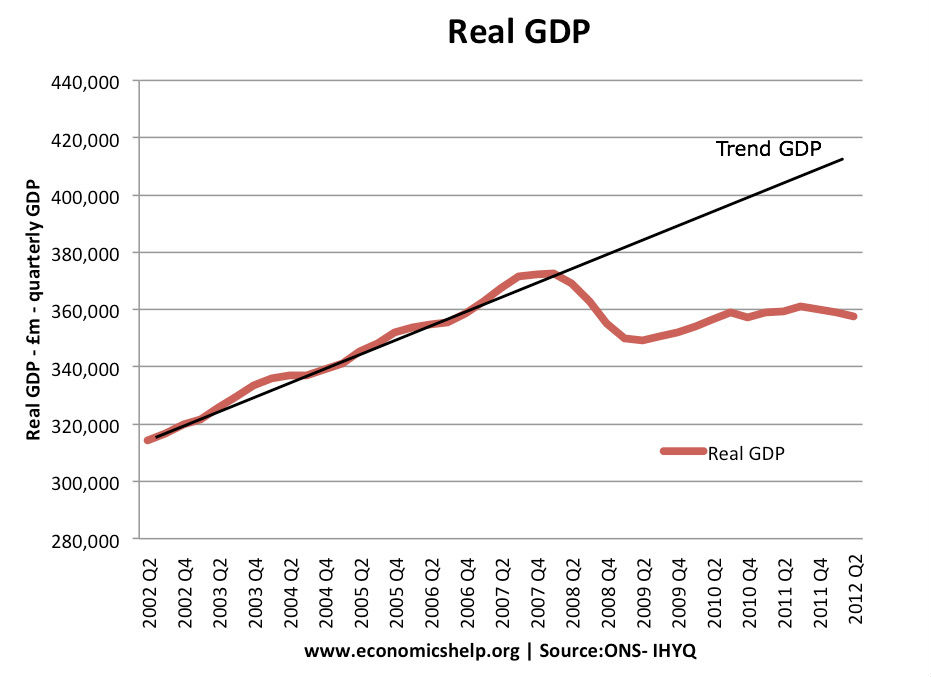
The prolonged recession of 2008-12 caused GDP growth to fall well below the long-run trend rate.
If growth is consistently below the long-run trend rate, it may cause the long-run trend rate to decrease. In other words, in a serious recession, demand-side conditions can have an effect on the average growth and lead to a persistent decline in productivity growth.
What Caused Fall In UK Long-Run Trend Rate Since 2009?

- Productivity slowdown: Output per hour grew about 2% pre-2008, but only ~0.5% since, sharply lowering potential growth. Productivity output per worker has a key impact on the long-run trend rate of growth.
- Weak business investment: Firms cut back on capital spending, R&D and skills after the crisis, limiting efficiency gains. UK one of lowest investment levels in OECD
- After-effects of the financial crisis: Damage to banks and credit supply reduced risk-taking and long-term investment. Asset prices rose during QE, but real wages stagnant
- Structural issues: A shift towards lower-productivity services, especially in the public sector and weak diffusion of new technology, e.g. UK has low take up rate of new robotics
- Brexit effects Reduced trade openness and discouraged investment.
- Demographics: Slower growth of the working-age population and rising inactivity.
Related
About The Author

I think it would be great if the difference between Actual Growth and Long-Run trend rate of growth was more simply explained at the top, through making a comparison between the two. One is the productive potential for an economy (IF they were at full capacity, it would operate on that point) and the other is the actual growth an economy (how much they are actually growing).
I mean you do explain it very well, but making it a comparison between the two will mean that it will come up on more search engines as well as providing a quicker answer to those doubtful ones like myself.
You are the best!
other determinants of the long run trend of rate of growth are ; capital accumulation; growth-compartible institutions; resources availability ; technological sophistication and entrepreneural capacity.
thanks alot, you are of help