
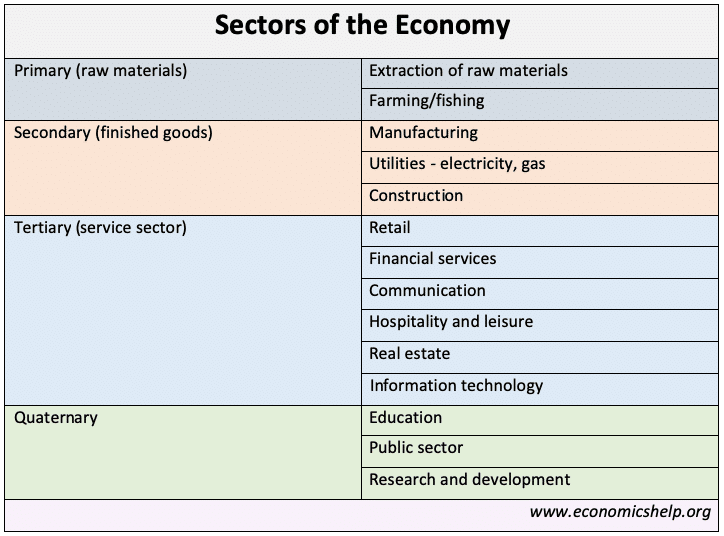
The main sectors of the economy are:
- Primary sector – extraction of raw materials – mining, fishing and agriculture.
- Secondary / manufacturing sector – concerned with producing finished goods, e.g. Construction sector, manufacturing and utilities, e.g. electricity.
- Service / ‘tertiary’ sector – concerned with offering intangible goods and services to consumers. This includes retail, tourism, banking, entertainment and I.T. services.
- Quaternary sector (knowledge economy, education, research and development)
Video on different sectors of economy
Primary sector
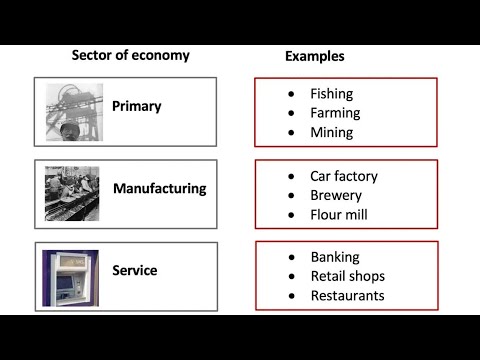
The primary sector is sometimes known as the extraction sector – because it involves taking raw materials. These can be renewable resources, such as fish, wool and wind power. Or it can be the use of non-renewable resources, such as oil extraction, and mining for coal. Examples include:
- Mining, farming, fishing.

In developing economies, the primary sectors tends to take a big share with many employed in agriculture and mining. In the 1920s, over one million people were employed in the UK coal industry. It was a key part of the economy. However, improved technology and the growth of other energy sources has seen a dramatic decline in this primary sector industry.
Secondary sector
The secondary sector makes and distributes finished goods.
- Manufacturing – e.,g producing cars from aluminium.
- Construction – building homes, factories
- Utilities – providing goods like electricity, gas and telephones to households
The manufacturing industry takes raw materials and combines them to produce a higher value added finished product. For example, raw sheep wool can be spun to form a ball of better quality wool. This wool can then be threaded and knitted to produce a jumper that can be worn.
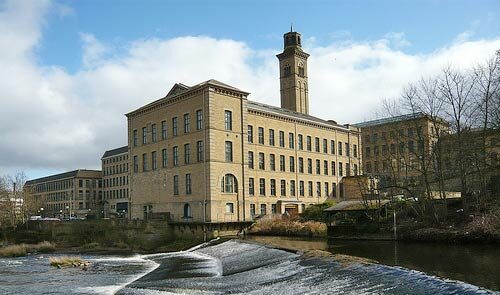
Initially, the manufacturing industry was based on labour-intensive ‘cottage industry’ e.g. hand spinning. However, the development of improved technology, such as spinning machines, enabled the growth of larger factories. Benefiting from economies of scale, they were able to reduce the cost of production and increase labour productivity. The higher labour productivity also enabled higher wages and more income to spend on goods and services.
More on: manufacturing sector
Service / tertiary sector
The service sector includes
- Retail
- Financial services – Insurance, investment
- Leisure and hospitality
- Communication
- IT
- Transportation
The service sector is concerned with the intangible aspect of offering services to consumers and business. It involves retail of manufactured goods. It also provides services, such as insurance and banking. In the twentieth century, the service sector has grown due to improved labour productivity and higher disposable income. More disposable income enables more spending on ‘luxury’ service items, such as tourism and restaurants.
More on: Reasons for the growth of the service sector
Quaternary/knowledge sector
- Education
- Research and development
- Public sector bodies
The quaternary sector is said to the intellectual aspect of the economy. It includes education, training, the development of technology, and research and development. It is the process which enables entrepreneurs to innovate better manufacturing processes and improve the quality of services offered in the economy. Without this growth of technology and information, economic development would be slow or non-existent.
It is also known as the knowledge economy – this is the component of the economy based on human capital – IT, knowledge, education. It is primarily related to the service sector, but also is related to the high tech component of manufacturing.
Change in the importance of different sectors
A primitive economy will primarily be based on the primary sector – with most people employed in agriculture and the production of food.
As an economy develops, improved technology enables less labour to be needed in the primary sector and allows more workers to produce manufactured goods. Further development enables the growth of the service sector and leisure activities.
Change in UK economy
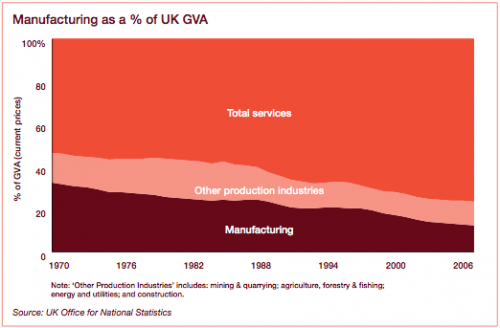
Relative decline of UK manufacturing
Other sectors of the economy
Quinary sector
The quinary sector is the part of the economy where the top-level decisions are made. This includes the government which passes legislation. It also comprises the top decision-makers in industry, commerce and also the education sector.
Public vs Private sector
Another division is between the public sector – government and the private sector – free market, individuals and business.
The government is primarily concerned with services, such as health and education. However, the government could own key industries, such as coal mines were once nationalised in the UK. See: public vs private sector
Digital vs Traditional economy
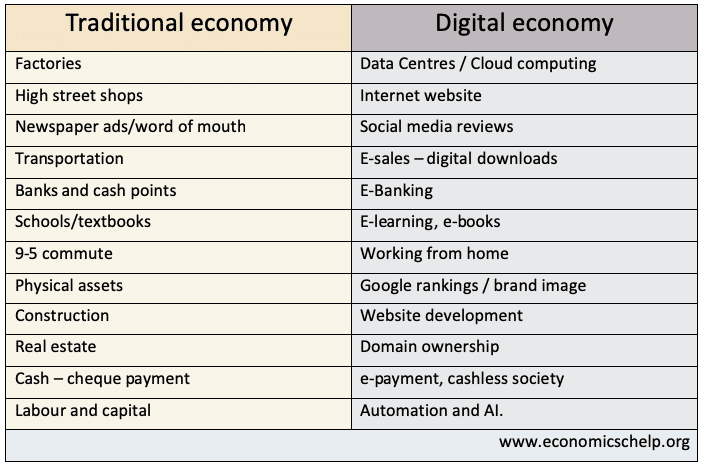
Another division is between the traditional sector – bricks and mortar shops and the digital economy – online sales. In practice, there is an overlap between the sectors, e.g. Traditional shops have embraced aspects of the digital economy, such as online sales.
However, the digital part of the economy is becoming more pronounced with some businesses no longer having a physical presence on high street, but providing intangibles goods and services, such as Netflix.
Related pages
Can any one tell me which book is good for this type of topic above about differnet bussiness sector and types and human need and all
I think we can utilise the cbse economics book itself its enough to gain good marks .,if you understand the topics clearly you can answer any questions and anytime
Actually cbse books can make you get marks, here I’m telling about 10std books but actually the book provides just an overview of things… For 10th we can use NTSE state board material… It’s actually bit more advanced than cbse… I’ve not refered many other books so this is my small suggestion
Discuss the relationship of three economic sectors with the global division of labour.
Do holding companies fall under the tertiary sector?
I am old: the sectors of economy until the 1990s were divided as what generate work and wealth in taxes and products. Today, you have that Quarternary sector which is total non sense: it consumes wealth and resources before it creates any.
I am young: the quaternary sector is arguably one of the most important industries in an economy. Specializing in research, advancements, and technology can completely revolutionize an economy. Most medicines, A.I, Robotics, artillery/military equipment the internet, nanotechnology, and other tech (such as the phone/computer you’re using) come from the “nonsense sector” as you call it. The quaternary sector is what gives some economies superiority over others.
Information like this helps a lot especially to students during these times.