
Readers Question I am having trouble understanding the circular flow of economics. Could you explain it in simple terms, like how is it involved in my life, I don’t get the connection to the product and factor markets
The circular flow of income is a simple model to explain basic economic transactions.
To start off, consider 2 groups of people
- Households – people like yourself
- Firms – companies like BMW, Vodafone e.t.c.
Simple flow
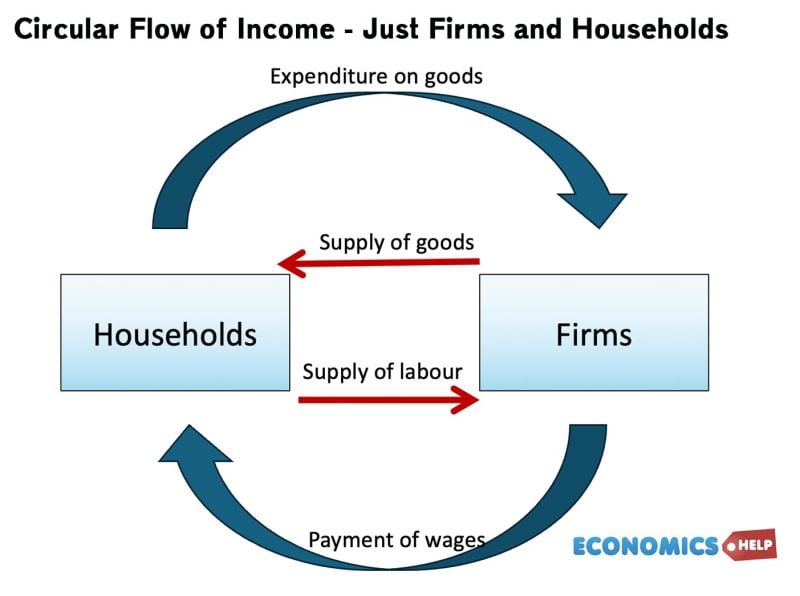
- Householders (people like you or me) could get a job in a factory making cars. This leads to an output of goods.
- In return, workers get income (wages) from the firm.
- With this income, we can buy the goods that firms are producing. This is Expenditure.
Thus, in a closed economy with no savings, taxes, tax or imports. Total Output should be the same as Total Income and Total Expenditure.
- Note: Factor markets are markets like labour markets.
- Product markets are the production of goods like cars
Therefore, this is the very basic circular flow of income.
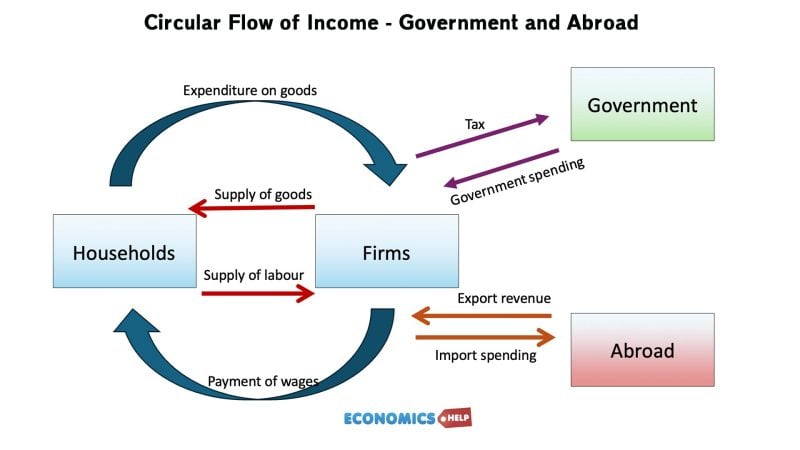
Government – Tax and spending
- To this circular flow, you could add a government which collects taxes from firms and households.
- The government then spends this money in the form of benefits and subsidies.
Foreign – Exports and Imports
Also, you could add a foreign dimension.
- Goods and services could be exported – Money comes into economy
- Goods and services could be imported – Money leaves the economy
Banks – Saving and Investment
Also, we don’t spend all the money we receive, but will save some in banks. Firms could borrow from banks to invest.

Diagram on Circular Flow
Withdrawals (W) into Circular Flow of Income
Withdrawals are items that take money out of the circular flow. This includes:
- Savings (S) (money not used to finance consumption, e.g. saved in a bank)
- Imports (M) (money sent abroad to buy foreign goods)
- Taxes (T) (money collected by government, e.g. income tax and VAT)
Injections (J) into Circular Flow of Income
Spending that puts money into the circular flow of income.
- Investment (I). Money invested by firms into purchasing capital stock.
- Exports (X). Money coming from abroad to buy domestically produced goods.
- Government spending (G). Government welfare benefits, spending on infrastructure.
Equilibrium in the Circular Flow
The economy is in equilibrium when:
- Injections = Leakages
- I + G + X = S + T + M
Change in equilibrium
- If injections > leakages → economic growth
- If leakages > injections → fall in national income
Link to the Multiplier
An increase in injections (e.g. higher government spending) can lead to a multiplied increase in national income, depending on the size of leakages.
This is the multiplier effect – an initial injection leads to bigger final increase in real GDP
Related posts
About The Author

really nice, very simple and understandable.
Thanks now I know it,,,I dont jst understand it better but I know it…surely I can explain 2 others..u r a star thank you tons
Really nice, dude. Like i tried to read from the professor’s notes, i couldn’t understand it very clearly. You gave a clear picture. thumbs up. :)
perfect lecture even an ordinary person will understand what we mean by circular flow of income you are my role model i which i can lecture like that
that was really a very good way to teach circular flow
I think da diagram is ok
You cycle omits the accumulation of capital, which means that income does not equal expenditure.
Becasue of this inequality inceasing levels of debt/leverage are require to maintain household income and make income equal to expenditure
put it simply: capital accumulation implies credit bubbles