
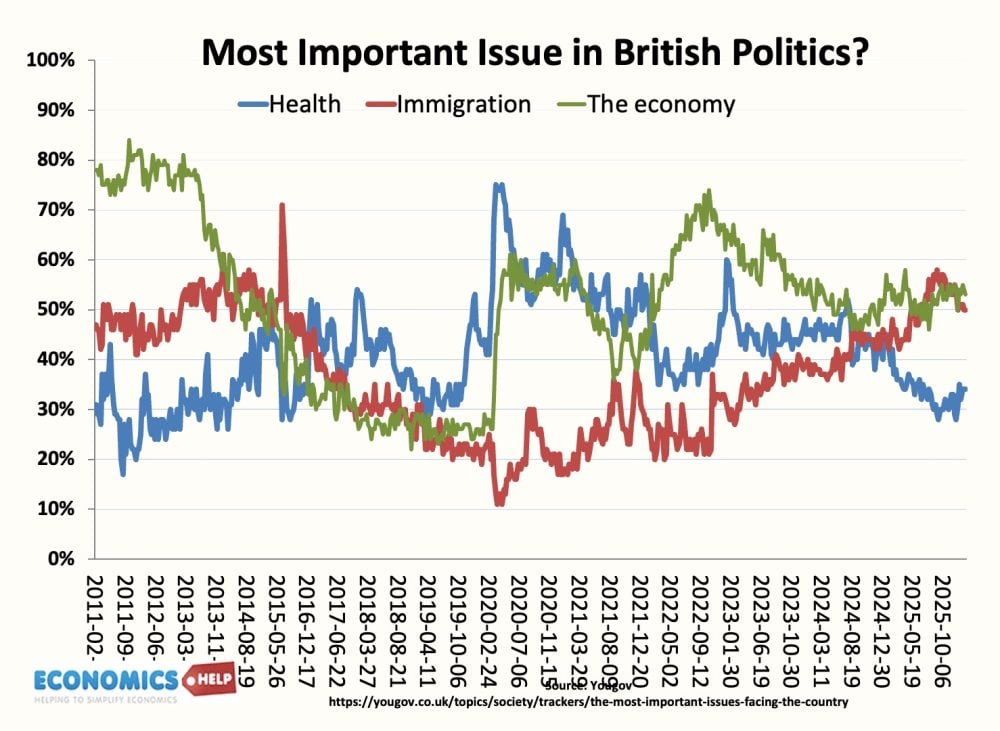
In autumn of last year, 57% of Britons felt that levels of immigration were one of the most important issues facing the country. Yet, 2025 saw levels of net migration fall drastically, and with a fall in the number of work visas, restrictions on family members and rising emigration, UK is heading towards more people leaving than coming in. This would be the first time since 1993.

Back in 2022, the ONS predicted that the UK population would soar to over 75 million by 2040. However, this was based on two assumptions which have now changed. The ONS have consistently underestimated how much birth rates are falling.
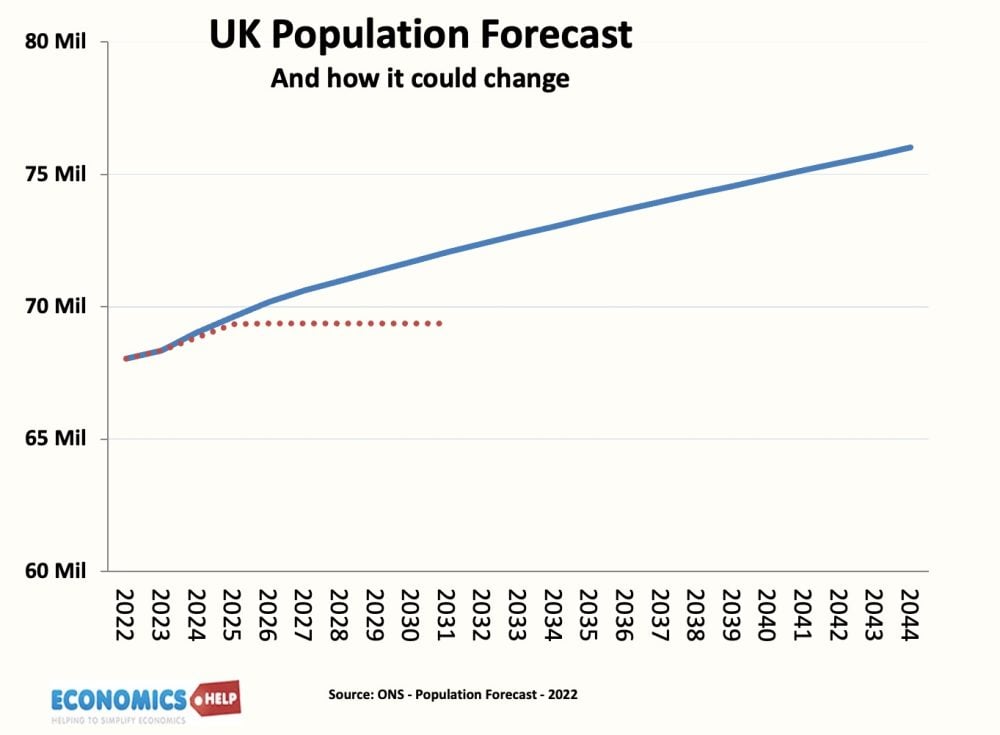
The outcome is always lower than their predictions. Just like the rest of the world, the UK has a fertility crisis with rates falling to 1.4. The ONS also assumed net migration would remain high. But, that is now changing fast.

If we look at work visas, in areas like health care workers, the number of monthly applications has fallen from 18,000 for to less than 1,000.(link) See also: Times link

But, it’s not just about decline in workers, it is also the corresponding fall in dependent family members. If you look at migration statistics, family dependents are always one of the biggest categories, and small boat arrivals are relatively small, though they tend to get a lot of coverage. Anyway, if you restrict work visas, there is a multiplier effect of reducing dependents too. Not only that but emigration is rising. Part of this is due to the fact that many migrants stay for a short time. So Rising emmigration is a response to recent immigration surge of 2023, and many students who can stay 2 years after graduation will soon be leaving. This is why the UK, could go from the record net immigration to quite feasibly net emigration with a few years.
What happens next?
But, the bigger question to ask is what problems will this solve and what problems will it create?

The ONS model the average migrant as a working age taxpayer, so they assume migration it is a net fiscal benefit.

Certainly, in terms of net fiscal contribution, age is incredibly important. Adults make postive contribution, older people have negative fiscal contribution. The ONS state Low migration leads to more borrowing and already there are concerns that big drop in net migration may put renewed pressure on the government to put up tax.

However, the ONS do point out their model is a simplification and highly uncertain. The fiscal benefit of migration depends on wage levels and how long they stay.

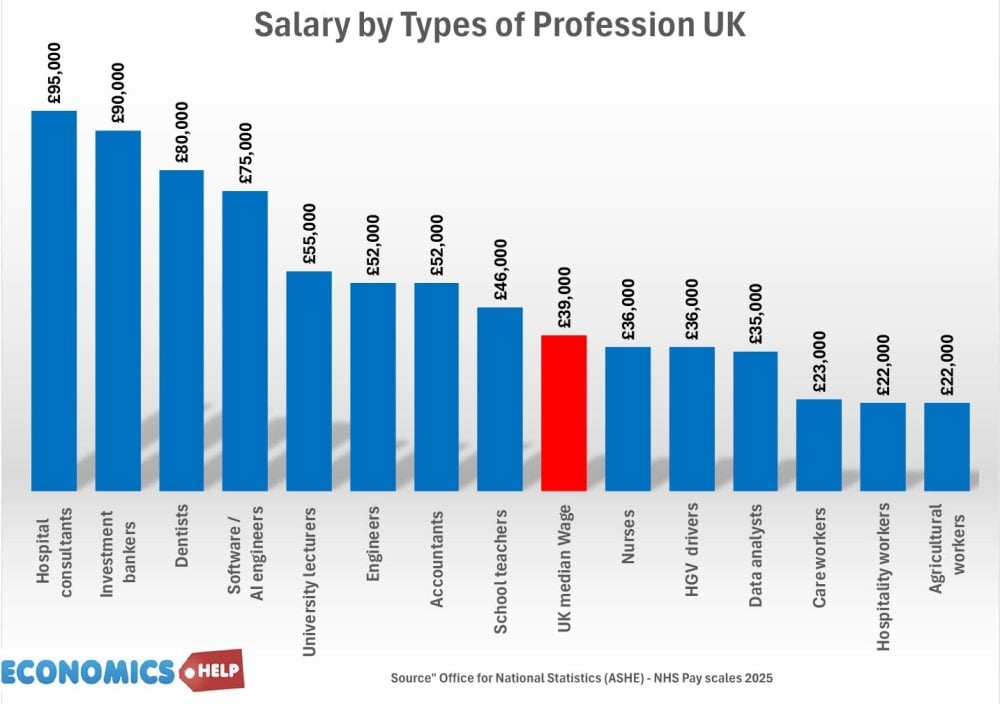
A migrant who stays to the end of his life, will change from net fiscal benefit to net cost as they age. The real issue is the composition of migration. A doctor on a £100,000 salary will be very different impact to low-wage porter. You can see how different low wage migration is to high wage migration. But, recent evidence suggests that the mean salary of a migrant is slightly higher than the average UK worker and not all stay until they die.
 salary-by-types-of-professions
If we look at average salary by profession, there is big difference between hospital consultant earning £95,000 and care workers at £23,000. And largely speaking there is greater support for migration for high salary professions like doctors. But it would be a mistake to only focus on the net fiscal benefit. An investment banker may get £90,000 and a care worker £23,000 but this reflects the fact care workers are underpaid compared to the social value of work. Most people will be in a situation of needing to arrange care workers for parents at some stage in life. Yet, there is a shortage and this shortage will get worse in the coming years. We rarely regret not being able to hire an investment banker, but carers are indispensable. Ideally, we would encourage more young people to see caring and nursing as a worthwhile career, but, if you end migration, that is going to take time to materialise.
Migration and Growth
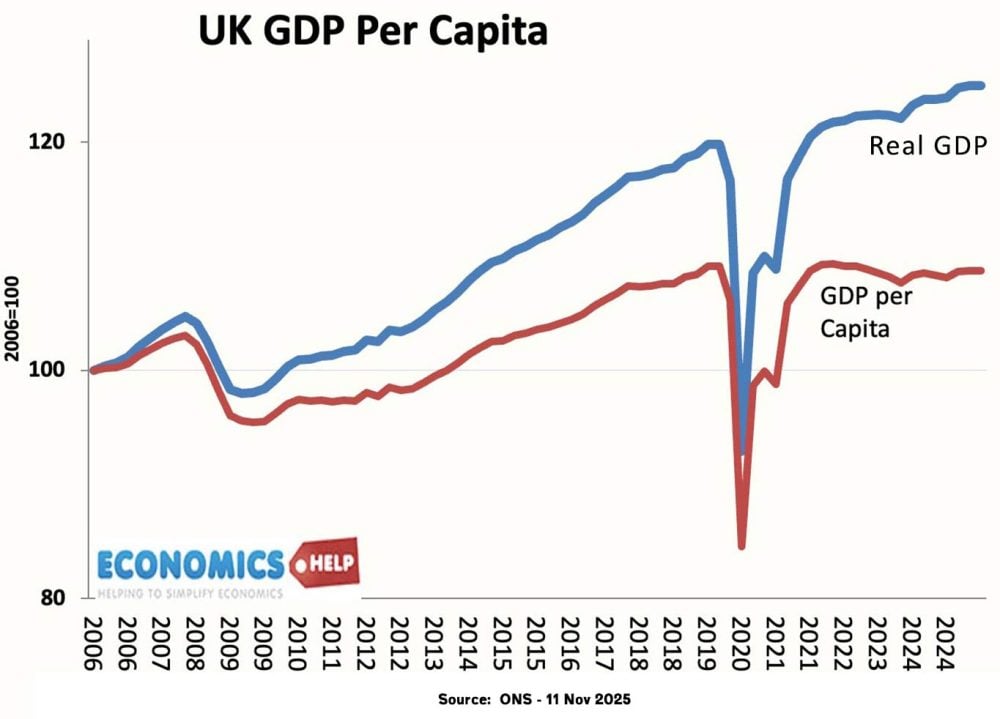
One thing about UK economic growth is that in the past 16 years, population growth and migration have been significant drivers of economic growth and an increase in real GDP. This may help short-term budget requirements, but the key question is not real GDP, but GDP per capita and actual living standards. You can see real GDP per capita has really struggled to increase. Not only that, but real GDP per capita doesn’t take into account housing costs. There is no doubt that the migration surge of 2023, pushed up the cost of rents faster than inflation. And this is a cost not reflected in ONS models. If net migration falls to zero, it will ease pressure on the housing market, especially the rented sector.
When people rate migration as the biggest issue, you do wonder if it is a proxy for living standards and housing costs. Given the UK nearly always fails to meet housing targets, and the government’s 1.5 million is already behind schedule. It is easier to restrict migration and growth in the population than build houses. It is worth saying that although lower migration will reduce rent growth, it is not a magic bullet to suddenly making housing affordable. The UK has significent supressed household formation and relative shortage of housing. House prices are more determined by interest rates and real income. So net migration of zero will not be transformative to housing costs.
Less building?
In fact, if the UK population falls rather than rises over the next 20 years, does it mean we can re-evaluate need to build houses? Some claim the UK has a backlog of 4 million homes, but at the very least, there is less pressure to build.
We are ageing
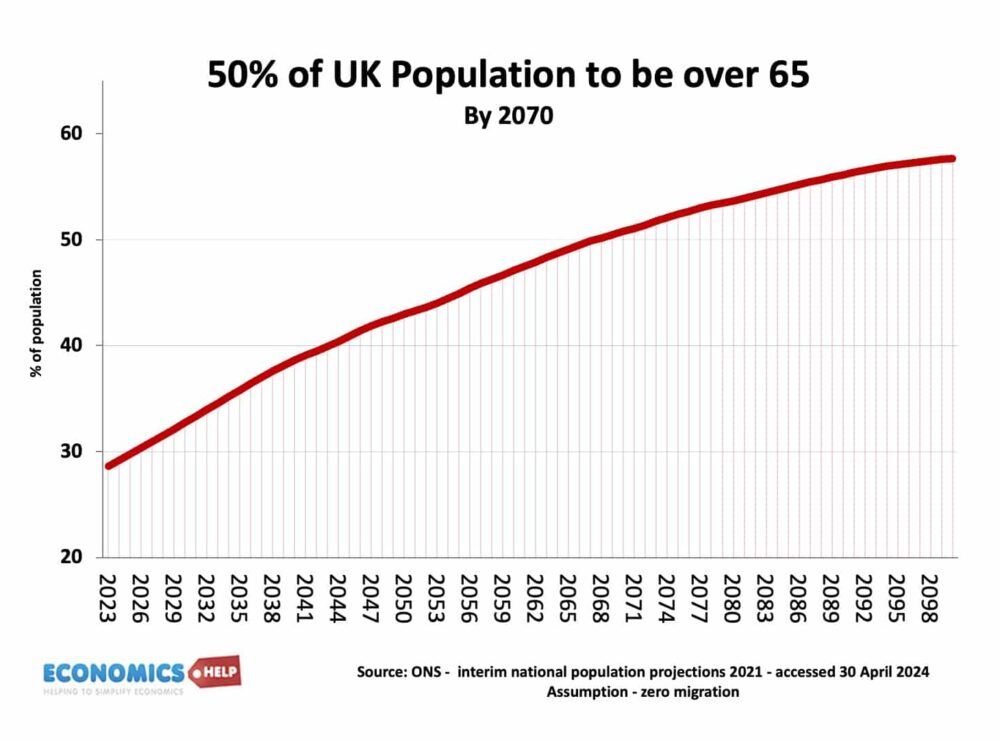
The other big issue is that a fall in migration has to be set against the UK’s ageing population. With a fall in birth rates, the share of the population over 65 is rising, and this is why the UK has these drastic forecasts of rising spending and rising debt. Health care, pensions are all going up. It’s a demographic headache, and this has always been a strong argument for net migration. If your population is ageing, bring in young workers. Migration can definitely ease the fiscal pressures of an ageing population by increasing the number of working-age taxpayers, but to some extent, it delays rather than solves the underlying demographic problem. Migrants themselves will age. And one argument is that high levels of net migration allow the economy to paper over other problems, such as high levels of economic inactivity and poor adoption of vocational skills. However, there is no doubt that if net migration falls rapidly, it is likely to cause short-term pressures to put up taxes. Current average migrant makes more contribution than native born population.
Public sector pay
One issue is that high levels of migration has been a very effective way of squeezing public sector pay. Between 2010 and 2022 the real pay of nurses fell 10%. Is it a surprise that less young native born workers want to train to be a nurse? Migration has enabled public pay to be cut during the austerity years. But, if migration of nurses and care workers does fall, it may mean upward pressure on public sector pay, if we want to fill those gaps. The problem is that even a modest increase in public sector pay means higher taxes. There is no such thing as a free lunch.
Productivity growth
Another issue of the UK economy is incredibly low productivity growth; in fact, UK productivity has been lower than that of other major economies. You could argue that this reflects a preference for low wage, low-capital production. In other words, firms rely on migration, rather than boost productivity and paying higher wages. An end to net migration would cause service sector businesses in the hospitality sector real headaches, but in an optimistic model it could cause more investment in capital and higher productivity. On the one had, this could be beneficial, on the negative side, it might mean less staff and more ordering through machines.
UK Good at
I once made a video – what is the UK good at? It wasn’t particularly long, but the UK does have strengths; one of those is the university sector.
It is a net exporter of education services, it brings in revenue and foreign currency, which helps offset our net import of Chinese goods. But, for some reason, UK politicians see this great export sector has something expendable, and universities have been hit by spending cuts, higher fees and now restrictions on visas. Cutting foreign student numbers will hurt the university sector, a big source of employment.
It is a mistake to only look at headline net migration figures. It depends a lot on composition. But, net migration is going to fall. And, in the short-term this will cause headaches lower real GDP growth and a hole in public finances, it will not lead to a magic improvement in living standards. Yet, it does have some potential benefits. Lower rent growth, and an incentive for the UK business to boost productivity and skills of workforce. The problem is this isn’t guaranteed and will at the least take time. But, it is an interesting development. Let me know what you think.
Related posts
Sources
- https://migrationobservatory.ox.ac.uk/resources/briefings/the-fiscal-impact-of-immigration-in-the-uk/
- https://www.thetimes.com/comment/columnists/article/britain-population-shrink-migration-birth-rates-zdg0shrpw
- https://obr.uk/box/the-impact-of-migration-on-the-fiscal-forecast/
- https://inews.co.uk/opinion/falling-migration-could-be-about-to-drive-your-taxes-up-4167369
- https://ukandeu.ac.uk/the-coming-collapse-in-immigration/
About The Author
