Readers Question Explain with the help of diagrams the equilibrium of a firm having monopoly power in the market in the short-run and long-run?
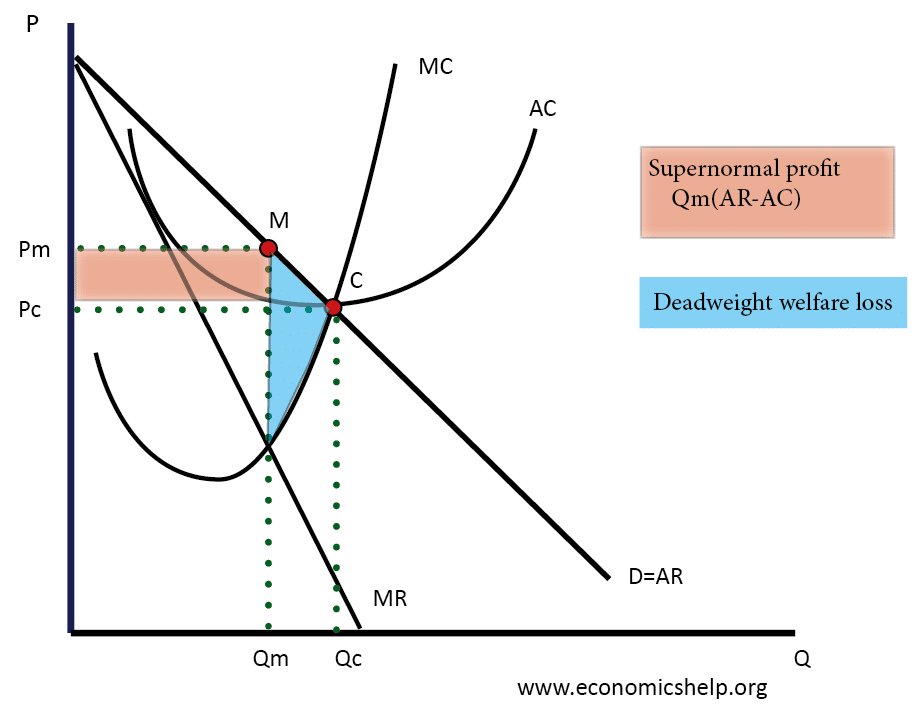
The diagram for a monopoly is generally considered to be the same in the short run as well as the long run.
Profit Maximisation occurs where MR=MC. Therefore equilibrium is at Qm, Pm.
Features of this diagram
- There are barriers to entry in Monopoly. Firms are price makers. The industry demand curve is the same as the firms demand curve.
- Profits are maximised at output where MR=MC. This means they set a price greater than MC which is allocatively inefficient.
- In this diagram the firms makes supernormal profits because AR is greater than AC.
Monopoly Diagram and Welfare Loss to Society.

- In a competitive market, output will be at P1 and Q2.
- In a monopoly, output will be QM and PM.
- A monopoly causes a fall in consumer surplus and a fall in producer surplus. Some of the consumer surplus is captured by firms.
- The red triangle shows the net loss of consumer and producer surplus to society.
Long Run Average Costs

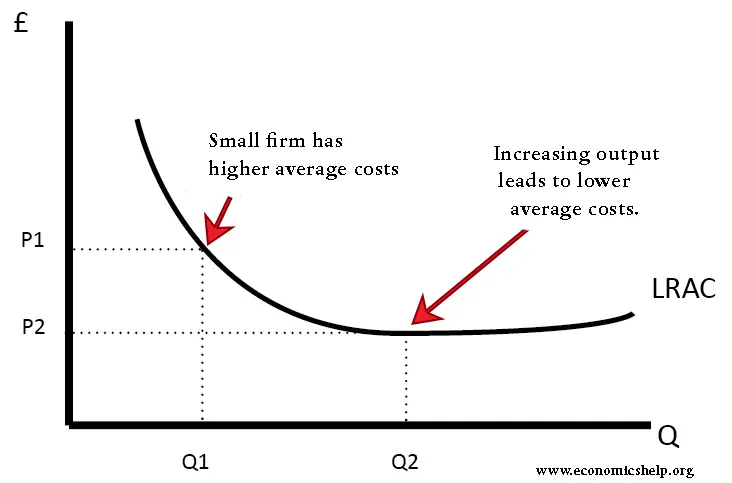
It is assumed monopolies have a degree of economies of scale, which enables them to benefit from lower long run average costs.
Note: In monopolistic competition the short run equilibrium is different to the long run equilibrium
More on Monopoly


distinguish between long and short runs?
monopoly competition market in long run within the industry or group itself
monopoly competition equilibrium with free entry price competition graph
show diagrammatically the long run equilibrium position of a supplier in monopolistic competition?
please try to be more explicit
it is the same in the short run and long run due to the barriers to entry that exist. a firm maximising profit where mc = mr can continue to do so in the long run as there are no new entrants into the market that would make the monopoly have to behave in a different way as a monoply can be protected by things like patents and high start up costs.
Show with diagram how monopolist earns supernormal and normal profit in the long run
explain the equilibrum of profit making monopolist.
means of the diagram illustate a perfect competition firm making abormal profit in the short run?
Say something on the type of profits made by monopolies
Monopolies make supernormal or economic profits in both the long and short run because their is barriers to entry and so no new firms can enter the market and affect their price.
i want 2 understand the contrast that exist between profit maximisation in perfect competition and monopoly.
as far as I know there are different diagrams (3 diagrams) for long-run under monopoly, please answer
What is the difference between a monopolist and a perfect competitor?
show diagrammatically the long run equilibrium position of a supplier in monopolistic competition?
Why a monopolist make abnormal profit in the long run
i want the detail of long run in monoply
1.is the monopolist firm always earn economic profit?
2. show both long run and short run equilibrium graphicallyand mathimaicaly?
why eskom makes economic profit in both short-run and long run situation?
i want to see only the long-run equilibrium of monopoly try to make it avialable
2.using appropriate illustrations and practical examples, compare and contrast profit maiximisation in perfect competition and monopoly
explain with the aid of a diagram, how production possibility curves can be useful in determining levels of efficiency, inefficiency, economic growth and technological improvement.
1.consider production of two products of your choice and explain with the aid of the diagrams, ow production possibilities curves can be useful in determining levels of efficiency, inefficiency,economic growth and technological improvement?
2.using appropriate illustrations and practical examples, compare and contrast profit maiximisation in perfect competition and monopoly
consider production of two products of your choice and explain with the aid of the diagrams, ow production possibilities curves can be useful in determining levels of efficiency, inefficiency,economic growth and technological improvement?
using the appropriate illustration and practical examples, compre and contrast profit maximazation in perfect competition?
explain with the aid of a diagram, how production possibility curves can be useful in determining levels of efficiency, inefficiency, economic growth and technological improvement.
using appropriate illustrations and practical examples, compare and contrast profit maiximisation in perfect competition and monopoly
Hi I have a quick question. When I look in textbooks regarding profit maximization for monopolies or perfect competition The economic profit is calculated as the area above the average total cost where MR=MC. I’m confused about what the area means for the distance between MR and MC to the left of when MR=MC. The area between those curves is larger.
where the monypoly equilibrium.. here some people cant understand..website name i seconomicshelp.com but no clarity i that.. so please give the clarity
Why monopolies make economic profit in both the long run and the short run?
what is short run equilibrium?