
Economies of scale occur when increased output leads to lower unit costs. (lower average costs)
Diagram Economies of Scale
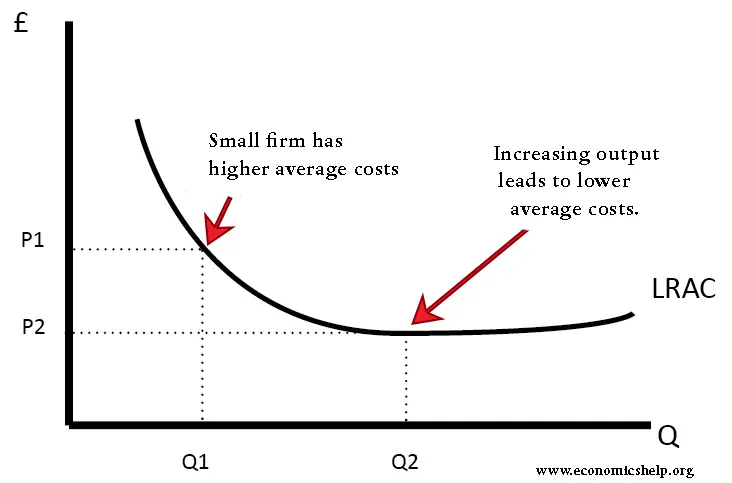
This diagram shows that as firms increase output from Q1 to Q2, average costs fall from P1 to P2. There are many different types and examples of how firms can benefit from economies of scale – including specialisation, bulk buying and the use of assembly lines.

Examples of economies of scale include
Tap Water – High fixed costs of a national network
To produce tap water, water companies had to invest in a huge network of water pipes stretching throughout the country. The fixed cost of this investment is very high. However, since they distribute water to over 25 million households, it brings the average cost down. However, would it be worth another water company building another network of water pipes to compete with the existing company? No, because if they only got a small share of the market, the average cost would be very high and they would go out of business. This is an example of a natural monopoly – where the most efficient number of firms is one.
Specialisation – car production
Another economy of scale is in the production of a complex item such as a motor car. The production process involves many different complex stages. Therefore to produce a car you should split up the process and have workers specialise in producing a certain part. e.g. a worker may become highly specialised in the design of a car; another in testing e.t.c. Specialisation requires less training of workers and a more efficient production process. However, if you have several distinct production processes, it is most efficient to have a large output.
Bulk Buying – Supermarkets
Supermarkets can benefit from economies of scale because they can buy food in bulk and get lower average costs. If you had a delivery of just 100 cartons of milk the average cost is quite high. The marginal cost of delivering 10,000 cartons is quite low. You still need to pay only one driver; the fuel costs will be similar. True, you may need a bigger van, but the average cost of transporting 10,000 is going to be a lot less than transporting 100.
Marketing Economies
If you spend £100 on a national tv advertising campaign, it is only worthwhile if you are a big national company like Starbucks or Coca-Cola. If your output is small, the average cost of the advertising is much higher.
Risk Bearing
To develop new drugs to treat illness takes considerable degrees of investment and research with no guarantee of success. Therefore this can only be undertaken by pharmaceutical companies with significant resources. Major pharmaceuticals companies, such as Novartis, Pfizer Inc and GlaxoSmithKline Plc all undertake significant research in developing new drugs.
Container Principle
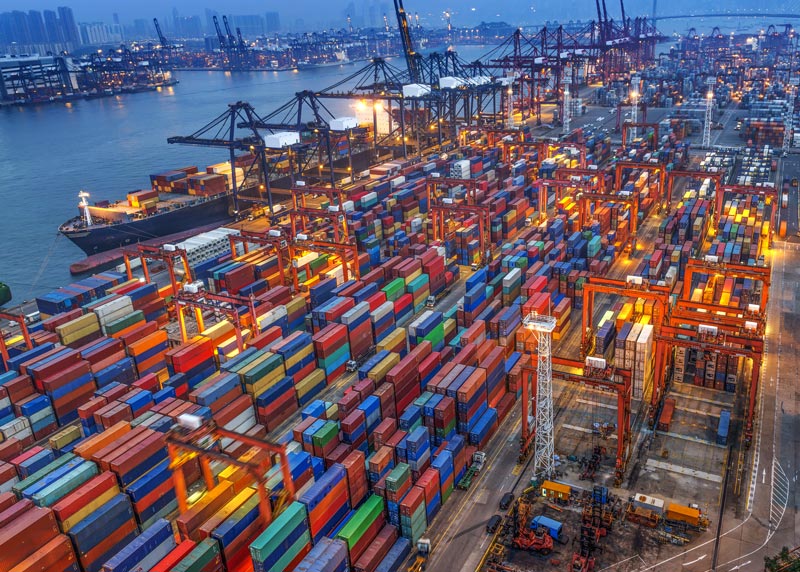
More efficient transport and packaging with bigger containers. If the surface area of a container increases by 100%, the volume it can carry will increase by 200%. Therefore, transporting larger quantities leads to lower average costs.
Financial economies
A bigger firm gets a lower rate of interest on borrowing.
Spreading overheads
If two different companies merged, e.g. AOL and Time Warner. They could still see some economies of scale from having one head office rather than two.
Economies of scope.
Economies of scope are different to economies of scale – though there is the same principle of larger firms benefiting from lower average costs. Economies of scope occur when a large firm uses its existing resources to diversify into related markets. For example, once a firm is producing soft drinks, it can use its marketing and distribution network to start producing alcoholic drinks.
Related
This comprehensive explanation on “economies of scale” is helpful to me in baking & bakery management in a medium scale bakery where i works as manager. Thanks to the authur. Lawrence Anjoorin, Osun State, South West, Nigeria.
Define economies of scale and explain why they might arise. Define diseconomies of scale and why they might arise with a graphical representation.
Cost theory
give more examples pls