
Diseconomies of scale occur when long-run average costs start to rise with increased output.
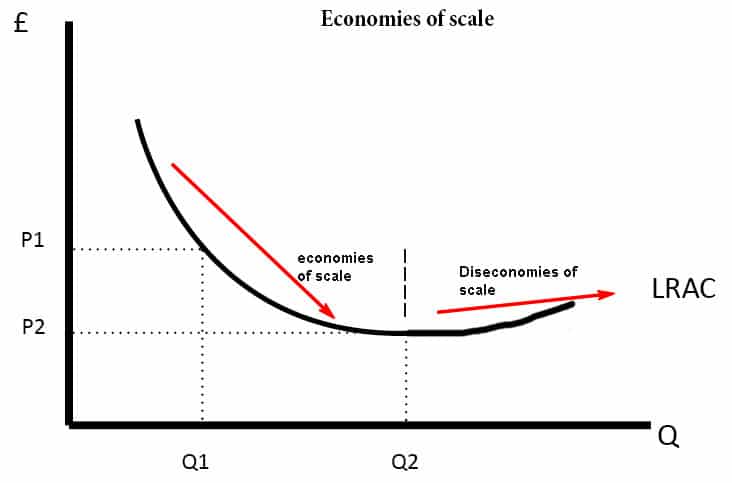
Economies of scale occur up to Q1. After output Q1, long-run average costs start to rise.
Reasons for dis-economies of scale
- Poor communication in a large firm. It can be hard to communicate ideas and new working practices.
- Alienation: Working in a highly specialized assembly line can be very boring if workers become de-motivated. In a large firm, there is an increased gap between top and bottom e.g. call centres
- Lack of control: when there is a large number of workers it is easier to escape with not working very hard because it is more difficult for managers to notice shirking.
Overcoming Diseconomies of scale
Firms may attempt to overcome diseconomies of scale by splitting up the firm into more manageable sections. For example, a large multinational may be split up into local geographical areas, with local managers facing incentives to maximise efficiency.
Minimum Efficient Scale
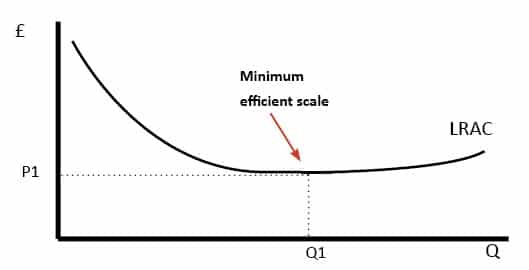
This is the minimum point of output necessary to achieve the lowest A.C. on the LRAC. In the above diagram, the MEC is at Q1.
- This has implications for the optimal number of firms in the industry
- If the MES was 10,000 cars a week and the total industry demand was 40,000. This would mean that the optimal number of firms would be four, if there were more firms in the industry then average costs would be significantly higher.
- In a natural monopoly the optimal number of firms is one, therefore the MES would be equal to the total industry demand. E.g. Water or Electricity networks
The minimum efficient scale will be determined by factors such as:
- i) Degree of fixed costs
- ii) Scope for specialisation
Decreasing Returns to scale
Returns to scale relates to how a firms production is affected by increasing all the inputs.
Decreasing returns to scale implies that increasing the inputs by 50%, would increase the actual output by less than 50% (e.g. 40%)
Relationship with economies of scale
If a firm faces constant input costs, then decreasing returns to scale imply rising long run average costs and diseconomies of scale.
However, it is possible that if the firm gains purchasing economies then increasing the factor inputs by 50% may not actually increase costs by 50%. Therefore, it is possible to have decreasing returns to scale, but not necessarily diseconomies of scale. But, if we assume a constant input price, decreasing returns will cause diseconomies of scale.
Related
- Economies of scale
- Diminishing returns to scale – note this is higher average costs in the short term because capital is fixed in the short-term.