
Definition – Price discrimination involves charging a different price to different groups of people for the same good. For example – student discounts, off peak fares cheaper than peak fares.
Different Types of Price Discrimination
1. First Degree Price Discrimination
This involves charging consumers the maximum price that they are willing to pay. There will be no consumer surplus.
2. Second Degree Price Discrimination
This involves charging different prices depending upon the choices of consumer. For example quantity, time period, collecting coupons
- After 10 minutes phone calls become cheaper.
- Electricity is more expensive for the first number of units. For a higher quantity of electricity consumed the marginal cost is lower.
- Loyalty cards reward frequent buyers with discounts on future products.
- If you collect coupons from a newspaper you can get a discount.
2nd-degree price discrimination is sometimes known as ‘indirect price discrimination’ because the firm allows consumers to choose which price they will pay. Some choices are offered cheaper because they impose costs on consumers (e.g. collecting coupons, buying in bulk or unsocial hours.
3. Third Degree Price Discrimination – ‘Group price discrimination’
This involves charging different prices to different groups of people. For example:
- Student discounts,
- Senior citizen railcard
- Peak travel/ off-peak travel
- Cheaper prices by the time of the day (e.g. happy hour’s in pubs – usually earlier on in evening where demand is lower.
More on third-degree price discrimination
3rd degree price-discrimination is sometimes known as direct price discrimination. Because a firm directly sets different prices depending on distinct groups of consumers (e.g. age)
Product versioning
One way firms practise price discrimination is to offer slightly different products as a way to discriminate between consumers ability to pay. For example:
- Priority boarding tickets. Same flight but for a premium, you get a shorter queue.
- Organic coffee / fair trade coffee
- Extra legroom on aeroplanes
- First-class/second class
This is a form of indirect segmentation. By offering slightly different choices, the firm is able to separate consumers who are willing to pay higher prices.
Conditions necessary for price discrimination
Firm is a price maker. The firm must operate in imperfect competition; it must be a price maker with a downwardly sloping demand curve.
Separate markets. The firm must be able to separate markets and prevent resale. E.g. stopping an adults using a child’s ticket. Prevent business travellers from buying discount tickets.
Different elasticities of demand. Different consumer groups must have elasticities of demand. E.g. students with low income will be more price elastic and sensitive to price. Business travellers will have more inelastic demand.
- Low admin costs. It must be relatively cheap to separate markets and implement price discrimination.
Simple diagram for Price Discrimination
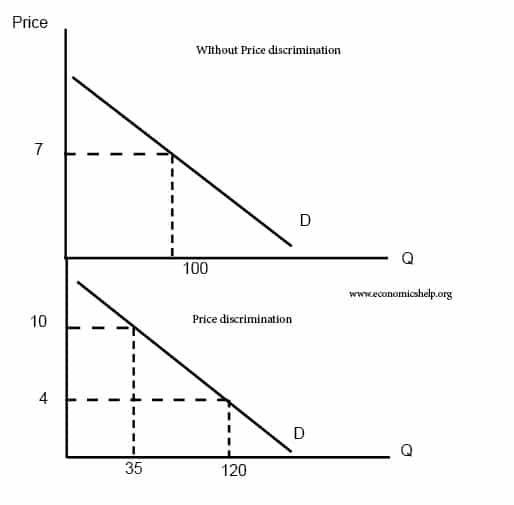
WIth price discrimination, the firm can charge two different prices:
- £10 * 35 = £350
- £4 * 120 = £480
Total revenue = £830. Therefore, the firm makes more revenue under price discrimination.
Profit maximisation under Price Discrimination
To maximise profits a firm sets output and price where MR=MC. If there are two sub markets with different elasticities of demand. The firm will increase profits by setting different prices depending upon the slope of the demand curve.
- Therefore for a group, such as adults, PED is inelastic – the price will be higher
- For groups like students, prices will be lower because their demand is elastic
Diagram of Price Discrimination
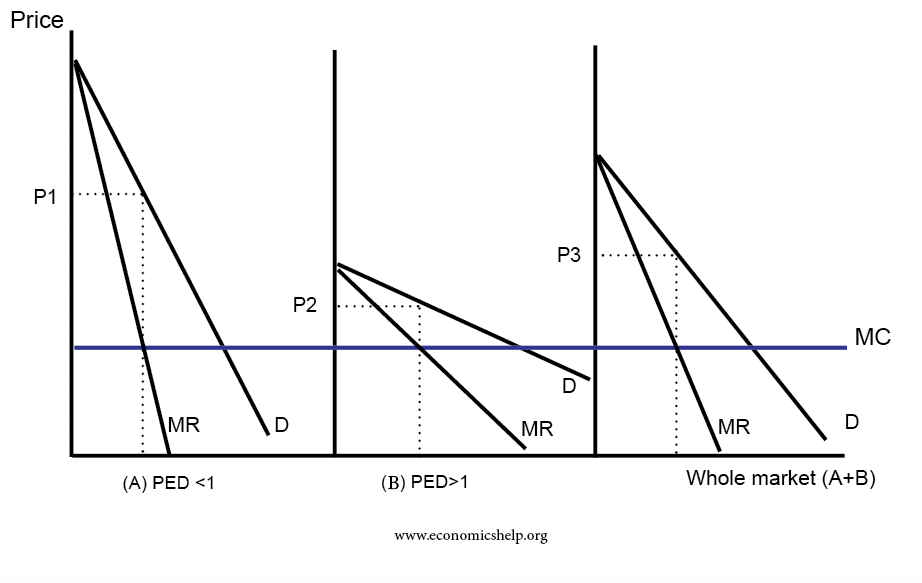
Profit is maximised where MR=MC. WIthout price discrimination, there would just be one price set for the whole market (A+B). There would be a price of P3.
- However, price discrimination allows the firm to set different prices for segment A (inelastic demand) and segment B (elastic demand)
- Because demand is price inelastic, segment (A) will have a higher profit maximising price (P1)
- In segment (B) demand is price elastic, so the profit maximising price is lower.
Advantages of price discrimination
Firms will be able to increase revenue. Price discrimination will enable some firms to stay in business who otherwise would have made a loss. For example price discrimination is important for train companies who offer different prices for peak and off-peak. Without price discrimination, they may go out of business or be unable to provide off-peak services.
Increased investment. These increased revenues can be used for research and development which benefit consumers
Lower prices for some. Some consumers will benefit from lower fares. For example, old people benefit from lower train companies; old people are more likely to be poor. Also, customers willing to spend time in researching ‘special offers’ and travelling at awkward times will be rewarded with lower prices.
- Manages demand. Airlines can use price discrimination to encourage people to travel at unpopular times (early in the morning) This helps avoid over-crowding and helps to spread out demand.
Disadvantages of Price Discrimination
Higher prices for some. Under price discrimination, some consumers will end up paying higher prices (e.g. people who have to travel at busy times). These higher prices are likely to be allocatively inefficient because P > MC.
Decline in consumer surplus. Price discrimination enables a transfer of money from consumers to firms – contributing to increased inequality.
Potentially unfair. Those who pay higher prices may not be the poorest. For example, adults paying full price could be unemployed, senior citizens can be very well off.
Administration costs. There will be administration costs in separating the markets, which could lead to higher prices.
Predatory pricing. Profits from price discrimination could be used to finance predatory pricing.
Importance of marginal cost in price discrimination
In markets where the marginal cost of an extra passenger is very low, the firm has an incentive to use price discrimination to sell all the tickets. This is why sometimes prices for airlines can be very low just before their date. Once the company is due to fly the MC of an extra passenger will be very low. Therefore this justifies selling the remaining tickets at a low price.
Examples of price discrimination
- Student discounts on trains
- Discounts for buying train tickets in advance
- Discounts for travelling at off-peak time
- Lower unit cost price for buying high quantity.
- Phone deals which give 100 texts free.
- Initially, units of electricity are set at one tariff, but for higher quantity, price is lower.
Does price discrimination help the consumer?

Benefits and disadvantages of price discrimination
Related