Economic growth increases real incomes, real output and real expenditure. It is often sold as the solution to our economic problems, but it also has many real costs to the environment, congestion and may fail to solve problems if inequality increases.

The Growth Illusion
If British politicians got a pound for everytime they talked about economic growth, UK Finances would be in a lot better shape. Whether Tory or Labour, we are told we need economic growth, we must have economic growth and it seems nearly everything must be sacrificied on the alter of economic growth. Build houses, new runways, deregulate city finances, anything so long as we get higher GDP. Where did this obsession with economic growth and is it justified?
There was a great BBC sitcom – the Good Life. The basic premise Tom Good had a dispiriting, boring job, making useless plastic toys to put in cereal packets. Disillusioned with the 9-5 grind, he gave up his job to become self-sufficient, growing vegetables and looking after chickens in his Surbiton back garden. Suddenly life had meaning, joy and fulfilment, but from the perspective of economic growth statistics, it was a disaster. Income fell, consumption fell, spending on the daily commute fell. If everyone lived the good life, it would cause the biggest recession in history. What this shows though, is that high GDP numbers are not necessarily related to living standards. You can increase growth, by making people work longer hours, delaying retirement age. But, is life any better? In a very limited sense, I live the good life, growing most of my fruit and veg in the summer months, I couldn’t do it with a proper job.
But, it’s one thing to make a personal decision to step out of the rat race, it’s another thing to impose it on other people. The thing about the Good life is that it is all very well to throw away your job, but don’t forget, the plan did require a very large house in Surbiton with very large garden. The good life is much easier if you have the wealth to support it. Most people don’t have wealth, and that is why many young are forced to take on second jobs to be able to afford extortionate rents.
This is one of the tragedies of modern societies. We are often forced into the rat race of working long hours, because such a high share of income goes on rent. Research suggests that for much of the past millennium, English households spent a higher share of their income on beer than they did on rent. Something has changed drastically. Economic growth which leads to rising housing costs, is the kind of growth that isn’t helpful. The economic pie may be getting bigger, but it will mean owners of assets gain a bigger share and those on the fringes can actually be worse off.
Why Growth is important

Since 1900, economic growth has led to an increase in living standards.
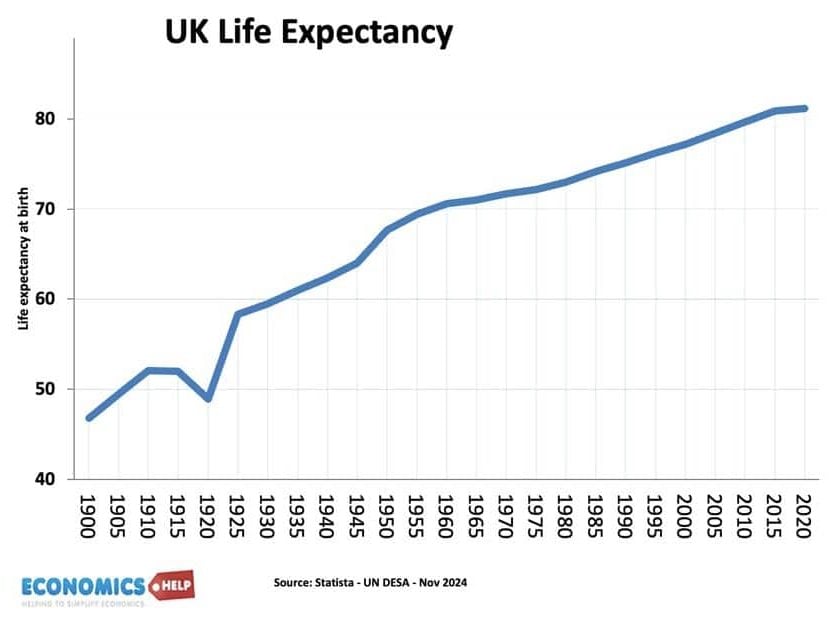
It has also corresponded with an increase in life-expectancy. Higher growth enables more spending on health care, food and welfare state.
Short-run problems of zero growth

But, why are our politicians obsessed with growth? In short economic growth means higher output and income and with that comes higher tax revenue. Generally, economic growth enables politicians to do nice things like spend money on health and pensions and cut taxes or at least not increase taxes as much as before. So for a politician seeking re-election, economic growth does have some important political benefits. When growth is close to zero, like the past 15 years, bad things tend to happen, we haven’t got enough money to spend on hospitals, waiting lists rise and then the government have to increase taxes anyway. If you want to improve many issues like backlogs at court, poor education, waiting lists, and economic growth make your job easier.
Life is better
Go back 125 years and the quality of life was really pretty rubbish, malnourised children, low wages and life expectancy of 45. Since then economic growth has played an important role in improving living standards and increasing life expectancy. Inequality is still with us, but if you’re made unemployed or sick, at least you aren’t thrown into the workhouse.
In a very broad, sense economic growth through technological improvements has improved quality of life for all people. If you fundamentally opposed to all forms of economic growth, it’s not very fair for the millions still iving on less than $2 a day. Economic growth in China and India may have drawbacks, but you can’t deny it has helped millions escape that cycle of real, absolute poverty.
Not all growth is equal
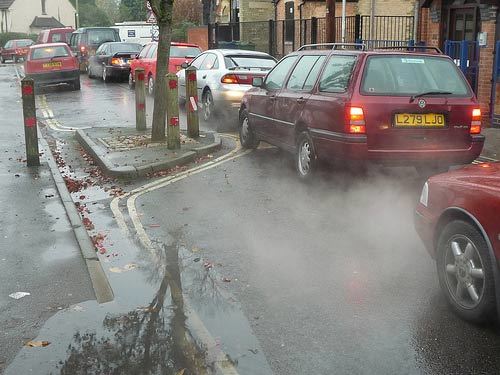
Yet, before we get carried away with economic growth, it’s worth bearing in mind not all growth is equal. Rapid economic growth in China led to a surge in people buying cars, people can now commuter further to work. The result is a huge surge in traffic congestion and pollution. This is economic growth, but it comes with real downsides for quality of life. Burning petrol stuck in a traffic jam is increasing GDP, but you are wasting your time and breathing in toxic fumes. For all the economic growth in London, average traffic speeds in London are pretty much the same as the time of the horse and cart. In fact, we spend more time commuting than ever before. However, if technology allows you to work from home, you save both money and time on transport and time, which could be used more productively – as long as you don’t get distracted watching YouTube videos.

UK has seen falling CO2 emission per capita since 1990
If modern technology, enables you to put a solar panel on your roof, then this consumption is going to save money in the long term, reduce emissions and generally improve quality of life. You can say it is a costless form of growth. The good thing about recent economic growth is that we have broken the link between growth and emissions. It used to be economic growth that led to more pollution. But, new technologies means that growth is now consistent with falling pollution rather than rising. This is a double win – higher growth and less pollution, and hopefully better health in the long-term. But, there are many other areas worth examining, has economic growth led to better food and health? If so why are we getting new diseases of affluence like obesity and heart disease? Big pharma and big food multinationals, often prioritise profits at the expense of long-term health.
Consume more
One aspect of a modern capitalist economy is the subtle pressures to consume more. We are bombarded with advertisements for something we never knew we needed. Go into DIY store and you can’t work out how you managed without a five in one cleaner. There’s always something more to buy. This consumption drives growth, but is it necessary or helpful?
Another feature of modern capitalism is the built-in obsolescence of many devices. Buy a phone or computer, and there is a distinct time frame, before you are either encouraged or forced to upgrade. Any problem with a device, and it is generally cheaper to throw it away and buy the latest model. This is all great for consumption and economic growth, but in a way we are spending money to kind of standstill; growth is an illusion. OK, phones have more features than 10 years ago, but there is increasingly diminishing returns. When I visited my grandma’s house in the 1980s, a feature that stood out is that most of the things in her house and been there for 50 years, since she bought it. Things were made to last, and if they broke, they were fixed and repaired. So what would happen, if individuals held back from this kind of conspicuous consumption and ever greater materialism, would government finances collapse and we all end up in a recession?
No, it wouldn’t, this idea that we need to keep buying more stuff, is misleading, if people cut back consumption 10-20%, it would just enable resources to be redirected to more socially useful activities. Perhaps paying for social care, leisure or education. Suppose more Tom Goods, walked away from useless jobs designing plastic toys for cereal packets or advertising, cereals would just be cheaper, perhaps we would have more money to buy organic veg from local producers.
Zero Growth?
So does that mean the government should adopt a zero growth strategy? It’s complicated. If you did aim for zero growth, on its own the people most affected would be the poorest, those who rely on government social programmes and government social investment. At the moment, degrowth is generally a luxury for highly educated and those with some degree of wealth. However, what is worth bearing in mind, is that some forms of economic growth can have so many external costs, that the increase in living standards is meaningless. Growth per se is not a bad thing, especially if it comes from better technology and work practises, but it’s also not the holy grail. And if your boss demands you do overtime at the weekend, tell him sorry you have to go down to the allotment to plant your leeks, he’ll understand one day.
Alternatives to maximising growth
- Wellbeing economy – prioritises health, happiness and life satisfaction rather than GDP.
- Green economy – focuses on environmental sustainability and lower emissions instead of higher output.
- Inclusive economy – aims to reduce inequality and raise living standards for the poorest, not maximise total growth.
Related posts
About The Author
