
Definition of ceiling prices – When there is a limit placed on the increase of prices in a market. The government may do this for basic items which are considered a necessity. It can also avoid price gauging when firms have monopoly power.
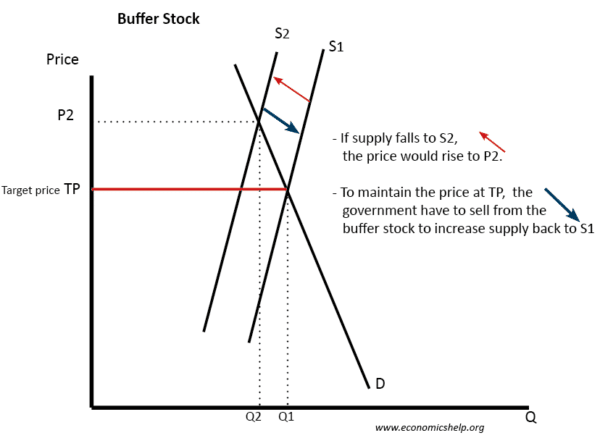
In a buffer stock scheme, governments attempt to reduce price volatility. Therefore, ceiling prices may be placed for certain goods; this prevents the price of food rising too rapidly. If the supply falls to S2, then the government would sell from its buffer stock to keep prices at the top range of the target price
Without the release of stocks into the market, ceiling prices are likely to lead to a shortage, waiting lists and black markets.
Maximum price
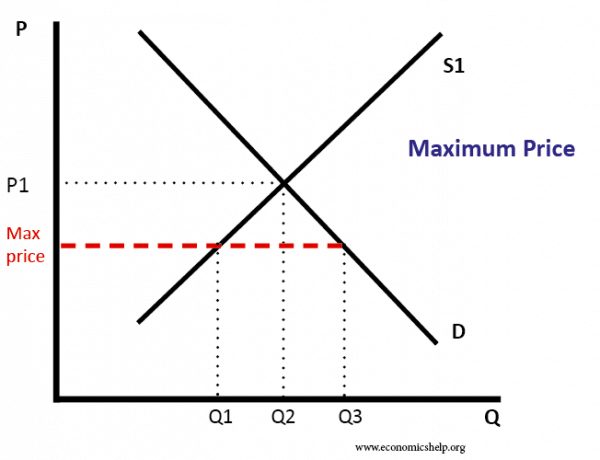
In this example, there is a maximum ceiling price of Max Price. This is lower than the market equilibrium of P1.
With the ceiling of Max price, it leads to a shortage (demand greater than supply)
Price ceilings on rent
It is often argued we should have price ceilings on rent.
- Housing is an important basic commodity
- Landlords have a degree of monopoly power
- Supply is quite inelastic
However, if we put a maximum price on rents, it could lead to a shortage and waiting list to get housing

This can be the problem with price-ceilings, it distorts the market. To be effective, price ceilings really need to be combined with increasing supply, but with lower prices the private sector is unlikely to want to do, so we need government efforts.

Ceiling prices in regulated monopolies
If a firm has a monopoly, then in a free market it can charge higher prices than in a competitive market. Governments may regulate how much prices can rise. For example, local governments may set the price taxis charge. Government regulators may set price limits for monopoly utilities like water and gas.
Related concepts
About The Author
