
Capitalism is an economic system based on free markets and limited government intervention. Proponents argue that capitalism is the most efficient economic system, enabling improved living standards. However, despite its ubiquity, many economists criticise aspects of capitalism and point out is many flaws and problems. In short, capitalism can cause – inequality, market failure, damage to the environment, short-termism, excess materialism and boom and bust economic cycles.
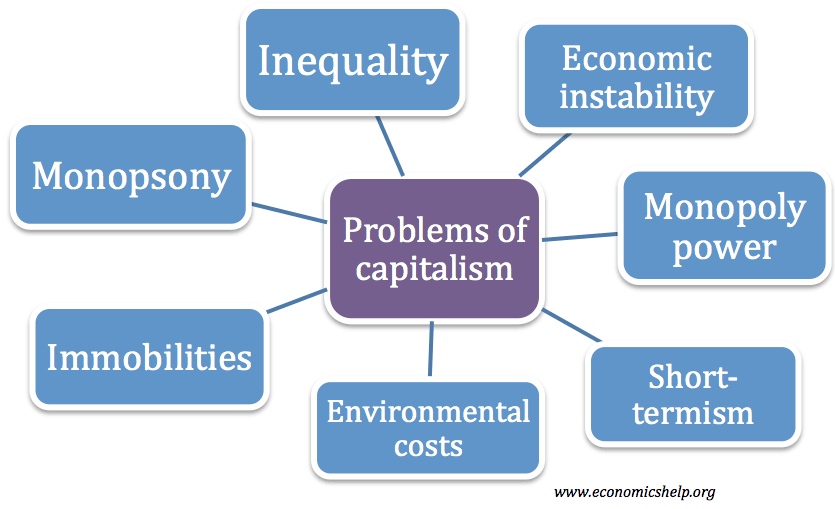
Problems of Capitalism
1. Inequality
 Top 1% of wealth own 35% of wealth. Bottom 50% about 1%
The benefits of capitalism are rarely equitably distributed. Wealth tends to accrue to a small % of the population. This means that demand for luxury goods is often limited to a small % of the workforce. The nature of capitalism can cause this inequality to keep increasing. This occurs for a few reasons
- Inherited wealth. Capitalists can pass on their assets to their children. Therefore, capitalism doesn’t cause equality of opportunity, but those born in privilege are much more likely to do well because of better education, upbringing and inherited wealth.
- Interest from assets. If capitalists are able to purchase assets – bonds, house prices, shares, they gain interest, rent and dividends. They can use these proceeds to buy more assets and wealth – creating a wealth multiplier effect. Those without wealth get left behind and may see house prices rise faster than inflation.
- The economist Thomas Piketty wrote an influential book Capital in the Twenty-First Century, which emphasised this element of capitalism to increase inequality. As a general rule, Picketty argues wealth grows faster than economic output. He uses expression r > g (where r is the rate of return to wealth and g is the economic growth rate.)
2. Financial instability/economic cycle
Capitalism relies on financial markets – shares, bonds and money markets but financial markets have a tendency to cause booms and busts. In a boom period, lending and confidence rise, but frequently markets get carried away by ‘irrational exuberance‘ causing assets to the spike in value. But, this boom can quickly turn to a crash when market sentiment changes. These market crashes can cause economic downturns, recession and unemployment. At various times, capitalism has suffered prolonged recessions (the 1930s), periods of mass unemployment and a decline in living standards.
3. Monopoly Power
In a free market, successful firms can gain monopoly power. This enables them to charge higher prices to consumers. Supporters of capitalism argue only capitalism enables economic freedom. But, the freedom of a monopoly can be abused and consumers lose out because they have no choice. For example, in industries like tap water or electricity supply, which are a natural monopoly, consumers have no alternative but to pay the prices charged by consumers. In the Nineteenth Century, monopolies like Standard Oil bought our rivals (often with unfair competitive practices) and then became very profitable.
4. Monopsony
Monopsony is market power in employing factors of production. For example, firms can have monopsony power in employing workers and paying lower wages. This enables firms to be more profitable but can mean workers don’t share from the same level of proceeds as the owners of capital. It explains why with increasing monopsony power we have seen periods of stagnant real wage growth while firms profitability has increased (2007-17 in UK and US)
5. Immobilities
In a free market, factors of production are supposed to be able to easily move from an unprofitable sector to a new profitable industry. However, in practice, this is much more difficult. E.g. a farmworker who is made unemployed cannot just fly off to a big city and find a new job. He has geographical ties to his birthplace; he may not have the right skills for the job. Therefore, in capitalist societies, we often see long periods of structural unemployment.
6. Environmental costs and externalities
In capitalist economies, there is limited government intervention and reliance on free markets. However, market forces ignore external costs and external benefits. Therefore, we may get over-production and over-consumption of goods that cause harmful effects to third parties. This can lead to serious economic costs – pollution, global warming, acid rain, loss of rare species; external costs that damage future generations.
7. Encourages greed/materialism. The nature of capitalism is to reward profit. The capitalist system can create incentives for managers to pursue profit over decisions which would maximise social welfare. For example, firms are using theories of price discrimination to charge higher prices to consumers who want to jump the queue. This makes sense from the perspective of maximising profit. However, if we have a society, where the rich can pay to jump a queue at a Fairground – or pay to see Congressman quicker – it erodes social norms and a sense of ‘fair-play’
The pursuit of the profit motive has encouraged some law firms to aggressively pursue litigation claims. This has created a society where we devote resources to protecting ourselves from being sued. Further reading – “Moral Limits of Markets” by Michael Sanders
See also:
- Capitalism v Socialism
- Advantages of capitalism
- Types of capitalism
- Economics – The Dismal Science
- Why Has US Inequality Increased Since 1980?
About The Author

I guess that “monetary policy” caused the “roaring twenties” and the “great depression”, huh?
Solutions to the alledged problems of Capitalism (hint at why Capitalism is morally good and the alternatives morally evil).
1. Inequality – bad solution is equality. Everywhere and at every time that necessarily means equally unable to exercise one’s individual rights. So equally unable to save and invest capital. So equally impoverished.
2. Boon and bust – not a feature of Capitalism. Government interference picks winners and losers – suppressing price information. (good solution is purer Capitalism)
3. Monopoly power – bad solution – all efforts to produce are granted monopoly powers (e.g. too big to fail), made outright monopolies, or nationalized.
4. Monopsony – bad solution – successful companies that create value are throttled. Less value created, government choice of winners and losers distorts the market (creating misinformation that leads to losses for the masses), fewer employees, and denying the masses their first choice when spending their hard earned dollars.
5. Immobilities – bad soluiton – don’t allow progress. Total oppression of any individual who could improve the lives of millions, and well, robbing the masses of innovations that would improve their lives (over and over and over again and so on). The base idea is that farmers shouldn’t even have shovels – more people would be employed digging with their hands. Which is itself wishful thinking – there would just be far fewer people (mass starvation).
6. External costs – bad solution – see #1 and #5 for the ‘just say no to everything’ solution, and #3 for the ‘gulag anyone who asks questions about the national effort to whatever’ solution.
7. Greed – greed is irrelevant, either someone or a group of folks know how to create value, and do, or the value isn’t created (lack of greed, don’t know how, tried but didn’t profit, etc.). As for jumping the queue, access to a politician has nothing to do with Capitalism (pure Capitalism means the politician has no sway). Jumping the queue for a private business? Bad solution – throttle any and all innovation. For example, a life saving medicine. If it’s possible to sell the early doses at massively high prices to the rich (low volume x high price), we can afford to start mass producing (high volume x low price). If it’s not possible, it’s too risky to do it – first they need the money as capital, and second early adopters are always important in going to market.
And the bad solutions I’ve outlined are *always* the solutions implemented. The base delusion is that taking capital away from businesses, or taking some measure of control of it, or seizing it outright, won’t disrupt the flow of goods and services to the masses. The base moral corruption is that it’s okay to make slaves of productive individuals. Anyone who sanctions or champions the reduction or elimination of Capitalism – and achieves it – will wake up one day either shocked to discover they were on the productive side of the equation, or that it’s much harder to live off of the efforts of the *formerly* productive.
The United States is not a purely capitalist economy. It’s a mixed economy. Yes most business are held by private entities and able to make decisions as they see fit, but there is the government sector of the economy which would include weapons and defense contracts, infrastructure, social safety nets and much more than I’m obviously forgetting. The government shouldn’t be playing police by bailing out “too big to fail companies” and if the choice is made to do so there should be a “restructuring” of that business that is failing that is going to tank the economy. The best rule is to cut once, and cut deep. Anyone who holds a board position or has 3-4 letters after their name need to go. It made me sick to see the bail outs that we taxpayers have to payback while the COO’s, CEO’s, and CFO’s gift themselves a huge bonus. I’d much prefer to let the market crash out for a while and let them reap what they have planted. I would almost guarantee this would send shockwaves of ice up and down the spines of these companies who practices are devious and manipulative. Like selling AAA guaranteed loans that were a steaming pile and they knew it as to appear legitimately a great opportunity. To fix our problems that do occur yes, we need a trustworthy sector of government to break up monopolies which are few and far. We also need school choice, it’s a capitalistic model which would make school throw out 1619 and replace critical theory with reading, writing, arithmetic, and 1776. Teach economics in every grade level and how loans, simple interest, spending habits hurt/help, supply chain, distribution and how to build credit. Teach the kids the importance of food, diet, exercise, and how it sets the tone for their life. Teach kids to think logically versus having to memorize and repeat. Make it mandatory that all state and federal funded schooling be required to a set number of hours and participate in a service/community service to graduate to the next grade. Our educational system should t cut off the tall grass to make everyone “equal” by challenging the advanced with outside the box opportunities to grow. Bust up the school unions so we can flush the tenured turds posing as educators. I know this was the long route but this is where it starts otherwise we will be paying an idiocracy tax for the burden of those who just didn’t try or didn’t want to try.
“Capitalism” is unethical. ANY system with “capital” rather than decency and morality at the center is clearly wrong. I can’t believe that we are still having this discussion, as we rush toward the 6th great extinction event, thanks in large part to individual greed, the jewel in the crown of the “free market”. If we continue in deliberate ignorance and evil, we deserve everything we have coming…it’s not ALL capitalism, to be sure. We’ve had slavery, feudalism, monarchy- ALL exploitation of the many by the few, including the exploitation of the planet and every other species on it.