Readers Question: What is meant by monetary and fiscal policy?
Monetary Policy vs Fiscal Policy

Monetary Policy
Controlled by: Central Bank (e.g. Bank of England)
Main tools:
- Interest rates
- Quantitative easing / tightening
Main objectives:
- Control inflation 2% target
- Stabilise the business cycle
- Maintain financial stability
Speed: Relatively quick to implement
Limitations: Banks may not cut lending rates, savers worse off from interest rate cut.
Fiscal Policy
Controlled by: Government / Treasury
Main tools:
- Government spending / Taxation
- Budget deficits or surpluses
Main objectives:
- Boost demand in recessions
- Fund public services
- Reduce inflation if necessary
Speed: Slower (political decision-making)
Limitations: Higher debt, time lags, political constraints
Definition – monetary and fiscal policy
- Monetary policy is managed by the Bank of England. They have a target to control inflation (CPI = 2% +/-1) and also consider economic growth. The Bank of England use interest rates and influencing the money supply to implement this policy.- Monetary Policy
- Fiscal policy is the attempt to influence the level of economic activity through changing taxation and government spending. Fiscal policy influences the level of government borrowing. – More on Fiscal Policy
Shared Objectives of Fiscal and Monetary policy
- Low inflation CPI = 2%
- Strong economic growth, but, not inflationary growth.
- Reduce unemployment.
- Maintain sustainable public finances in the long-term.
Monetary policy in UK

In the UK, interest rates used to be set by the chancellor, but in 1997 the Bank of England was given independence to set interest rates. The government only set the inflation target of 2% inflation. You can see in the graph above, that the Bank of England have not always succeeded in keeping inflation close to the 2% inflation target. In 2022, they were caught out by the post-covid inflation surge (partly due to rising oil prices)
Setting interest rates
- If the MPC predict inflation will rise above the inflation target then they will increase interest rates.
- Higher interest rates increase the cost of borrowing and reduce disposable incomes.
- Higher interest rates increase the return from saving, encouraging saving rather than spending
- This reduce demand, prevents the economy growing too fast and reduces inflation
If economic growth is sluggish and inflation low, then interest rates can be cut, lower interest rates should help to boost economic growth.
See – How Bank of England set interest rates
QE and monetary policy

In exceptional circumstances, the Bank of England may use unconventional monetary policy. For example, between 2009 and 2021, low-interest rates were insufficient to restore normal levels of economic growth, therefore the Bank of England pursued quantitative easing – a policy which involved increasing the money supply and buying government bonds. The aim of QE is
- Reduce bond yields and other interest rates in the economy
- Increase money supply and increase bank lending.
Fiscal Policy in UK
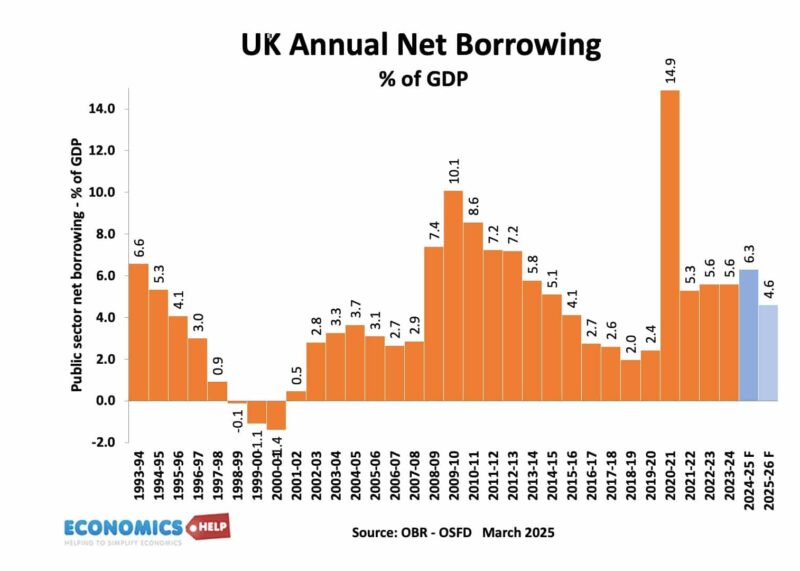
Fiscal policy is not often used to manage demand in the economy. In theory, the government could use fiscal policy to moderate economic cycle, but there are political difficulties to changing tax rates just to reduce inflationary pressures. The government tend to leave inflation management to monetary policy and the Bank of England.
However, automatic fiscal stabilisers play a role in moderating the economic cycle – in a recession, the government automatically receives lower tax revenue and spends more on unemployment benefits.
Fiscal Policy in a recession
Also, in exceptional circumstances, the government may pursue expansionary fiscal policy. For example, in 2009, the government cut the rate of VAT to try and stimulate economic activity in the period of deep recession. It caused borrowing to rise to over 10% of GDP. But, by increasing disposable income it helped maintain demand in the economy.
This level of public borrowing helped to provide an economic stimulus to a depressed economy, but there was a high political cost to the level of government borrowing. A rising deficit was a factor in the Labour government losing the 2010 election and the Conservatives winning – promising to follow a policy of austerity and cutting government spending.
In a recession, the government can increase AD, by increasing government spending and cutting taxes. Lower taxes increase disposable income. This helps increase economic growth and reduce unemployment.
Problems of Fiscal policy
- Expansionary fiscal policy leads to higher debt and potentially higher inflation.
- It can be easy to cut taxes to stimulate economy, but then hard to put them up again when economy is growing.
- Time lags. It takes time for government to increase spending
- Increased government spending may lead to inefficient use of resources, if government doesn’t have good use of funds, e.g. high cost of HS2, suggested some government failure.
Liz Truss Fiscal Disaster
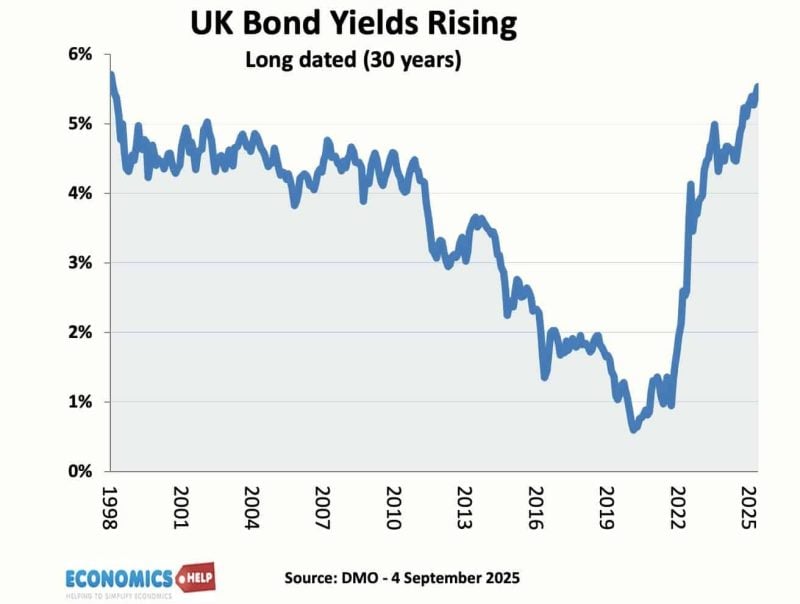
Bond yields can be a constraint on government borrowing
In 2022 Liz Truss and Kwasi Kwarteng introduced a mini budget with large scale tax cuts. However, inflation was already at 10%, and so markets assumed this fiscal stimulus would lead to higher inflation and higher interest rates. Also, the scale of extra borrowing made markets worried about fiscal sustainability, so bond yields rose.
Related
- Evaluation of Monetary Policy in controlling inflation
- Monetary v Fiscal Policy
- Criticisms of fiscal policy
About The Author

Cool advice! I have already been seeking something like this for a while now. Thx!
thank you!!!