

It’s been another bad week for the UK economy, with UK bond yields rising to the highest level for 30 years. Not only that but the Pound has had a bumpy ride. A falling Pound and higher yields are a toxic combination, just ask Mrs Truss. And this comes on the back of several years of very low growth, and growing concern over a doom loop of rising debt, higher tax and lower growth.

This graph shows that since 2009, the UK economy has virtually stopped growing. It means that incomes have stagnated, tax revenues disappointed, and living standards often fallen. This has contributed to a lot of economic problems.
Yet, whilst incomes and growth stagnates, housing costs have risen meaning people feel worse off.
If you want to paint a picture of the UK economy on the brink of collapse, you can easily point to widespread pessimism and grim economic data. But is the UK really facing an economic meltdown or is it just a self-reinforcing cycle of bad news and persistent panic about the next tax rise, fiscal black hole and government u-turn?
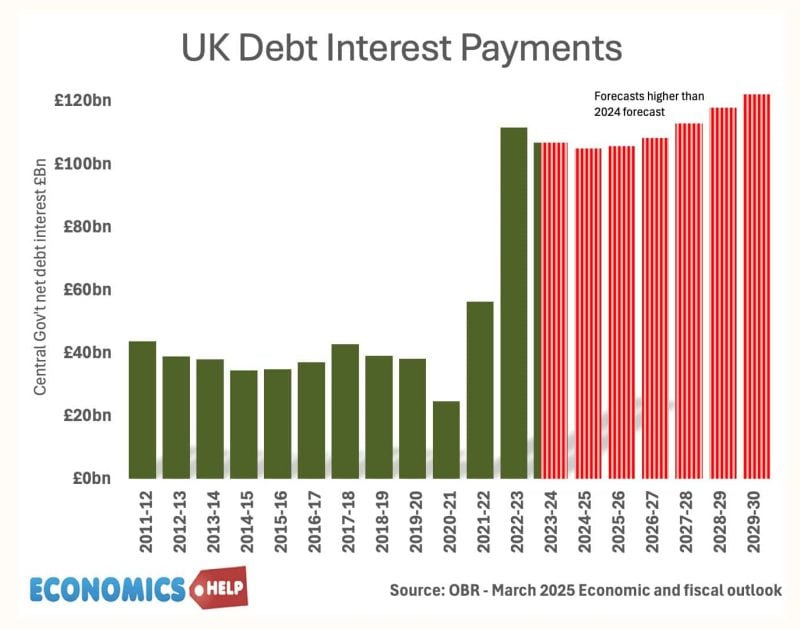
Whatever the long-term forecast, there is no doubt that the rise in bond yields is a major headache. It makes borrowing more expensive, and as debt rises and bond yields continue to go up, interest payments will only continue to rise. When you spend a higher share of GDP on debt interest payments, you need to raise tax just to meet the debt interest payments. And we will see there are some factors which are likely to push up yields even more.

The problem is that markets have been pretty negative about the UK ever since Liz Truss’ mini budget of 2022. The unfunded tax cuts and market reaction caused bond yields to rise above those of comparable countries. But even after the removal of Liz Truss and the reversal of her policies, there was little improvement in market sentiment. It means that any bad UK news is pounced on by the market as a warning sign.

Despite Germany’s own fiscal problems, the gap between UK and German bond yields has risen in the past few years. The UK has the one highest borrowing costs amongst advanced economies, so what do the markets dislike about the UK economy?

Firstly, the long-term debt situation of the economy is grim. OBR forecasts rising debt as a share of GDP. To prevent this kind of surge in debt requires quite severe spending cuts, serious tax rises or a miracle in terms of higher economic growth. But markets are not impressed by recent, very limited efforts to constrain spending, followed by U-turns and a sense of no direction. In an age of populism, no political party are really in the mood to point out the unwelcome choices facing the UK economy. So higher bond yields do partly reflect the dismal outlook for finances and the likelihood that low growth and political constraints will mean the outlook continues to deteriorate.

However, it would be a mistake to say the UK is at risk of default, at least at the moment. This shows the credit default swap rate for government debt. A higher figure indicates markets think government default is more likely. So Turkey and South Africa are in trouble. But, the UK has one of the lowest credit default swap rates in the world. There is no problem selling UK gilts, it is just very expensive. By the way, the US has seen a sharp rise in its credit default swap rates in recent months.

In the short term, higher bond yields reflect the fact that the UK really stands out for being an outlier in terms of higher inflation. 3.8%, is roughly double that of Germany and the Euro Area. This high inflation does not represent a booming economy, far from it. More of stagnation, with an uptick in unemployment, giving the worst of both worlds.
National Debt

At this point, you might ask, why worry about UK debt of 100% of GDP, when we’ve had debt of 240% of GDP in the past? It is hardly a sign of imminent collapse; we’ve survived a lot worse in the past. But, whilst this is always worth bearing in mind, there are important differences to that golden age of the post-war period. Debt fell in the post-war period because of strong economic growth, but with an ageing population, low confidence, numerous shocks and falling labour participation, per capita growth has largely eluded the UK. The result is rising government spending on pensions, health care and benefits, but tax revenues are stagnant.

The outlook is grim. To plug the shortfall, the government is raising taxes which reduces growth , increase inflation and create a new cycle of higher borrowing, which pushes up bond yields.
Pound
The fall in the Pound this week is particularly concerning because the UK is becoming increasingly reliant on foreign buyers of UK gilts. A big factor in rising bond yields is the fact that UK pension funds are reducing their exposure to UK gilts. In the past, pension funds largely committed to defined payouts, making gilts attractive, but pension funds are switching to contribution-based pensions which prefer higher risk equities; the result is a big drop off in demand for long-term gilts. This decline is forecast to continue for decades to come. It means the UK will rely more on overseas buyers. But relying on overseas holders has two big drawbacks. Government debt around the world is rising, and bond yields are rising even in past safe havens like US and Japan. There will be a lot of competition to attract foreign buyers, that means higher bond yields in the future to attract foreign buyers. The second problem of relying on foreign buyers is that the value of the Pound becomes more influential.
If the pound were to crash, overseas buyers will sell UK bonds, potentially creating a sovereign debt crisis as you can’t finance the debt from domestic buyers. If you look at real economic crises, it is usually a combination of high debt and falling currency that is the toxic combination.

Now it is true that this week, the pound had a bad day, but if we zoom out, the Pound has actually strengthened this year. Why would the Pound rise when the economy is doing badly? Well, ironically, because inflation is high, interest rates are higher than elsewhere, and this makes saving in the UK relatively more attractive at least in the short term. So you could argue the Pound’s strength is misleading. What does the future hold for the Pound? Firstly, relatively high inflation is bad news as it will make the UK less competitive. It’s not just one off shocks, the UK has seen things like rising electricity prices to the most expensive in Europe, hurting manufacturing in particular. Evidence of poor competitiveness is also evident in the UK’s current account deficit which is wider than most major competitors except the US. This current account deficit requires capital inflows to finance it. But, will the UK be able to continue to attract capital inflows? With low growth, low business investment and higher stamp duty on housing, the UK is not particularly attractive. Using the Big Mac index, the Pound is 13.5% overvalued compared to the US dollar. But, the major long-term fear for the Pound is whether the UK economy can recover from its current state of high inflation, economic stagnation and rising debt.
Other Countries Struggling
But, if you predict the imminent collapse of the Pound, you might well ask who the Pound will collapse against? On some metrics, the UK isn’t an outlier; debt is higher in several European countries like France and Italy. The French government is teetering once again over how to reduce its debt. The US government’s unorthodox embrace of tariffs and attacking Fed independence is causing the dollar to fall from favour. The US has seen the biggest slowdown in economic growth this year and has a much higher budget deficit than the UK. The Eurozone has low inflation, but with growth similar to the UK. The point is the problems of the UK in terms of low growth, ageing population and high debt are not unique.

Also, if you wanted to paint a more optimistic picture of the UK you could point to some factors. The exceptional high inflation is partly a result of rising utility bills, higher tax, which should in theory be one-off factors. With low growth and a weakening labour market, inflation should fall in autumn quite sharply. Although a cynic may say the Bank of England have been forecasting this fall in inflation for quite a long-time. Other positive factors include some signs of economic growth, even if weak. The UK equity market is severely undervalued and has actually received a boost in capital flows from the US. Certainly, if you’re looking for a bargain, Britain is relatively cheap these days.
Improve Situation
Also, there are some factors that could help improve the situation. Moving to one forecast per year rather than two would reduce the constant speculation of tax rises. The Bank of England which have been the most aggressive Central Bank in selling bonds accumulated during QE could also halt the process of quantitative tightening. Also better co-ordination of fiscal and monetary policy to avoid tax-induced inflation
However, I wouldn’t be too quick to dismiss the more doomster forecasts.
The deterioration over the past two decades has made the UK much more vulnerable to a global economic shock. Markets haven’t really reflected or priced in the big changes we are seeing in the US economy and the future of the dollar. According to USB, the likelihood of a US recession has increased to 93%. Should the US pull the rest of the world into an economic slowdown, it would really magnify the pressures on the UK economy. The past 10 years, show that black swan events seem to be really quite common these days. Also, it is more than just data; the past 20 years have seen real cracks in British institutions, and British policy and a general feeling of malaise. A rise in waiting lists, potholes in the road, railways incredibly expensive to build, energy not keeping up with demand. And it seems that the cumbersome state of the UK government is struggling to address these issues. Managed decline could increasingly spiral in the wrong direction. So even if no imminent crisis, the relative decline of the economy is a real cause for concern.
About The Author

Lions lead by aspiring middle class Donkeys
UK over extended , good indicator is the gold price , Everybody & their dog buying gold .
Energy prices highest on the planet , Record numbers of unemployed .
Immigrants flooding into the country aided by the border force who ate supposed to keep them out .
Parliament is a just another bun fight while . MPs/ ministers on APPX £200,000 salary & expenses then given a £3000 cost of living rise .
They also are filling their pockets with millions of tax payers money, with their VIP fast track procument , I sight Baroness Mone and co all off shore & that’s only one .
Government sliding the public down the road into a Mad Max dystopian world of the haves & the have nots .
No police on the streets , Shop lifting not a crime anymore , Prisons over flowing .
Old school men saw this coming from a long way off .
Home security adds on the TV by the gross 🤢
Lots of people going self employed & we are not talking legit. NHS on the brink as is the DWP .
THERE IS A STORM COMING !