Readers Question: What are the advantages and disadvantages of the WTO formally the GATT?
Advantages and Disadvantages of the WTO
World Trade Organization – global rules for international trade
Advantages
- Lower trade barriers – reduced tariffs and quotas
- Rules-based system – predictable and transparent trade
- Dispute settlement – reduces risk of trade wars
- Economic growth – efficiency and productivity gains
- Protects small countries from trade bullying
Disadvantages
- Loss of policy freedom – limits tariffs and subsidies
- Unequal gains – richer nations benefit more
- Job losses in import-competing industries
- Weak labour & environmental rules
- Slow decision-making and stalled negotiations
restrict national policy choices and distribute gains unevenly.

The WTO is a body designed to promote free trade through organizing trade negotiations and act as an independent arbiter in settling trade disputes. To some extent the WTO has been successful in promoting greater free trade. The principles of the WTO are
- Promote free trade through the gradual reduction of tariffs
- Provide legal framework for negotiation of trade disputes. This aims to provide greater stability and predictability in trade.
- Trade without discrimination – avoiding preferential trade agreements.
- WTO is not a completely free trade body. It allows tariffs and trade restrictions under certain conditions, e.g. protection against ‘dumping’ of cheap surplus goods.
- WTO is committed to protecting fair competition. There are rules on subsidies, dumping
Advantages of promoting free trade
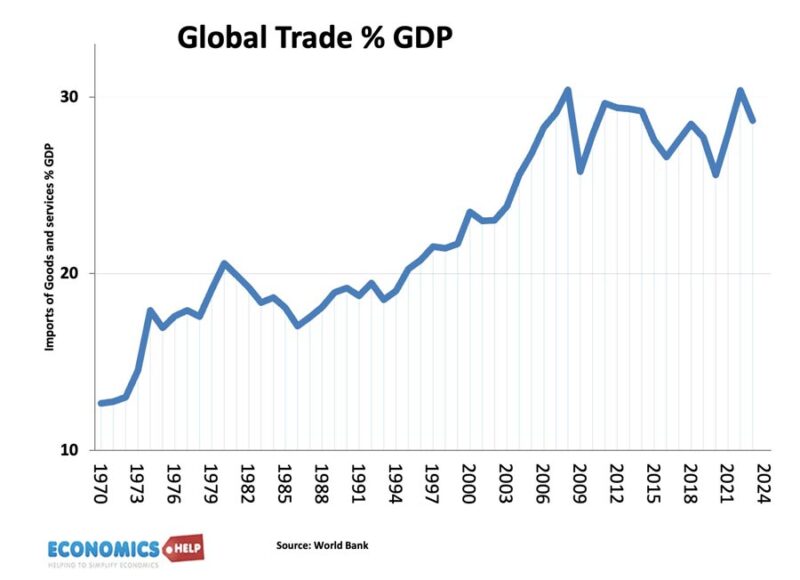
Global trade has increased as a share of GDP
- Lower prices for consumers. Removing tariffs enables us to buy cheaper imports. Cheaper imports leads to higher disposable income and greater spending on services, benefiting domestic service industries. Also, helps to keep inflation low
- Rules-Based Trading System Common rules reduce uncertainty for firms and investors. This prevents (in theory) arbitrary protectionism and should help small countries who lack political clout to negotiate.
- Dispute Settlement Mechanism The WTO Provides a legal process to resolve trade conflicts – Reduces risk of trade wars, Encourages compliance through authorised retaliation
- Free trade encourages greater competitiveness. Through free trade, firms face a higher incentive to cut costs. For example, a domestic monopoly may now face competition from foreign firms.
- The law of comparative advantage states that free trade will enable an increase in economic welfare. This is because countries can specialise in producing goods where they have a lower opportunity cost.
- Economies of scale. By encouraging free trade, firms can specialise and produce a higher quantity. This enables more economies of scale, which is important for industries with high fixed costs, such as car and aeroplane manufacture. In new trade theory, it is this specialisation and exploitation of economies of scale that is most important factor in improving economic welfare. See also: Advantages of Free Trade
Successes of WTO
To what extent has the WTO been able to promote free trade?
- The WTO has over 160 members representing 98 per cent of world trade. Over 20 countries are seeking to join the WTO.
- An increased number of trade disputes have been brought to the WTO, showing the WTO is a forum for helping to solve disputes.
- WTO regulations and co-operation helped avoid a major trade war; this was significant during 2008/09 global recession. We could compare this to the 1930s, where trade wars broke out causing a fall in global trade. According to (Bagwell and Staiger 2002) the average tariff in 1930s was 50%. In 2000s, average tariff is 9% (VOX)
- According to Ralph Ossa, “WTO success: No trade agreement but no trade war”VOX.eu 11 June 2015. The value of WTO in preventing trade wars could be estimated at up to $340 billion per year.
Disadvantages of WTO
- Loss of National Policy Autonomy WTO limits use of: tariffs, industrial policy, subsidies
- Structural Unemployment from deindustrialization. WTO encouraged free trade, this led to shift of manufacturing to China, causing deindustrialization and job losses in US/Europe.
- Unfavourable for some developing countries. the WTO has often been criticised for trade rules which are still unfavourable towards developing countries. Many developed countries went through a period of tariff protection; this enabled them to protect new, emerging domestic industries. Ha Joon Chang argues WTO trade rules are like ‘pulling away the ladder they used themselves to climb up’ (Kicking away the ladder at Amazon)
- Infant industry argument Free trade may prevent developing economies from developing their infant industries. For example, if a developing economy was trying to diversify their economy to develop a new manufacturing industry, they may be unable to do it without some tariff protection.
- WTO undermined by new trade deals/tariffs. WTO is being overshadowed by new TIPP trade deals. These deals are negotiated away from the WTO and focuses mainly on US and EU. It excludes China, Russia, India, Brazil and South Africa. It threatens to diminish the global importance of WTO
- Difficulty of making progress. WTO trade deals have been quite difficult to form a consensus. Various rounds have taken many years to slowly progress. It results in countries seeking alternatives such as TIPP or local bilateral deals.
- Protectionism WTO trade deals still encompass a lot of protectionism in areas like agriculture. Protectionist tariffs which primarily benefit richer nations, such as the EU and US.
- Patent protection WTO has implemented strong defense of TRIPs ‘Trade Related Intellectual Property’ rights These allow firms to implement patents and copyrights. In areas, such as life-saving drugs, it has raised the price and made it less affordable for developing countries.
“Pharma companies [such as Moderna and Pfizer] didn’t even create a lot of the intellectual property that went into the COVID vaccines,” Ghosh told Al Jazeera. “They simply bought the patents and limited the supply, creating an artificial supply and raising the price.” (Tariff Wars)
- Multi-national favouritism. WTO has rules which favour multinationals. For example, ‘most favoured nation’ principle means countries should trade without discrimination. This has advantages but can mean developing countires cannot give preference to local contractors, but may have to choose foreign multinationals, whatever their history in repatriation of profit, investment in area.
Evaluation
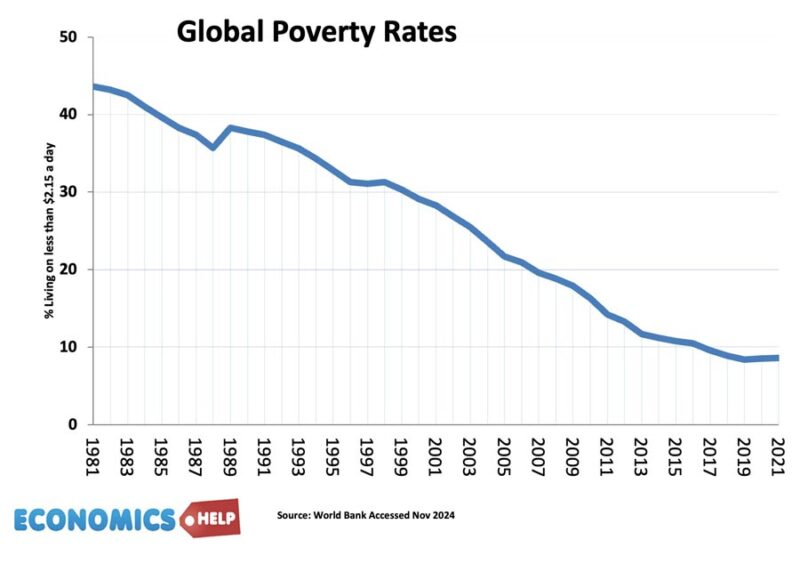
- In response to this the WTO may say that free trade has been an important engine of growth for developing countries in Asia. Although there may be some short term pain, it is worth it in the long run.
- Also the WTO has sought to give exemptions for developing countries, enabling in principle the idea that developing countries should be allowed to limit imports more than developed countries.
Global Imbalances since China Joined WTO

Trump and WTO
“The most beautiful word in the dictionary is tariff,”
– Donald Trump (2024)
Trump’s tariffs (from 2018 onwards) were largely unilateral, imposed on steel, aluminium and especially Chinese imports without waiting for WTO rulings. The US justified many of these tariffs using national security or unfair trade arguments, but critics argue this bypassed WTO procedures.
At the same time, the US blocked appointments to the WTO’s appeals body, weakening enforcement. Supporters claimed the tariffs protected US industries and pressured China to reform; critics argue they undermined the WTO, raised costs for consumers and firms, and encouraged a shift away from global free-trade rules toward protectionism.
Related topics
About The Author
