
The gold standard is a monetary system where a country’s currency is directly linked to gold. Each unit of money represents a fixed quantity of gold, and people (or foreign governments) can convert paper money into gold at that fixed rate.
For example, in 1717, the United Kingdom fixed £1 to 113 grains (7.32 g) of fine gold. The money supply is effectively tied to how much gold the country holds.
How the Gold Standard Worked

- Fixed gold price – The government sets a fixed price of gold in terms of currency.
- Convertibility – Currency can be exchanged for gold on demand.
- Automatic discipline – Money supply expands or contracts based on gold inflows and outflows.
- Fixed exchange rates – Countries on the gold standard have stable exchange rates with each other.
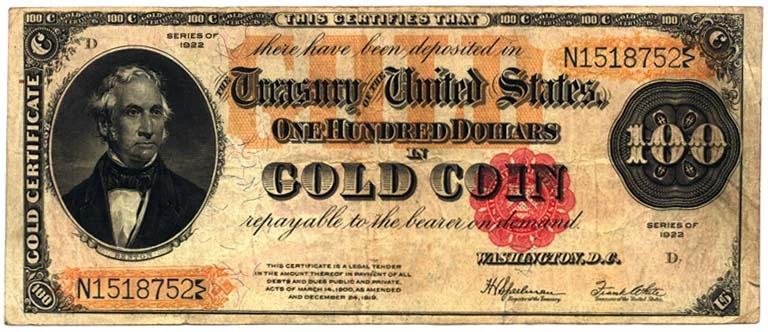
A Gold certificate from 1922, which you could convert into gold coins. Gold certificates were used as paper currency
Why Use Gold Standard?
- In the early days of money, gold coins were used to pay for goods. The money had intrinsic value. Cut a gold coin in half and you had two pieces half its value.
- With a rise in the volume of goods and services produced there was a need for notes and coins. The gold standard was a way to fix the value of money by allowing them to be converted into a certain amount of gold. This gave people faith in the new ‘paper money’.
- In 1717, United Kingdom fixed £1 to 113 grains (7.32 g) of fine gold. The official US gold price was $20.67 per troy ounce.
- Throughout the nineteenth and early twentieth centuries, other countries also adopted the gold standard. They set their currency at a certain level against gold. Exchange rates were very stable and only moved after an agreed adjustment.
- American Express could print travellers’ cheques and say exactly how much foreign currency it would buy.
Advantage of Gold Standard
- Price Stability. The advantage of the gold standard is that the amount of gold was relatively stable. It means that governments couldn’t print money and create inflation. It also created confidence in the financial system.
- Stable Exchange Rates. The gold standard also creates stability in exchange rates. This creates greater certainty for international trade. Also, exporters know they can’t rely on devaluation to improve competitiveness, encouraging firms to cut costs and increase efficiency.
- Credibility & confidence Gold-backed money tends to inspire trust, especially during periods of weak institutions. The Gold Standard limited the government’s ability to print money and run persistent budget deficits.
Disadvantages of the Gold Standard
1. No flexibility in recessions. Governments and central banks could not easily increase the money supply during downturns. This was devastating in the early 1930s, when unemployment soared, but governments in the Gold Standard were hampered by keeping monetary and fiscal policy relatively tight
2. Deflationary bias
If the economy grows faster than the gold supply, prices tend to fall, increasing real debt burdens and reducing the ability of firms to invest and households to spend. Deflation was very damaging to the UK economy in the 1920s. And deflation was very damaging to the US in the 1930s.
3. Depends on gold supply. Gold discoveries (or shortages) can cause economic instability unrelated to real economic needs.
4. Encouraged a credit bubble in US. Whilst the gold standard caused deflation in the UK. The US was struggling to keep the dollar sufficiently low. To help the UK pound, in the 1920s, the US ran a relatively loose monetary policy – low interest rates to keep the dollar weaker than its natural level. But this loose monetary policy and low interest rates were a factor in causing an economic and credit bubble in the 1920s. This led to a boom in share prices and the pre-crash boom.
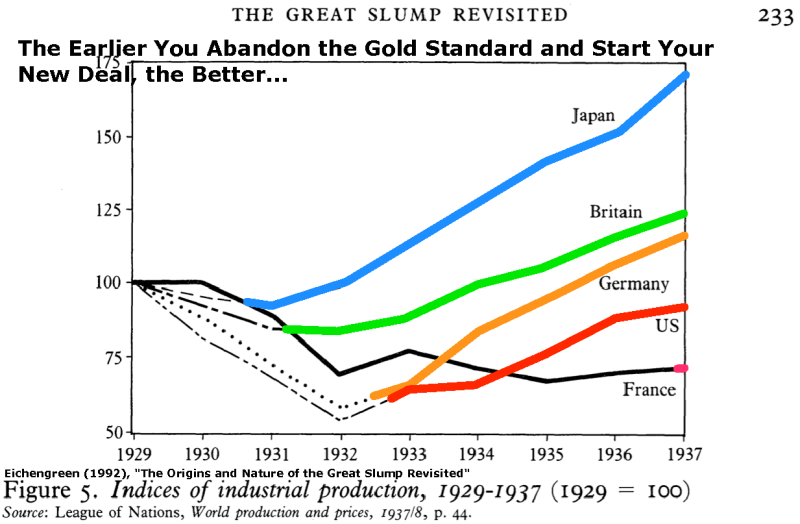
Source: JSTOR
This shows that leaving the Gold standard was helpful for enabling economic recovery from the depression. Japan and the UK were the first countries to leave, and they recovered first. The US and France were slow to leave and suffered longest recession.
- 5. Speculative Attacks on Currency Fixed exchange rates can encourage speculative attacks on the currency. (e.g. it was argued that the US was forced to raise interest rates in the Great depression to protect the value of the currency)

In 1931, US increased interest rates to 3.5% – despite the depth of the great depression and the fact, prices were falling by around 9% in 1931. This means real interest rates were very high (12.5%)
The Breakdown of the Gold Standard
- In the First World War, the costs of the war were so great that countries abandoned the gold standard so they could print more money and pay for the war. This led to inflation which persisted after the war.
- Defeated axis powers like Germany, Hungary and Austria couldn’t pay their reparations (denominated in gold). Due to broken institutions and economic weakness they never fully rejoined the gold standard.
- The UK (under Winston Churchill as Chancellor of Exchequer in 1925) rejoined the gold standard at a rate that was too high £1 = $4.85. The UK economy had suffered during the First World War and the attempt to maintain the £ at the pre-war rate caused UK exports to be overvalued and necessitated high interest rates. In the 1920s, partly because of the gold standard, the UK experienced deflation and a prolonged period of high unemployment (even before the Great Depression) Keynes was very critical of the decision:
“In truth, the gold standard is already a barbarous relic.”
-Monetary Reform (1924), p. 172
- On the other hand, the US dollar was undervalued, this contributed to a boom in US economy which led to the credit bubble and stock market crash of 1929.
- In the 1930s, the Great Depression caused many to leave the gold standards and allow their exchange rate to devalue. The UK left in 1931.
UK in Gold Standard
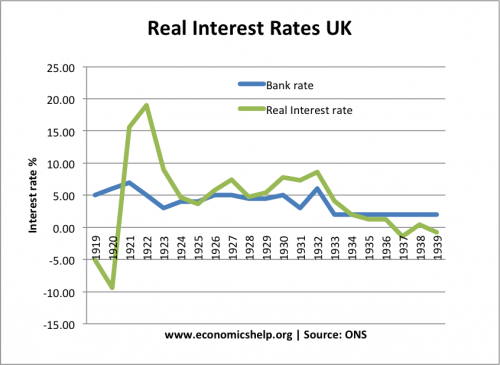
The Gold Standard led to problems for the UK manufacturing sector:
- Firstly, exports were uncompetitive, leading to lower demand, less employment and slower economic growth.
- Secondly, high real interest rates led to further deflationary pressure and lower economic growth
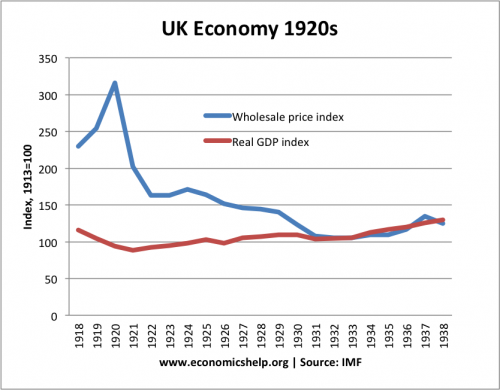
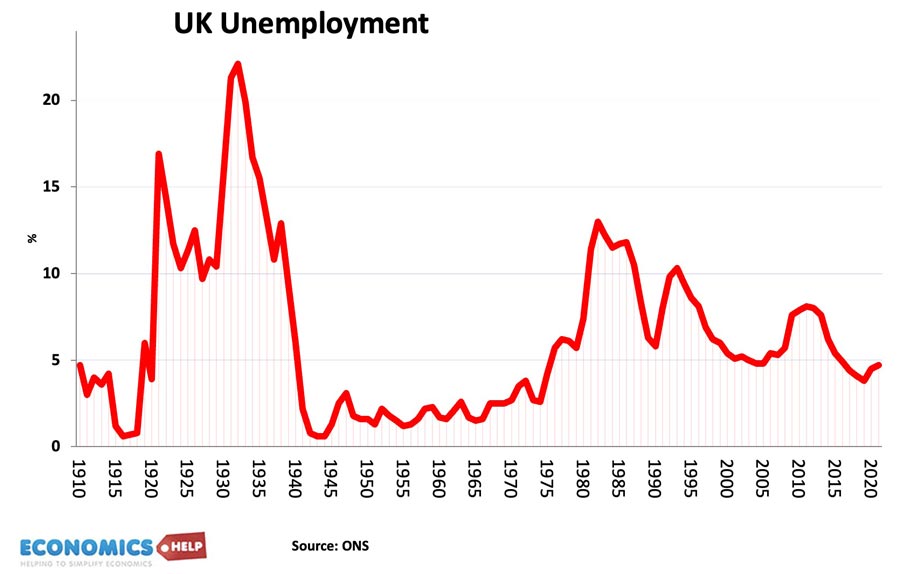
- UK unemployment was high in the 1920s, even before the great depression.
- See also: UK Economy in the 1920s
Should we rejoin Gold Standard?

When the UK was in the Gold Standard, inflation was low. In fact, you could argue in 1920s and 30s, it was too low.
Some Austrian economists argue we should rejoin the gold standard to protect against inflation and the power of Central banks to inflate away debt which benefits governments and those with debts but destroys the income of savers.
- Ludwig von Mises – Argued gold restrains inflationary finance.
- Friedrich Hayek – Criticised discretionary monetary policy and supported monetary competition.
- Ron Paul – modern day ‘libertarian’ argue some form of Gold Standard would limit governments ability to create money and inflation.
What happened to the gold price in the Gold Standard?

Under the gold standard, the nominal price of gold was fixed, but changes in the price level caused the real value of gold to fluctuate, producing long-run stability but short-run deflationary and inflationary pressures.
- The real price of gold rose 1929-24 because of severe deflation in the US.
- Since gold convertibility was abandoned in 1971, the real price of gold has risen and become more volatile.
Bretton Woods – Post-War Managed Exchange Rates
- After the Second World War, Britain had depleted its gold reserves in paying for the war, a return to the gold standard was not practical.
- However, to guard against the inflationary potential of floating exchange rates and Central Banks with the power to print money, the Bretton Woods system was set up.
- This was a fixed exchange rate system where countries pegged their currency to the dollar and the US fixed the price of gold at $35.
- Bretton Woods broke down in the 1970s.
Related
About The Author
