
If the Central Bank increases interest rates, the textbook assumption is that higher interest rates
- Increase the cost of borrowing. This leads to lower investment, lower consumption
- Increase the returns from savings. This leads to lower consumption
- Appreciation in the exchange rate, increasing export prices, leading to fall in demand for exports.
The net effect is a fall in aggregate demand, lower economic growth and lower inflation.

However, in the real world, this simple transmission mechanism may fail to work or at the very least have very significant time delays. And in particular, a few changes mean that higher interest rates are less effective in reducing inflation than in the past.
Evaluation Points
1. Cost-push inflation
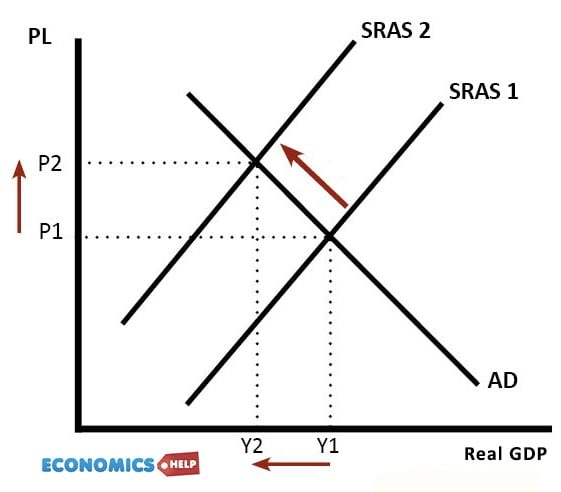
Suppose inflation is caused by rising oil prices. It causes SRAS to shift to the left, this is a real headache for the Central Bank. Because they face higher inflation and lower growth at the same time. What do they do? Prioritise inflation and increase interest rates or do the prioritise growth and keep interest rates low?
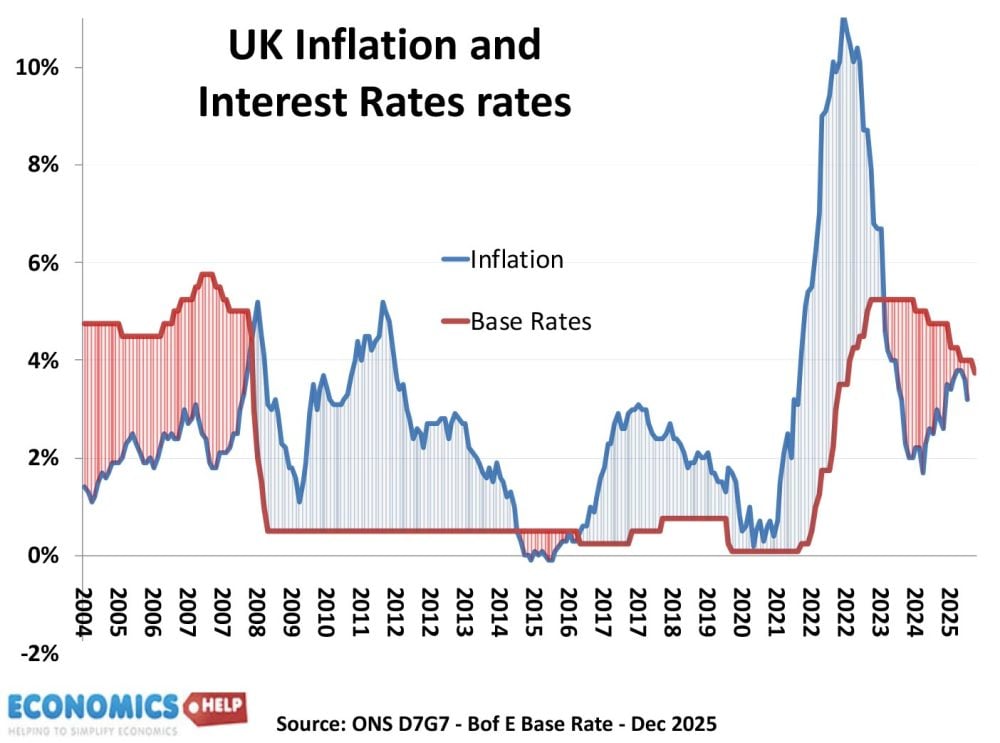
Many central banks faced this dilemma in 2022, when inflation rose above 10%, causing a fall in real wages and lower growth.
The problem is that higher interest rates might be effective in reducing demand-pull inflation (inflation caused by strong growth) but higher interest rates don’t reduce oil and gas prices; they don’t deal with supply constraints. So to get inflation at 2%, would require a massive reduction in demand and a deep recession. And Central Banks usually have a dual mandate – not just low inflation but growth too.
Therefore, the Central Bank have to really put up with a worse trade-off, at least in the short-term. Now, another view of this is that actually in 2022 the Central Bank were slow to react, and although there was cost-push inflation, there was also a problem of strong demand, resulting from the end of Covid, big QE in 2020. Therefore, the problem wasn’t necessarily cost-push inflation factors, but the Bank assuming inflation wasn’t a problem anymore and getting caught out by its return. One thing was clear, to make monetary policy work, you need good forecasts of future inflation and the output gap. Interest rates have time lags, so if your forecasts for inflation are all wrong, monetary policy becomes ineffective.
In fact, the UK had a few periods of cost-push inflation in 2008 and 2012, when the bank kept interest rates at 0.5%.
 Inflation not caused by strong growth, UK growth in 2025 very weak.
Even in 2025, the rise in UK inflation wasn’t due to the fact that growth was strong (growth was more anaemic), but a rise in utility bills, which are more due to cost-push factors, higher taxes, structural weakness in the energy sector, and problems of privatisation. The long-term solution is not monetary policy, but reform of labour and product market.
Decline in the number of variable mortgages
In the 1980s and 1990s more households had variable mortgages. But, these days only a small percentage of mortgages are variable. Therefore, if interest rates rise, there may be a time lag of 2 or 5 years before people notice more expensive mortgage payments. In the US, 30-year mortgage terms are more common, meaning interest rates have much less effect than before. Secondly, because of high house prices, there has been a decline in people buying new homes. Home ownership rates have fallen, more people now rent, and renters are less directly affected by interest rates than in the past.
Interest rate effect on increasing income

We have seen a rise in savings rates, especially amongst the ageing population. When interest rates rise, savers see an increase in interest income and may be more likely to actually spend or feel confident. So higher rates redistribute from borrowers (higher debt service) to savers (higher interest income). Because of the decline in mortgages and the rise in the saving ratio, increasing interest rates have less impact on reducing aggregate demand than in the past.
A big problem is that if the Central Bank wants to reduce inflation, it has to squeeze only a certain section of the economy – borrowers. To keep the economy from overheating, borrowers and mortgage payers will face a real tightening, but those with mortgage paid off and high savings will benefit from high interest rates and spend more. So it has become an unsatisfactory way to bring inflation under control
Interest rate effect on prices
A rise in interest rates can also be a cost-push factor itself. With higher interest rates, there is a rise in some mortgage payments, also rise in the cost of credit card debt. Therefore, at least in the short-term, some prices may rise as a result of higher interest payments, making it harder for the Bank of England to reduce inflation.
Exchange rate effect.
Higher interest rates should cause an appreciation in the exchange rate, making exports more expensive, leading to lower demand for exports, and weaker aggregate demand. However, demand for exports and imports tends to be quite inelastic. High export prices have limited effect in reducing inflationary pressures.
Related posts
About The Author
