
Labour productivity measures the output per worker in a period of time. Labour productivity is an important factor in determining the long-run trend rate of economic growth; tax revenues, inflation and real wages.
Since the start of the great recession in early 2008, UK labour productivity growth has remained very low – well below the historical average. (The ONS estimates 20% below its pre-crisis trend) The Royal Statistical Society (RSS) recently stated that the statistic that best “captures the spirit of some of the biggest issues of the last 10 years” is the annual productivity growth of 0.3% (compared to 2% pre-financial crisis)
Reasons for this ‘productivity puzzle’ include – more flexible labour markets, stagnant real wages, lack of investment, increase in part-time/temporary work, and international trends in technological development.
Recent UK Labour Productivity
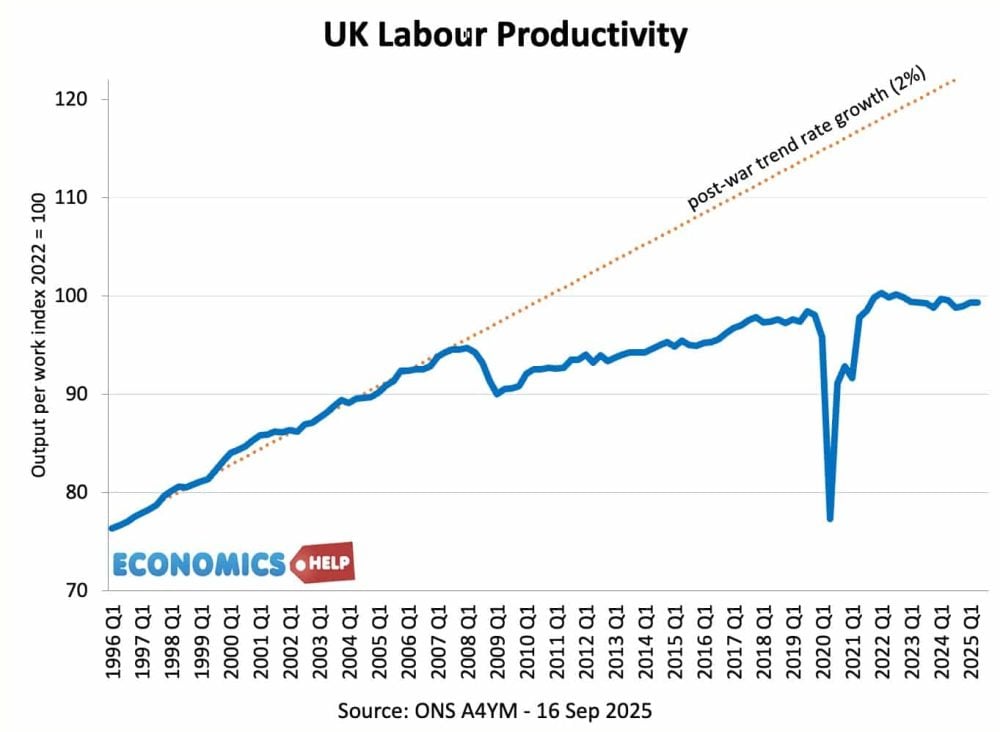
ONS Labour productivity – A4YN – Productivity index PRDY
Since the 2007 crisis, UK labour productivity has stagnated – falling well below its pre-crisis trend. This has had a serious impact on real earnings growth, prospects for future economic growth and tax revenues.
Annual growth in Productivity
In the post-war period, UK labour productivity growth averaged roughly 2-3% a year. However, since the start of the recession in 2008, UK labour productivity has increased by only 5% in the space of 13 years.
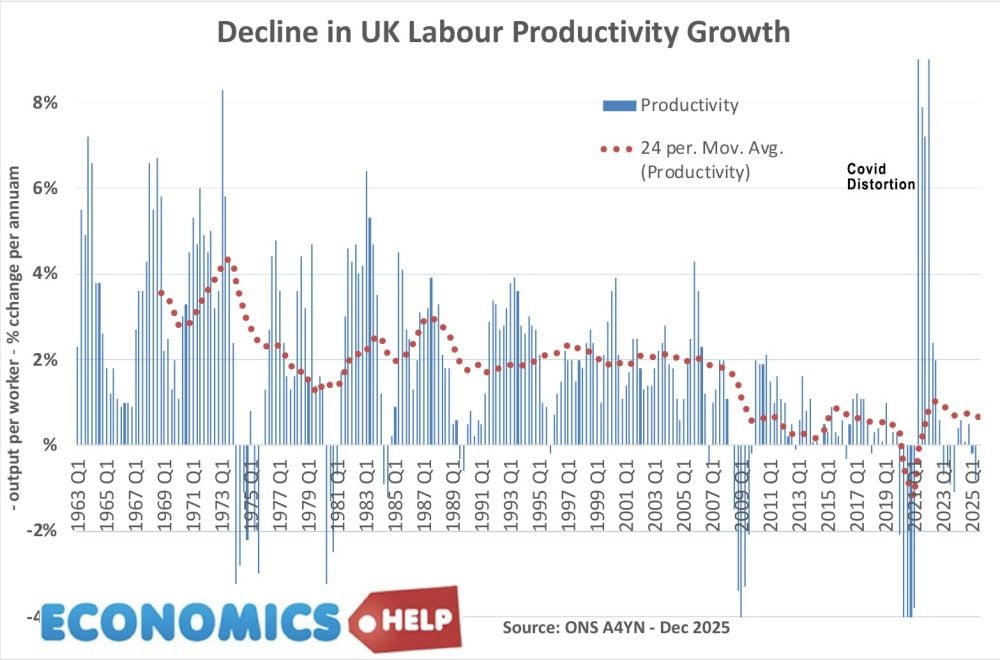
Unlike previous recessions, UK labour productivity growth has not bounced back when the recession ended. Productivity growth has struggled to remain positive. ONS – data: A4YM
Factors affecting labour productivity
- Skills and qualifications of workers. If workers become more skilled with relevant training, then this can increase labour productivity.
- Nature of employment. Temporary/part-time jobs may be subject to lower productivity than full-time work where firms have more confidence to invest in productivity. In recent years, the UK has seen a shift to more flexible labour markets.
- Morale of workers. In a period of industrial unrest and low worker morale, productivity is likely to fall. If workers are motivated and happy, productivity is likely to be higher. The morale of workers could be affected by wages, industrial relations, whether they feel they have a stake in the company, non-monetary benefits, e.g. do they enjoy the job?
- Technological progress. The implementation of new technology is one of the biggest factors in improving productivity. For example, the assembly line introduced from the 1920s made huge strides in productivity. In recent years, the development of microcomputers and the internet have also enabled improvements in productivity.
- Substitution of capital to labour. If labour becomes cheap and freely available, firms may have less incentive to spend money on capital and use labour-intensive methods rather than capital-intensive methods. Labour intensive processes are likely to have lower levels of productivity.
- Rules and regulations. If it is very hard to fire lazy workers, then productivity growth may be constrained. Though the absence of any labour market regulations could lead to high turnover and poor worker morale, which could also diminish labour productivity.
- Capacity utilisation. In a boom, firms may squeeze more output out of existing capacity by encouraging people to work overtime – this increases labour productivity. In a recession, firms may hold onto workers, rather than let them go – even if they are just working at 80% capacity – therefore labour productivity falls.
- Levels of investment. In the long-term, the level of investment in R&D, new technology and better working practices is very important for determining productivity growth.
What explains the fall in UK productivity growth?
Reasons put forward for the UK productivity puzzle include:
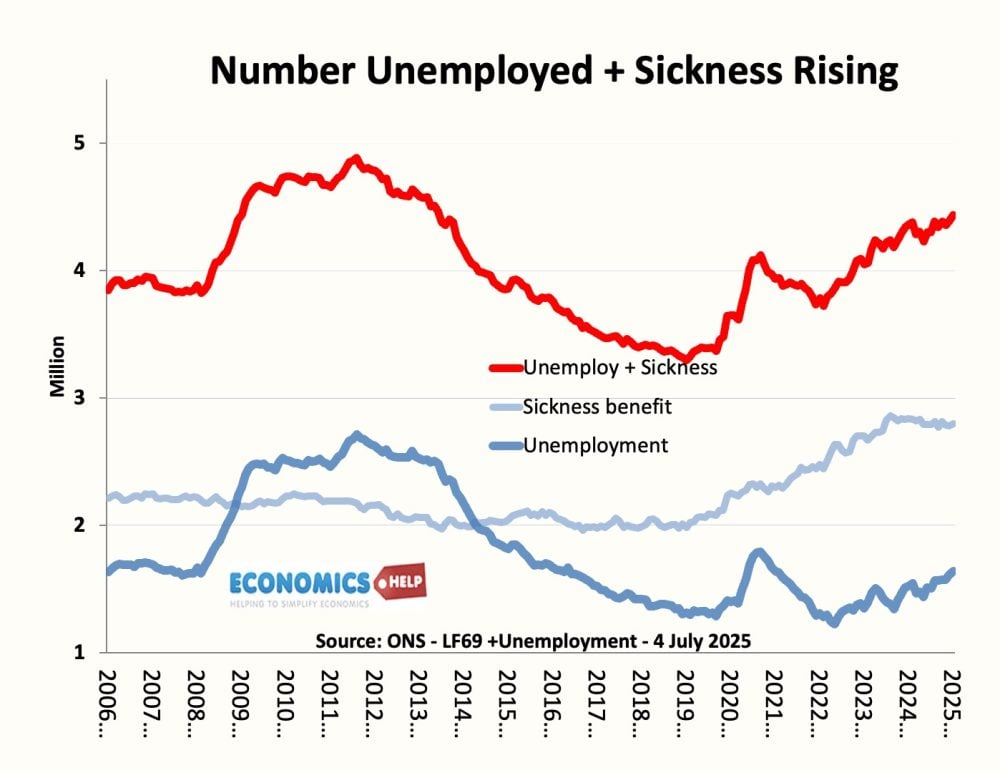
1. Labour hoarding. (When firms hold onto workers). Unemployment is relatively low since 2008, this could support the theory that firms are preferring to hang onto workers, despite lower demand. This depresses productivity. But, also, there has been a rise in long-term sickness which reduces labour supply
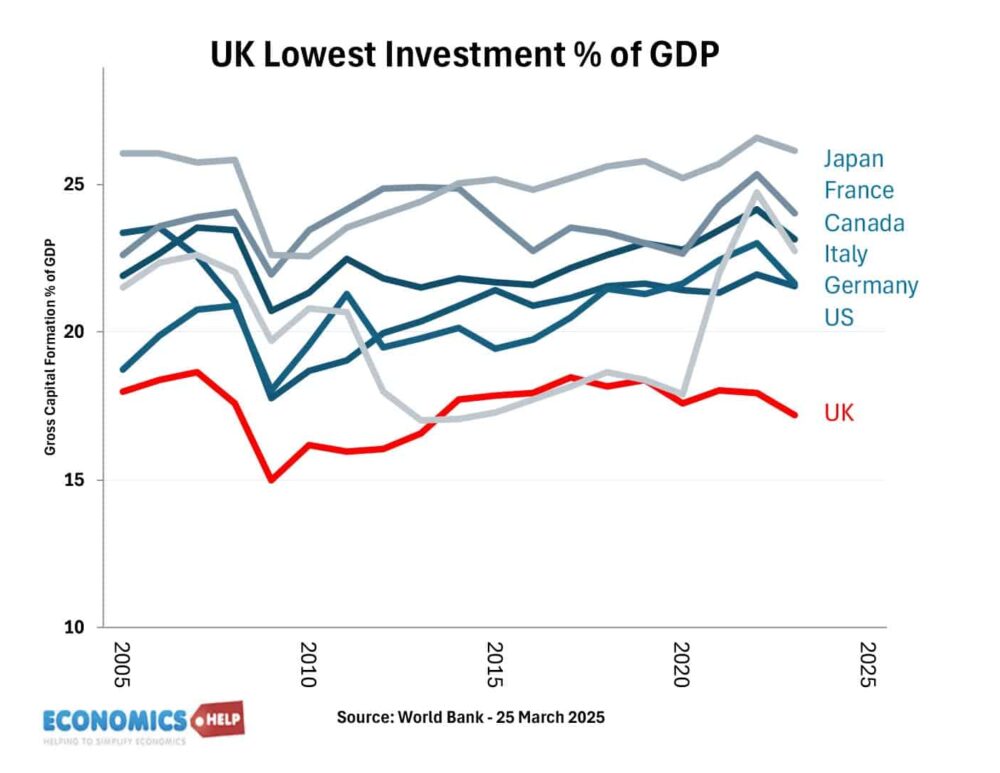
2. Low levels of investment. For a long-time the UK has experienced low levels of investment, crucial for boosting productivity in the long-term.
3. Falling real wages. During recent years, the UK has seen falls in real wage growth.
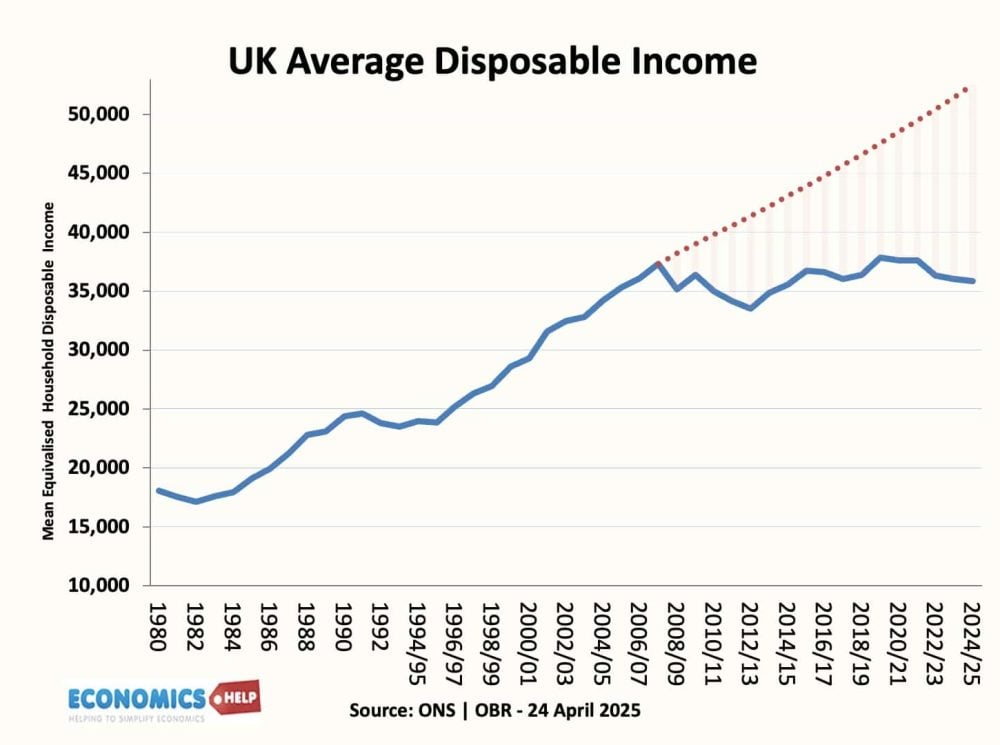
If real wages are lower (or stagnant), firms may be more willing to employ labour rather than capital. In other words, low wage growth means labour is relatively more attractive than usual. Therefore with lower labour costs, firms are willing to employ more workers and labour-intensive production methods. However, the national minimum wage has increased faster than inflation, meaning firms have faced higher costs for the minimum wage kind of jobs.
4. More flexible labour markets. In recent years, UK labour markets have become more flexible, with more part-time, temporary contracts (e.g. zero hour contracts) This has helped reduce the cost of labour to firms, and therefore, they are more willing to employ workers, without rising productivity.
5. Global fall in productivity
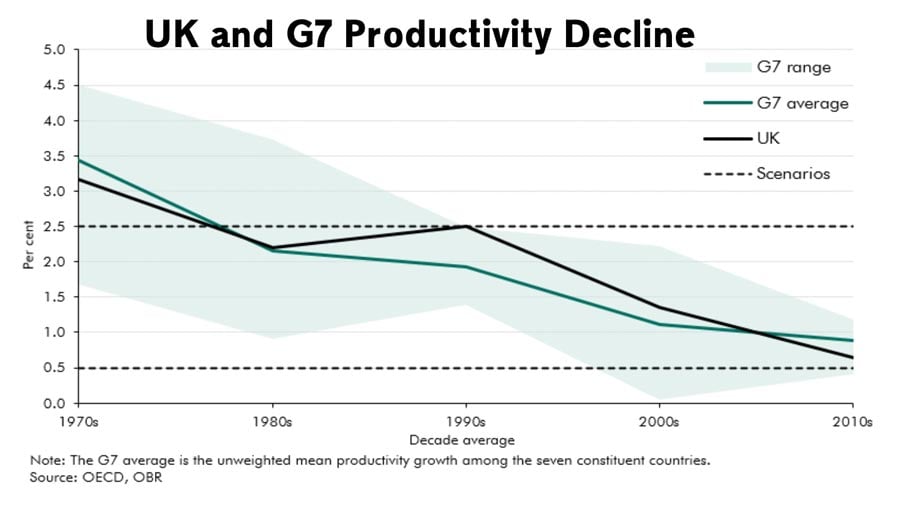
It’s not just UK with declining productivity. The graph above shows that labour productivity growth has also fallen in other Eurozone economies, suggesting there could be global issues with the growth of productivity and new technology.
6. Lack of major technological breakthrough In the past, the economy has attained major boosts to productivity through inventions such as the assembly line, electricity, containerisation, the microchip. The internet and automation has enabled some productivity gains, but the scope for big gains may prove less than less ‘glamorous’ attainments such as electricity or assembly lines. (Perhaps the internet is slowing down some labour productivity as we waste time on social media!)
7. Brexit uncertainty. Since 2016, UK productivity has performed worse than the Eurozone and OECD. Some economists argue this reflects the uncertainty over Brexit is reducing investment as firms wait to see the kind of deal people get.

Source: NIESR
8. Energy costs. The UK has seen a sharp growth in energy costs, which has proved particularly damaging for energy intensive industry. It has led to fall in industrial production, one area of an economy where technological improvements make it easier to see productivity gains.

The UK has been producing less electricity per capita since 2003, this partly reflects falling demand, though also the falling demand is due to high prices. (at least in industrial sector)
9. Growth in public sector, which has lower productivity

The whole economy has seen a 22% rise in productivity, but the public sector is notably lower, only a marginal improvement in productivity. This is a sharp contrast between the two sectors, but also at this time, government spending as a share of GDP has increased.

Since 1997, government spending has increased from around 36% of GDP towards 44% today. Tax revenues have gone up. Partly this reflects two big trends
- Ageing population – more spending on pensions
- More spending on health care – partly related to ageing population
But, the NHS and public sector in general typically gets lower productivity growth because of the Baumol cost disease – health care is labour intensive and it is harder to replace nurse and doctors with automation.
10. Housing Market
The housing market is both expensive, but also difficult to move. The UK has one of the slowest processes of buying a house. With high stamp duty it is also one of the most expensive. The rented sectors is also just as bad, with average rents in England reaching £1,399, with a big regional divide. This can make it difficult for firms to recruit workers in fast-growing areas like the Oxford-Cambridge corridor.
Implications of falling labour productivity
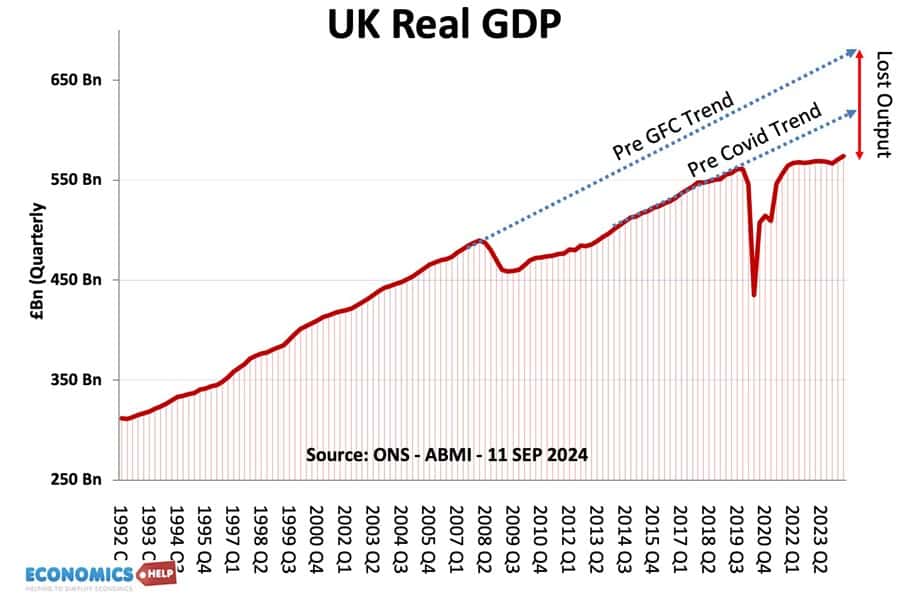
1. Lower output
The fall in labour productivity mirrors the fall in real GDP.
2. Lower wages
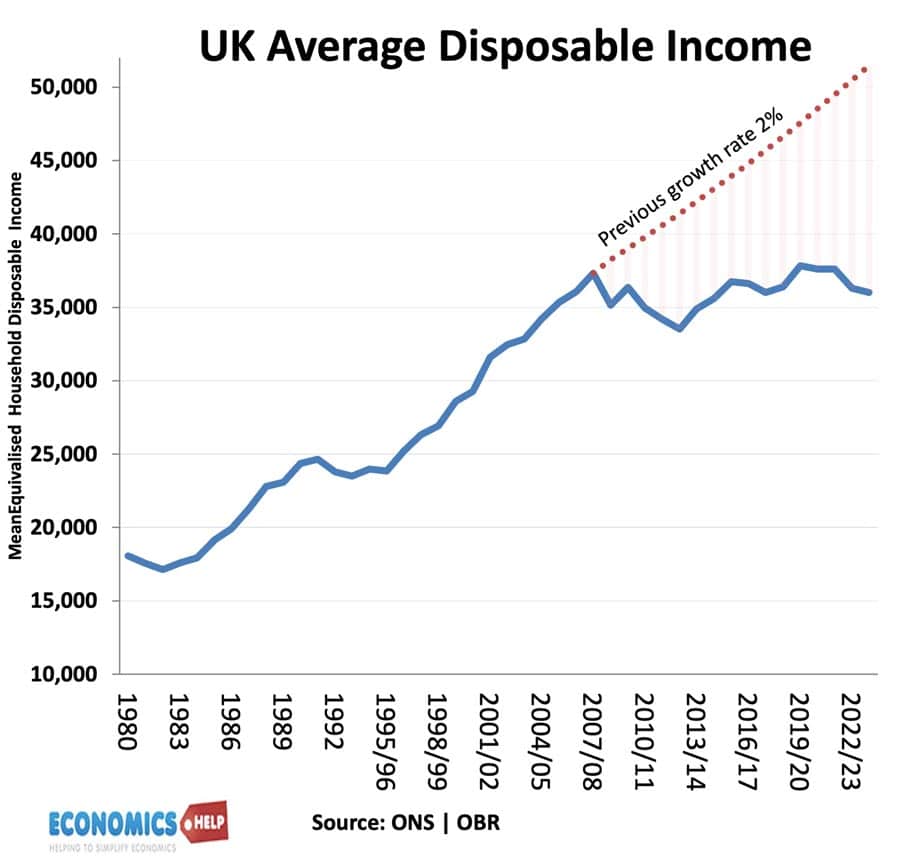
Average disposable incomes have really been hit by productivity slowdown.
With falling productivity, firms cannot afford wage increases. This is leading to depressed income tax receipts for the government.
3. Lower tax receipts/Higher debt. As productivity falls, and GDP falls, that means lower tax receipts, but also higher government spending. Since the productivity slowdown, public sector debt has risen from 50% of GDP to 100%
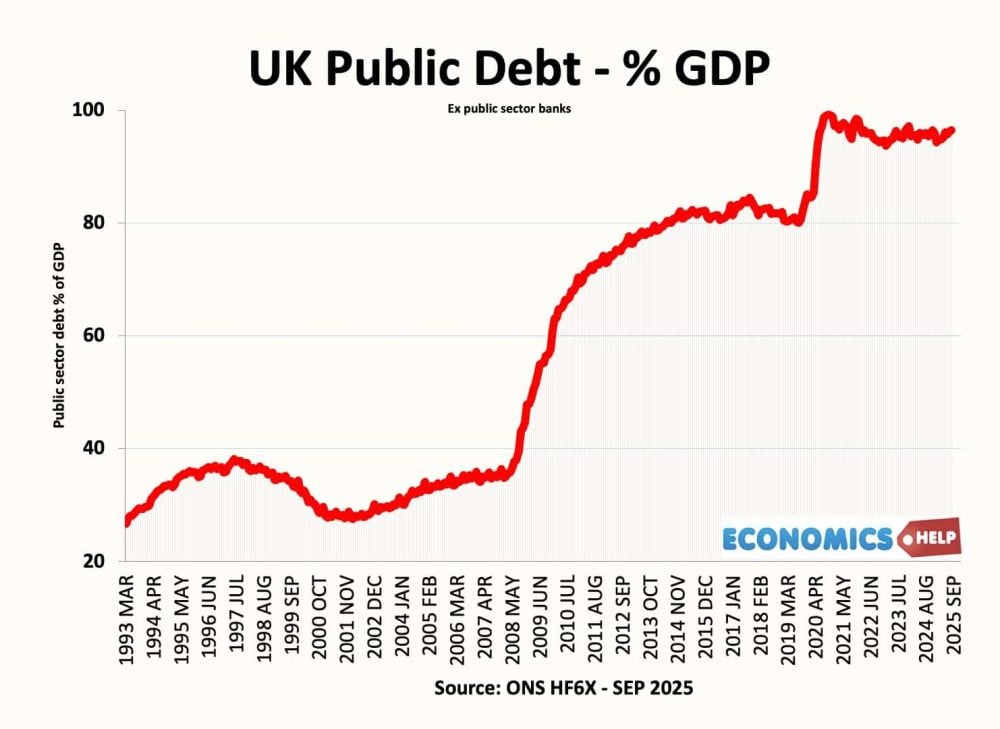
(Sky News). Lower productivity growth = Lower economic growth = lower tax receipts (VAT and income tax)
Importance of Labour Productivity
- Economic growth. UK labour productivity is a key factor in determining long-run economic growth (and LRAS). Improvements in labour productivity enable firms to produce more for lower costs. Without growth in labour productivity, it would be difficult to have strong economic growth. see: causes of economic growth
- Inflation. Rising labour productivity helps to keep costs and inflation low.
- Rising real wages. Rising labour productivity is a key factor in enabling rising real wages. If workers become more productive, firms can afford to pay the wage increases.
- International competitiveness. Improvements in labour productivity can help to boost the competitiveness of UK exports. See also: Factors that determine international competitiveness.
Video
Related posts
About The Author

The key to the productivity puzzle is understanding the policy of mass immigration.
By definition – You cannot have anything *BUT* falling productivity with mass immigration due to Hardin’s tragedy of the commons. Employers simply import Labour to the level of it’s marginal productivity.
The slowdown in productivity growth is not just a UK issue.
https://ades.vn/nen-su-dung-bep-tu-hay-bep-hong-ngoai