

- The Global Temperature has increased by +1.2°C average since the pre-industrial era (1850–1900).
The last 10 years have been the warmest on record. 2023 became the warmest year ever recorded, exceeding previous records by a large margin. “Virtually certain” human activity caused nearly 100% of the warming (IPCC). - Co2 Growth – Pre-industrial CO₂ levels: ~280 ppm. Today: ~420+ ppm (highest in at least 2–3 million years). Rising at ~2.5 ppm per year.
🌍 Economics of Global Warming
Market Failure: Climate change is a negative externality. Social costs (damage, health, flooding) exceed private costs → overuse of fossil fuels.
Key Facts:
- Temps +1.2°C since pre-industrial.
- CO₂ > 420 ppm.
- Damages: 5–20% of GDP (Stern). Action now: ~1% of GDP per year.
Economic Impacts:
- Lower crop yields & productivity.
- Higher insurance & disaster costs. Flooding & coastal damage.
Policies:
- Carbon tax.
- Cap-and-trade.
- Regulation & standards.
- Subsidies for renewables.
- Adaptation (flood defences, resilient crops).
Core Message: Early action is cheaper than long-term damage, but difficult to implement.
Global Warming as a Market Failure
Global warming is fundamentally an externality problem. When firms and consumers burn fossil fuels, they emit CO₂ and other greenhouse gases.
- Private cost: the cost of fuel, equipment, production.
- Social cost: includes climate damage — extreme weather, sea-level rise, biodiversity loss, health costs.
- Because these external costs are not priced, the market over-produces carbon-intensive goods → allocative inefficiency.
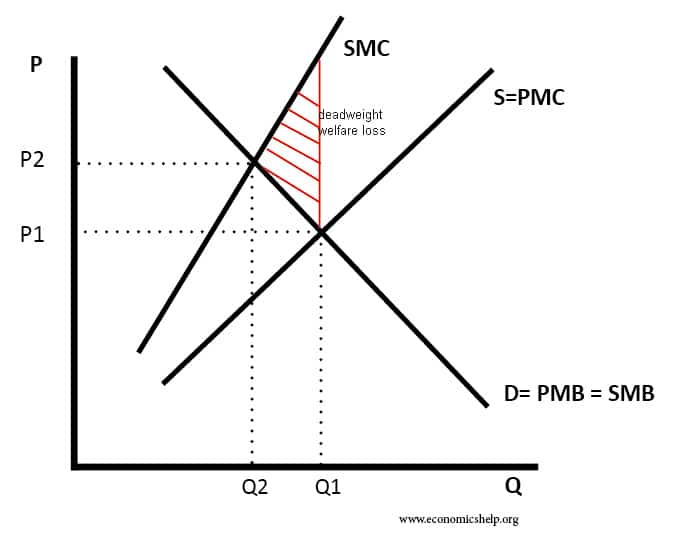 Negative externality
- In standard diagrams, the MSC (marginal social cost) lies above MPC (marginal private cost).
- Market equilibrium output is too high (Q₁ > Q2).
- Welfare loss occurs because the last units consumed create more social harm than private benefit.
Why Global Warming Is Economically Difficult to Solve
- Long time lags – Costs occur today (carbon taxes, regulation), but benefits arrive decades later.
- Global public good – A stable climate is non-excludable and non-rival. Countries have incentives to free-ride on others’ emissions reductions.
- Uncertainty and risk – Difficult to estimate the precise economic damages. High uncertainty pushes economists to use precautionary principle.
- Political economy Fossil-fuel industries lobby to delay action; consumers dislike upfront energy costs; voters discount the future heavily.
- Voters don’t want higher prices Global backlash to high energy prices and carbon taxes – especially atger 2023/24 inflation surge
- People dislike change, e.g. hard to persuade people to give up gas boilers and replace with heat pumps
- Renewable energy harder to integrate into electric systems. A country like UK struggles to get energy dependency from solar and wind, because it is not as reliable. Therefore, fossil fuels set marginal cost of electricity in 99% of occassions

UK energy transition to net zero will cost until 2040, according to OBR.
Economic Costs of Climate Change
Economists estimate damages through integrated assessment models (Nordhaus, Stern Review, etc.).
- e.g. Stern Review – If we do nothing, global warming could reduce global GDP by at least 5% per year, and possibly up to 20% or more in the worst scenarios.
- Mitigation ≈ 1% of GDP per year Doing nothing could cost ≥ 5–20% of GDP per year. But, problem that many costs and benefits are in the future.
Key impacts of Global Warming
Direct economic damages
- Lower agricultural yields (heat stress, droughts).
- Damage to infrastructure from storms and floods.
- Reduced labour productivity (heat reduces working hours outdoors).
- Increased health costs (air pollution, heatwaves).
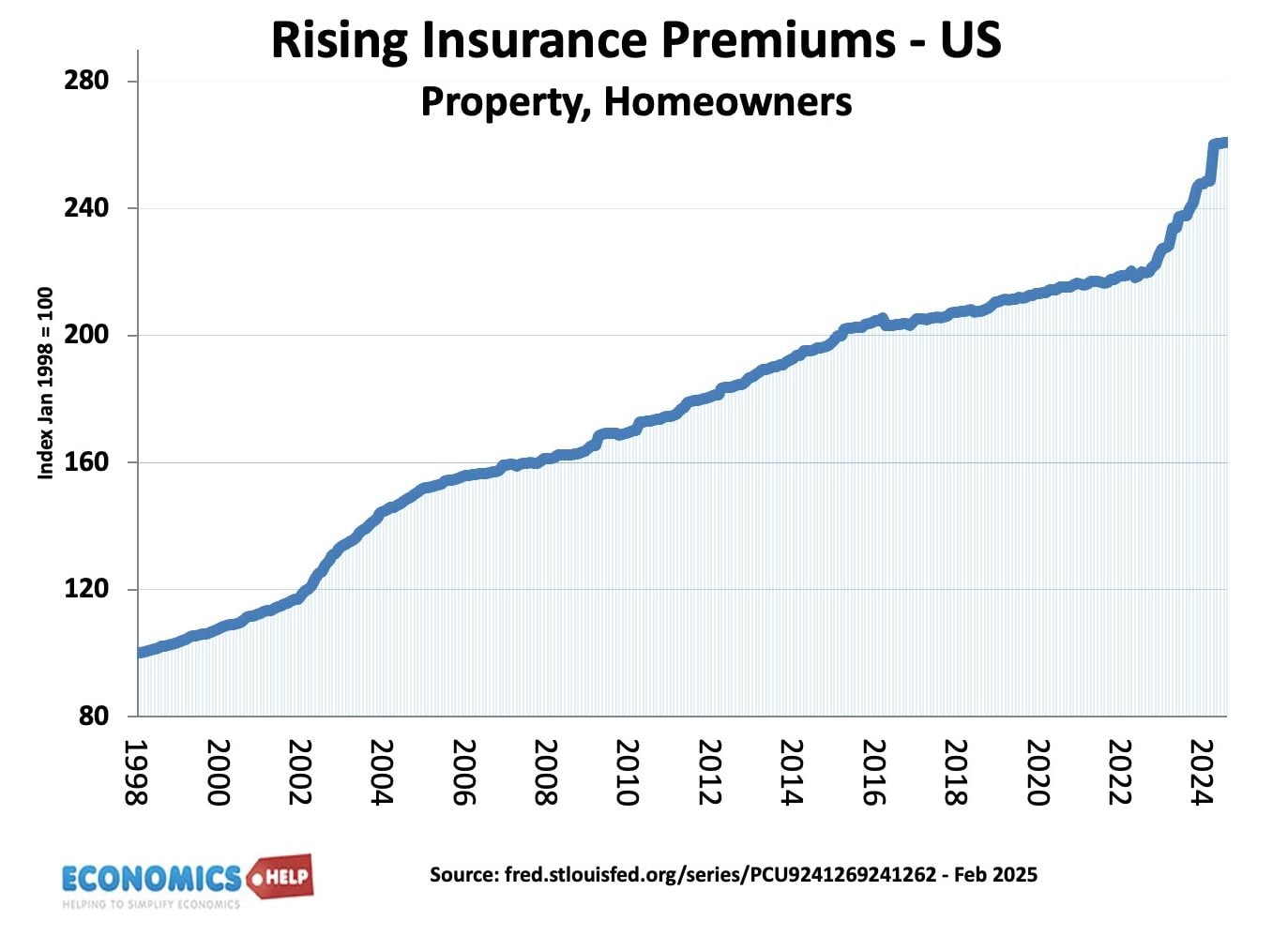
- Higher insurance premiums; some regions become uninsurable.
- Macro impacts Lower GDP growth — possibly 5%+ of global GDP per year in severe scenarios.
- Greater inequality: poor, hot countries suffer disproportionately.
Economic Policies to Reduce Emissions
1. Carbon Tax
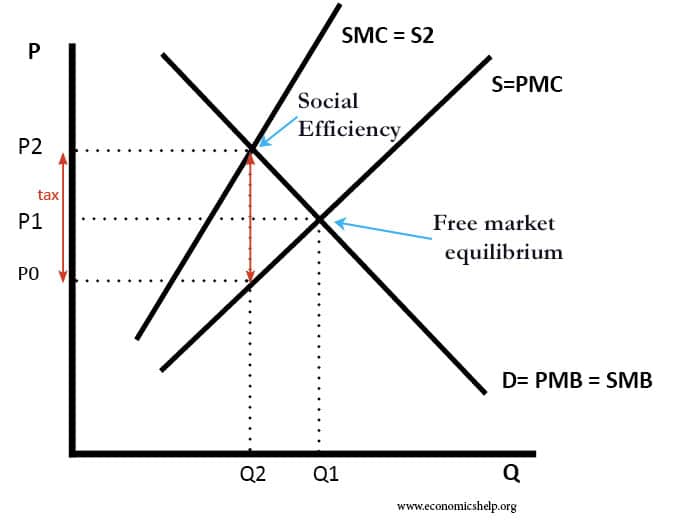
Internalises the externality by raising the price of carbon-intensive goods.
Encourages substitution to renewables, efficiency, innovation.
Can be revenue-neutral if revenue is recycled to reduce other taxes or compensate low-income households.
2. Regulation
- Bans on petrol cars (phase-out dates).
- Efficiency standards for appliances and buildings.
- Renewable energy mandates.
3. Subsidies for Clean Technology
- Solar/wind investment support.
- R&D funding for batteries, carbon capture, hydrogen.
- Helps overcome the positive externalities of innovation.
4. Behavioural economics
- Nudges: default green tariffs, information campaigns.
- Salience of energy consumption can reduce use.
Equity and Distributional Issues
Climate economics involves fairness between:
- Generations (future vs present).
- Countries (developed vs developing).
- Households (carbon taxes hit poorer groups harder unless compensated).
- Developing countries argue rich nations should finance their transition because they accumulated most historical emissions (“common but differentiated responsibility”).
- Some countries with low lying land, near sea more at risk from rising sea levels.
The Economics of Adaptation
A more positive case for global warming is that economies and people will adapt.
- Flood defences
- Heat-resistant crops, especially through use of GM
- Farmers grow different foods, e.g. you can start to grow grapes and make wine in the UK
- Air-conditioning making use of solar power energy will reduce impact
- Relocation of housing/industry
- Adaptation reduces damage but cannot fully offset risks.
- Fertility rates falling, future populations may be smaller, make it easier to deal with.
Innovation and the Green Economy
Climate action can stimulate:

- New industries (renewables, heat pumps, EVs).
- Job creation in installation, maintenance.
- Reduced dependence on imported fossil fuels → better energy security.
- Learning curves mean costs fall quickly (e.g., solar PV has fallen ~90% since 2010).
Evaluation Points
- Global coordination essential; unilateral action has limited effect. But, in polarised world, harder to get global co-operation
- Carbon leakage: emissions move abroad if regulations differ. E.g. High carbon taxes in UK have caused manufacturing to shift abroad.
- Technological uncertainty: breakthroughs (fusion, cheap storage, carbon capture) could lower transition costs.
- Political resistance: voters dislike fuel taxes (gilets jaunes in France, backlash in UK).
- Real free-rider problem. Why should UK reduce emissions, when China and the US don’t care?
Related
About The Author
