Tag Archives | unemployment

European unemployment crisis

Unemployment in many European countries has risen sharply due to the credit crunch and global recession. The worst hit countries include Spain (ES) and Greece (EL) who both have unemployment rates of over 26%.
  • Unemployment rate in the Eurozone area: 12% (March 2013)
  • The Eurozone jobless total is now 19.07 million. (link) The highest since records began.
  • Unemployment rate in the EU 27: 10.9%
  • Youth unemployment rates in the EU 27 is 23.5% (March 2013)
  • By comparison, unemployment in Japan is 4.4%, and in US 7.8%
Eurozone-unemployment

Eurozone Unemployment

Source: ECB

 Causes of European unemployment crisis

After falling to 7.5% in 2008, the prolonged recession of 2008-13, has caused a sharp rise in unemployment.  The continent seems to be stuck in a deflationary spiral and is facing a prolonged double dip recession. Hardest hit debtor countries, such as Spain, Greece, Portugal and Italy are facing stringent budget cuts – which are depressing demand.

Will Eurozone break up?

But, in the Eurozone, there is little relief available to boost demand. Countries are unable to devalue. Monetary policy set by the ECB has been unflinching in targetting low inflation and offering little monetary easing – despite the prolonged recession. Also, depressed demand throughout the region is making it difficult to grow through increasing exports. Even northern Europe, which has had large current account surpluses are engaging in modest austerity. The result is that demand has remained depressed across Europe.

Despite its potentially damaging social and economic impact, throughout the 2008-13 European crisis, unemployment has had a relatively low profile -  European policy makers have always given the impression they are more concerned about appeasing bond markets and low inflation than tackling the more pressing problem of unemployment. There has  been a reluctance to tackle the fundamental deficiency of aggregate demand which is leading to lower growth and falling employment. Efforts to reduce unemployment have centred on talk of more flexible labour markets. This may be part of the solution for structural unemployment, but increasing labour market flexibility alone cannot deal with the cyclical unemployment.

Continue Reading →

Comments { 7 }

The UK Unemployment Mystery

A strange feature of the past two years, has been a largely unexpected fall in UK unemployment. Recently, the ONS said there were 2.49 million people unemployed,  185,000 less than on a year earlier. It is the lowest unemployment rate since spring 2011. Usually, in a recession, you would expect a rise in unemployment because falling demand causes firms to get rid of surplus workers. (see: demand deficient unemployment)

For example, after the much milder 1981 recession, UK unemployment rose to over 3 million (around 11%) and remained high well until the mid 1980s. After the 1991 recession, unemployment again rose sharply, to just over 3 million.

unemployment

Also, in Europe, unemployment has recently risen to record levels. Only in the US, has unemployment shown a similar fall,  but the US has seen much stronger economic recovery than the UK.

In the 2007-13 recession, we have seen UK unemployment rise at a slower rate than previous recessions, and it has also been quicker to fall – even though evidence points to a unique triple dip recession. Why has unemployment been falling, when the economy is so weak?

1. Flexible Labour Markets. Evidence suggests that UK labour markets are more flexible. For example, it is easier to cut hours and keep people employed on shorter working hour contracts.

under-employment

This is illustrated by a rise in under-employment during the long recession. More people are reporting working fewer hours than they would like. However, flexible labour markets can also mean it’s easier to hire and fire workers. You would expect if labour markets were very flexible, firms would be quick to make redundancies, but this doesn’t seem to be occurring. (flexible labour markets)

2. Flexible Pay. Related to flexible labour markets have been the recent trends in pay. We have seen five years of falling living standards, with average pay rates rising at a lower rate than inflation. If unions were powerful, and workers could bargain for higher wages, it is likely that unemployment would be higher. The fact that wage growth has been stagnant has encouraged firms to keep holding onto workers, rather than let them go because they are too expensive. The headline rate of average earnings growth excluding bonuses is 1.4%, meaning that with CPI inflation or around 2.5%, real pay is falling at an annual pace of more than 1%.” (UK wages)

wages-inflation-2007-2012

Continue Reading →

Comments { 5 }

Unemployment Stats and Graphs

A selection of graphs and statistics on unemployment. Also links to further reading on causes and solutions to unemployment.

Current UK Unemployment rate

  • 7.8 % of the economically active population,  0.5 % points less than a year earlier.
  • There were 2.52 million unemployed people 128,000 lower than a year ago. (page updated March 19, 2013)

Recent Unemployment Trends

UK unemployment-past-5-years-percent

Raw data:  Labour market data  | ILO unemployment % rate at ONS

UK Unemployment Since 1980

UK Unemployment
See: Monthly Labour Market Statistics (Past Editions) Unemployment A02


UK Employment Rate

  • 71.5 %.  There were 29.73 million people in employment aged 16 and over.

Participation Rate

  • 22.3% per cent inactivity rate for those aged from 16 to 64. 8.95 million economically inactive people aged from 16 to 64

Continue Reading →

Comments { 8 }

The Luddite Fallacy

The Luddites were a group of English textile workers who engaged in violently breaking up machines. They broke up the machines because they feared that the new machines were taking their jobs and livelihoods. Against the backdrop of the economic hardship following the Napoleonic wars, new automated looms meant clothing could be made with fewer lower skilled workers. The new machines were more productive, but some workers lost their relatively highly paid jobs as a result.

luddites

A Luddite is a term used (usually pejoratively) to describe people who oppose the introduction of new technology. Yet, the idea that new technology leads to job losses has persisted, despite the fact that economists are almost universally united in stating that new technology will not increase the long-term unemployment rate.

The Luddite fallacy is the simple observation that new technology does not lead to higher overall unemployment in the economy. New technology doesn’t destroy jobs – it only changes the composition of jobs in the economy.

Why Do Economists say that new Technology does not cause Unemployment?

Firstly, rapid technological change may cause some short-term temporary unemployment. However, economic theory suggests that jobs lost as a result of technological change will be created in different, new industries.

Continue Reading →

Comments { 5 }

Unemployment Compared – Portugal and Spain v UK and US

A quick look at a comparison between the economies of Portugal and Spain, with the economies of the UK and US.

portugal-uk-us-spain-us unemployment

Four countries with very different paths of unemployment.

Continue Reading →

Comments { 0 }

Impact of Immigration on UK Economy

In the past two decades, the UK has experienced a steady flow of net migrants into the economy. Net migration is a significant factor in the growth of the UK population. But, does this net migration help or hinder the UK economy?

net migration into UK

In 2011, long-term net migration was +215,000 – slightly down from over +250,000 in 2010. It means that in the past five years, the UK population has been boosted by net migration of around 1,000,000.

Inflows and Outflows

net-migration-outflows-inflows

  • In 2011, the top 3 countries for source of migrants was India, China and Pakistan.
  • The top 3 destinations for people emigrating from  the UK was Australia, India and US.

Impact of Net Immigration on UK Economy.

1. Increase in Labour Force.

Migrants are more likely to be of working age – such as, students, and those looking for jobs. They may  bring dependants, but generally net immigration leads to an increase in the labour force and increases the potential output capacity of the economy.

2. Increase in aggregate demand and Real GDP

Net inflows of people also lead to an increase in aggregate demand. Migrants will increase the total spending within the economy. As well as increasing the supply of labour, there will be an increase in the demand for labour – relating to the increased spending within the economy. Ceteris paribus, net migration should lead to an increase in real GDP. The impact on real GDP per capita is uncertain.

Continue Reading →

Comments { 6 }

Reasons for Youth Unemployment

A look at the economics reasons for high youth unemployment (16-25) in the UK.

youth unemployment UK

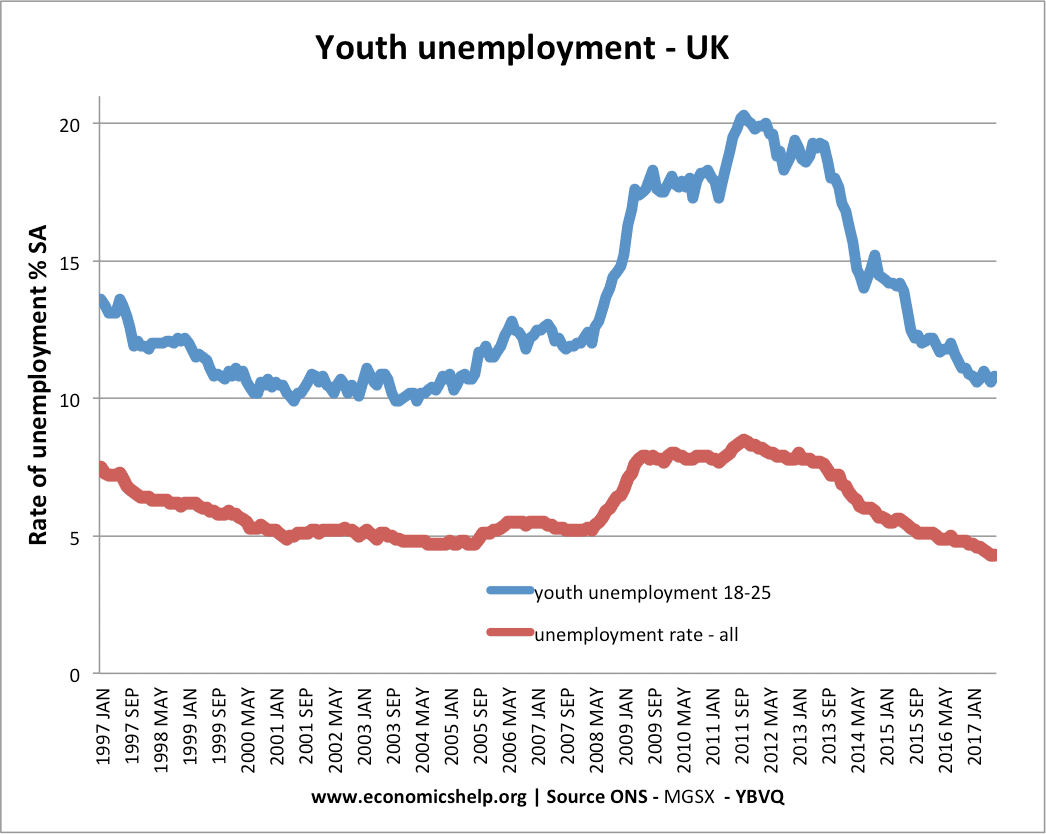
During the recession, youth unemployment rose at a faster rate than the main unemployment rate.  After peaking at 20% (1 million) in early 2012, youth unemployment has recently fallen to 18.5 %

The reasons for youth unemployment are fairly similar to other causes of unemployment. They include:

  1. Lack of Qualifications. Young people without any skills are much more likely to be unemployed (structural unemployment) A report by Centre for Cities suggest there is a correlation between youth unemployment and poor GCSE results in Maths and English. To some extent the service sector has offered more unskilled jobs such as bar work, supermarket checkout and waiters. However, the nature of the labour market is that many young people lack the necessary skills and training to impress employers.
  2. Geographical Unemployment. Youth unemployment is often focused in certain areas – usually inner cities where there is a cycle of low achievement and low expectations. For example, the employment rate for 16-24 year olds is only 64% in the North East compared to a national average of 70% Continue Reading →
Comments { 17 }

Did Generous Welfare Payments Cause the Recession and Unemployment?

Casey B. Mulligan, from the University of Chicago suggests a theory for a major cause of the great recession and the rise in US unemployment post 2008. – Higher welfare payments.

..Redistribution, or subsidies and regulations intended to help the poor, unemployed, and financially distressed, have changed in many ways since the onset of the recent financial crisis. The unemployed, for instance, can collect benefits longer and can receive bonuses, health subsidies, and tax deductions, and millions more people have became eligible for food stamps.

Economist Casey B. Mulligan argues that while many of these changes were intended to help people endure economic events and boost the economy, they had the unintended consequence of deepening-if not causing-the recession.

The Redistribution Recession
– Oxford University Press

us unemployment

US Unemployment – was it caused by generous benefits?

There is also an article here at the NY Times (paywall): A Keynesian Blind Spot.

The decline of home construction is not the primary reason that our labor market remains depressed: Keynesian policies are

Continue Reading →

Comments { 0 }

Econ Growth and Unemployment Stats – Countries with Own Currency

Readers Question I was wondering if you have any graphs plotting UK GDP and Unemployment against other economies which have monetary independence and their own currency. I often see graphs comparing the US with the UK. Are there any which include Sweden, Norway, Switzerland and other countries?

econ-growth-table-aus-nor-swe-swit-uk-us

click to enlarge

Economic growth rates for selected countries.

  • Australia has weathered the global recession well. Helped by strength of its commodity export market.
  • Sweden experienced one of the deepest recession (-5.0% in 2009), but also one of the quickest recoveries with very strong growth since 2010.
  • The Eurozone went back into recession in 2012, and the growth forecasts for 2013 may prove over-optimistic.

Continue Reading →

Comments { 0 }