
Trade unions provide an organisation for workers to have joint representation with their employers. Trade unions have several functions:
- Represent workers in disputes – A union can represent workers with regard to pay, safety and working conditions.
- Collective Bargaining – Unions bargain for higher wages with the possibility of going on strike to target higher wages.
- Promoting job security – Unions may seek to protect members jobs by negotiating with firm to avoid job losses.
- Productivity Deals. Firms can co-ordinate with firms to implement new working practises and negotiations with workers
Trades Unions in a Competitive Labour Market

- In a competitive labour market, wages were W1. If a trade union successfully bargains for a higher wage of W2, then employment falls to Q2.
- This situation can lead to real wage unemployment of Q3-Q2.
- This is why economists who believe labour markets are generally competitive argue that trade unions can cause inefficiency and unemployment.
It is worth noting that trade unions can increase wages for members – but those outside the union may be more likely to experience unemployment.
Trades Unions in a Monopsony
A monopsony is a firm with market power in employing workers. It is a situation where firms can pay lower wages and employ fewer workers, because workers have little alternative.
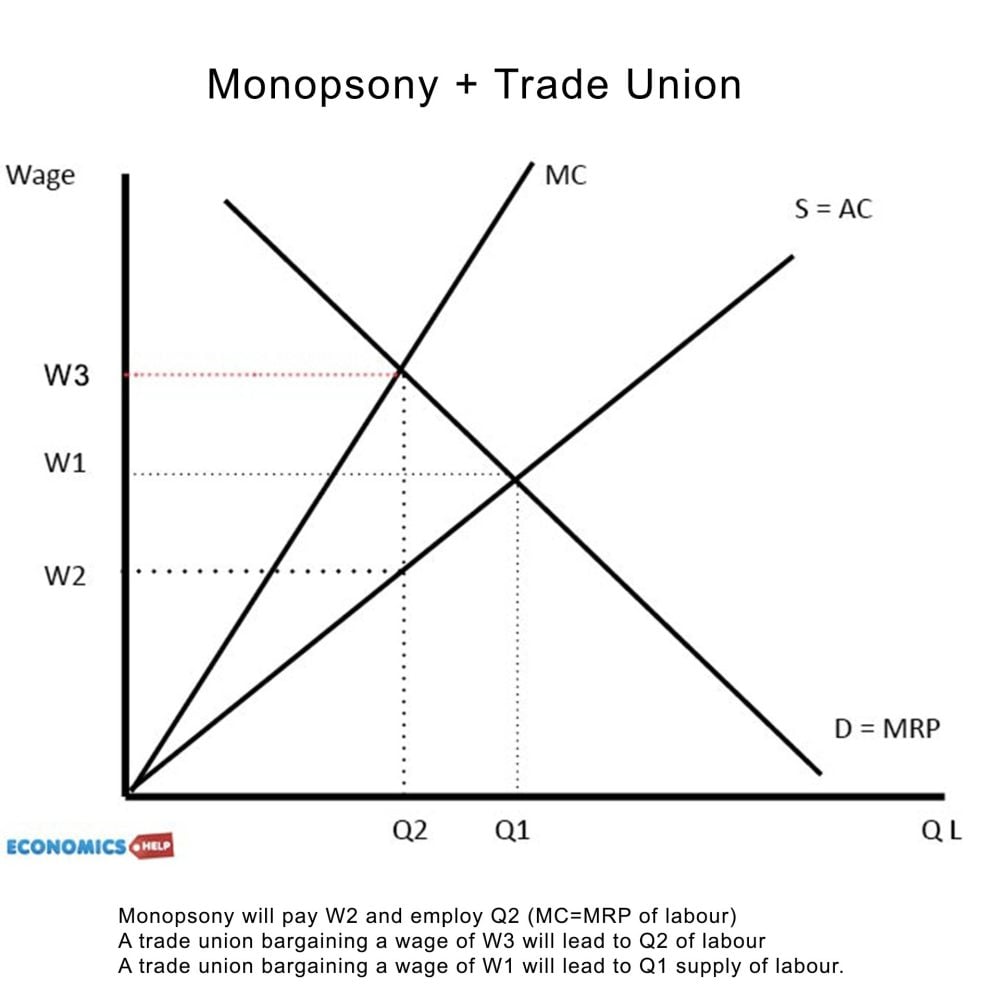
- Initially, a monopsony can pay a wage of W2 and employ just Q2. Note this profit maximising level is a lower wage and lower employment level than a competitive equilibrium of Q1, W1.
- In this situation, if a trade union bargains for W3, it does not create unemployment, but employment stays at Q2.
- If a trade union bargained for wage of W1, employment would actually increase to A1.
- We can say that a trade union is counter-balancing the monopsony power of employers.
See: Monopsony for more details.
Do trade unions cause unemployment?
In theory, trade unions can push wages above the equilibrium wage rate. This rise in real wages can lead to less employment. However, the impact of unions on employment rates is not certain.
- Depends on market structure. As seen above – it depends on the employer. If a firm has monopsony power, then the monopsony can restrict labour and lower wages. In this case, a trade union can provide a counter-balance to the monopsony power of an employer. Even if labour markets are competitive – demand may be quite inelastic, meaning higher wages would not cause much decline in employment.
- Efficiency wage theory. This states higher wages can lead to increased productivity.
- Productivity deals. A trade union may be able to bargain for higher wages in return for improving working practices and implementing higher productivity.
- State of the economy. If the economy is growing, then employment will be strong, and union activity less likely to cause unemployment.
- Protecting jobs key part of the union. A union will state one of their primary goals is to prevent job losses in the beginning.
What determines the success of trade unions?
- The density (% of the workforce in the trade union)
- Bargaining power of workers, e.g. power plant workers have more economic leverage than supermarket shelf stackers.
- Economic climate – is the firm highly profitable or struggling to survive?
- Government legislation. e.g. since the 1970s, UK government has reduced the power of trades unions, e.g. abolishing closed shops, outlawing secondary picketing.
- Nature of labour markets – competitive vs monopsony.
- Political climate. In the 1970s, unions were powerful, but Thatcher wanted to break power of unions and was largely successful.
- Rate of unemployment. High unemployment makes unions less powerful.
- Technology. When print unions went on strike Rupert Murdoch just moved whole process to a new highly automated factory, which needed fewer workers.

The trade union wage premium has decline in the UK since the mid 90s. This is due to more flexible labour markets, declining union membership, rise in role of minimum wage.
Trade union density in the UK

Trade union membership has been in decline since late 1970s

In 2025, there were 6. 4 million members (22% of workforces) in TUC-affiliated unions, down from a peak of 12,172,508 in 1980. Trade union density was 14.1% in the private sector and 56.5% in the public sector

The decline of trades unions is partly related to the decline of heavy manufacturing industries such as steel and coal – which were traditionally areas of strong union involvement.
The decline in the power of trade unions
Since 1979 Union membership has fallen for the following reasons
- Deindustrialisation. Decline of the manufacturing sector where unions were once strong. (e.g. coal and steel industries.
- Union legislation
- Ended closed shops (where a worker had to be in a union to be employed – giving a union 100% density.
- Secondary picketing outlawed. E.g. you can’t strike in sympathy of another union.
- Ballot necessary for a strike. Political levy must come from a vote
- Growth of service sector at the expense of manufacturing sector
- Growth of part-time/ temporary jobs/gig economy.
Trade unions in different industries

Do trades unions increase economic welfare?
Potential costs of trade unions
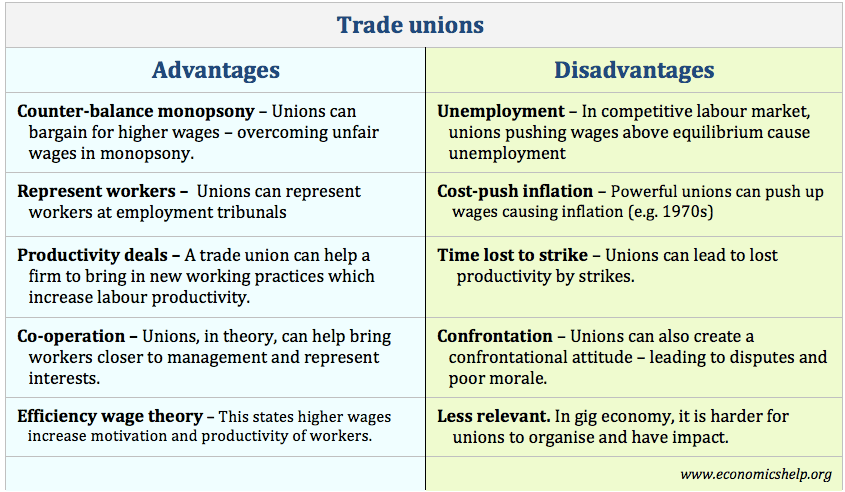
- Trade unions can push wages above the equilibrium. Therefore fewer people are employed by the firm – this leads to a loss of earnings to those outside the trade unions.
- Time lost due to strike action.
- Trade unions bargaining for higher wages can cause cost-push inflation. In the 1970s, union activity was responsible for some of the cost-push inflation of that period. Though unions were also trying to protect wages against the higher inflation.
- Trade unions can increase incomes of union members, but this is only a limited approach to reducing inequality. Lowest income groups are often unemployed or not employed in a union job.
Potential benefits of trade unions
- Trade unions can provide counter-balance to monopsony – increasing wages and employment for their members.
- Trade unions can provide greater coordination between firms and employers, e.g. introducing productivity deals.
- Trade unions can develop co-operation between workers and firms.
- Trade unions can represent workers in disputes over health and safety and disciplinary matters.
- Trade unions can increase wages – which leads to increased spending in the economy.
It depends on the quality of the relationship – is it antagonistic or mutually beneficial?
Role of trade unions late nineteenth/early twentieth century
At the turn of the Twentieth Century, trade unions played an important role in increasing wages for workers. Real wages rose rapidly in this period. – It was also consistent with rising employment levels. In the late nineteenth century – many firms had a degree of monopsony power. Workers earned low wages and worked long hours.
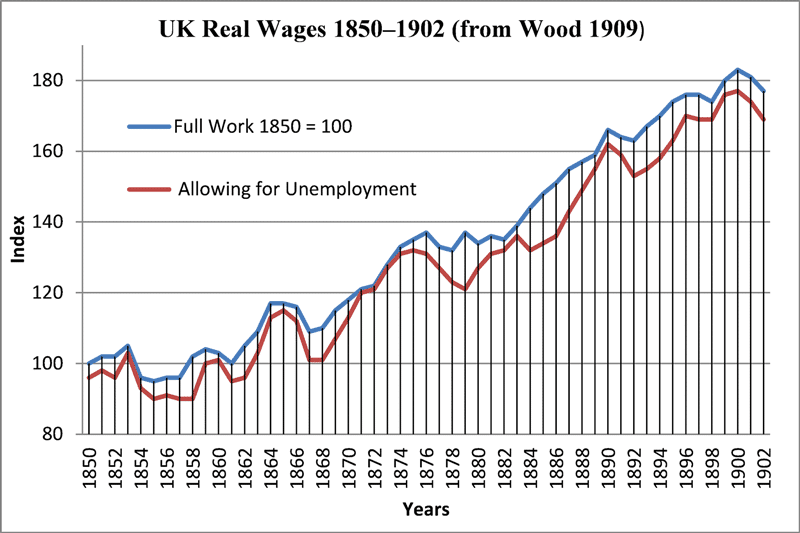
With increased wages, there was also increased spending in the economy, which led to increased demand for other goods.
From the nineteenth century – there was a general fall in inequality – with rising real wages for the working class. This was due to the influence of trade unions – though other factors were more important such as higher productivity and new technology.
US Trade Unions

The US has seen a similar decline in trade union membership rates (for similar reasons) It has also coincided with a period of rising inequality in the US.
Related topics
- Advantages and disadvantages of trades unions
- Decline of UK coal industry
- Collective bargaining
- Decline of Trade Unions
Sources:
- Trade union stats at gov.uk