
Definition of a Veblen Good. A Veblen good is a good where demand rises as price rises because people feel its higher price reflects greater status.
Readers Question: I once ran across a term and now can’t find it. It’s the economic theory that consumers will purchase a product or service which cost more money for the sole believe that it’s of higher quality due to its higher price. Is there a designated term for this?
Why might people buy more as price increases?
In the case of a Veblen good it is because people think more expensive goods are better quality, and so some people may buy more. Studies suggest people do get more satisfaction from receiving expensive goods. It is possible that designer clothes or luxury cars may sometimes meet the criteria of Veblen goods. This is often termed the snob effect – people equate price to quantity.
If Veblen goods do exist the demand curve would slope the opposite way.
Veblen goods were suggested by Thorstein Veblen, an unorthodox economist who identified ‘conspicuous consumption’ in The Theory of the Leisure Class (1899) Veblen noted that a motivation for buying goods was showing off to others in society.
There can also be other factors behind Veblen goods
Examples of Veblen goods
Vintage wine. In a posh restaurant, diners may avoid purchasing the cheapest wine – because it indicates poor taste. If the wine is increased in price, then it may sell more.
Modern art. If art is sold at £1, people may not value it, but if the same pieces are sold for £100, unsuspecting buyers may feel it is better. Art may be subject to the bandwagon effect – if an artist becomes in vogue, people want to be part of it.
Designer clothes. Some clothing retailers have found increasing the price of luxury ‘branded’ items can sometimes increase sales, e.g. branded jeans.
Diagram for Veblen Good
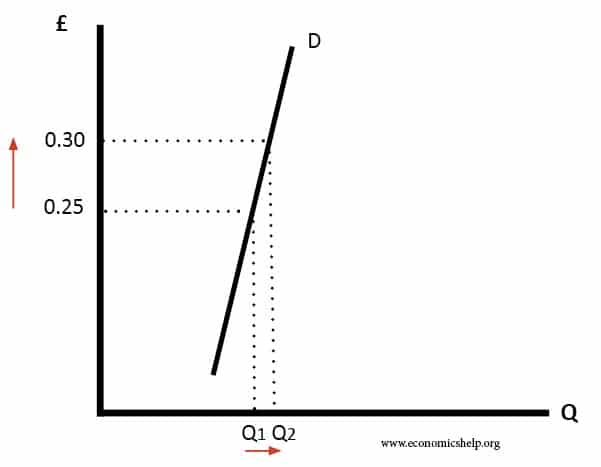
Veblen goods contradict basic law of demand.
Shift in demand
Though it could also be that with Veblen goods, demand is shifting to the right. WIth higher price – people believe it reflects an increase in quantity so, with a higher price, the demand curve is actually shifting to the right.
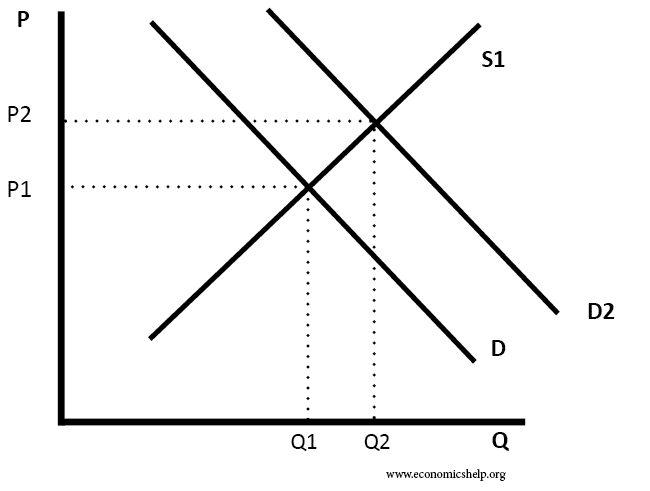
Some Veblen goods may have normal demand curve at low prices, but above a certain price start to have ‘snob value’ so demand curve starts sloping the other way. Above P1, this good behaves like a Veblen good.

In recession and periods of frugality, there are few Veblen goods, but possible many counter-Veblen goods – where lower price makes demand increase more than proportional.
Related Concepts
Positional Goods. These are goods which tend to be very scarce and are desired for their ability to show success over other people. For example, getting into the best university, moving in highest social circles. If a good help to illustrate your position in society.
Conspicuous Goods – goods people like to buy to show social status or success. Designer clothes and fashionable art can fall into this category. The idea is that people want to buy goods which convey their success. This could explain why as price rises, people want to buy more
Perfectly Inelastic Demand. If demand is perfectly inelastic, it means an increase in price doesn’t cause any fall in demand. People are willing to pay whatever price charged, e.g. price of a diamond wedding ring.
Giffen Good. Higher price leads to higher demand but for a different reason to Veblen goods. Demand rises with a higher price because the income effect of higher price outweighs the substitution effect. Giffen Good
Rising house prices and rising demand
With house prices and the law of demand, we looked at why rising house prices caused a rise in demand. Here it is not the snob effect at work, but maybe a bandwagon effect or asset bubble effect. Where people buy because prices are rising and therefore they expect them to keep rising.
Related
About The Author

I believe cosmetic surgery is a Veblen good. Price is a proxy for quality but only at higher prices. At lower prices “a breast augmentation is a breast augmentation”, the demand curve is slightly elastic but follows an expected curve. At high prices it is a Veblen commodity as higher income individuals don’t want the average breast augmentation, they want the “best” surgeon. Comments, criticisms?
After checking, the only problem with a Veblen good is that it doesn’t checks out in the Slutsky identity, because in that equations the substitution effect must always be negative. Since the Slutsky identity assumes convex preferences, the only thing I could guess is that a good consumed the “veblen way” would not reflect convex preferences… the rest is for now out of my reach.
any one?
I tried to bring about the Veblen Good in my microeconomics class when we talked about giffen goods.
I had to do a bit by myself for the teacher (give her a chance, she just began teaching!) didn’t quite knew about Veblen goods.
So I simply classified goods in the three well known general categories which are Normal, Inferior and Superior. Inferior goods are either ordinary or giffen goods, whereas Superior goods are either ordinary or Veblen goods.
I think you are all familiar with the difference between the 2 types of inferior goods, that is, both have a negative income-elasticity, both have an income effect that varies in the same direction as the price variation, and both have a substitution effect that varies in the opposite direction as compared with the price variation. The two differences between both are:
1. An ordinary inferior good has a negative price-elasticity (same as a normal good) whereas a Giffen good’s is positive (see potatoes example above)
2. A Giffen good’s income effect offsets the substitution effect, whereas the contrary happens for an ordinary inferior good (which explains the positive-sloped demand curve for Giffen goods)
Now let me explain you my reasoning concerning the difference between the two types of superior goods. I might be wrong, I have no mathematical support for this (yet, I’ll come back to you about this real soon).
An ordinary superior good has exactly the same properties as a normal good, with the exception that its income-elasticity exceeds 1 (a normal good’s is between 0 and 1), which means that consumption variation is greater than the revenue variation (both vary in the same direction).
A Veblen good, which is where I present my reasoning, is different from an ordinary superior good in two ways:
1. Whereas the income effect, just like the ordinary superior good, varies conversely to the price variation, a Veblen good’s substitution effect varies along (wish I could underline that word!) with the price variation. This is the only type of good, altogether with every ones I’ve categorized above, for which the substitution effect would vary in the same direction as the price variation. That makes sense: substitution effect reflects the variation in the good’s demand resulting from a variation in its price relatively to any other good (say a composite good, which represents any other good), assuming purchasing-power-variation-adjusted budget. The above discussion summarizes to my opinion quite well what a Veblen good represents (either through snob effect or bandwagon effect).
2. The other difference is that, resulting from (and requiring) the fact that the substitution effect offsets the income effect, the demand curve will be positive-sloped, just like a Giffen good.
All of this seems to checkout in slutsky’s equation, which is yet to be confirmed. I’ll come back to you about that.
what about an inferior good?
Here’s a question I’d like to know the answer to: even though people seem to criticize the Veblen goods idea a lot, isn’t it true in terms of different brands? When there are a number of different products on the market, and only one of them is lower priced, it seems logical for people to perceive it as inferior in quality, because the average price for the pruduct is telling them that. The fact that many products ARE more expensive because of higher quality contributes to this.