
Hype around artificial intelligence has set off a frenzy on Wall Street, driving a surge in share values and investment in AI and data centers. Big tech firms are now spending more on capital projects than they did during the dot-com boom of 2001. Everyone wants to be part of AI boom. But is this boom built on solid foundations, or is it more hype than reality? Take OpenAI: the company is planning an eye-watering $500 billion expansion, even though it posted a $5 billion loss in 2024. It has agreed to pay Oracle $30 billion a year for data-centre services, despite generating only $10 billion in annual revenue. In other words, it’s betting everything on explosive future growth.
In Silicon Valley, the prevailing belief is that AI will supercharge productivity and deliver huge gains for the economy. But the evidence is less convincing. A team of MIT researchers found that 95% of publicly disclosed AI projects failed to boost profitability. In one study, programmers using AI tools were expected to work 40% faster. The developers themselves felt they were about 20% faster. But when the data was measured, output was actually 20% slower. The study which says 95% of projects failed to boost profits, suggested a real problem with current models is the problem of being Confidently wrong. The models which succeed learned from input, and gave confidence intervals. The point is AI has huge potential for improvement.
Benefits of AI
Not everyone is so sceptical about AI—and I’ll admit, I wasn’t an early adopter myself. But once I started using ChatGPT, I found it genuinely useful. Need an Excel formula? Debug a website? Write a bit of code? It saves a lot of time. In fact, it’s even helped offset—just a little—the revenue that ChatGPT has taken from my own site, Economics Help. The trick is knowing how to use it. Ask it to write a YouTube script, and you’ll usually get vague, fluffy nonsense. But for some things it excels.
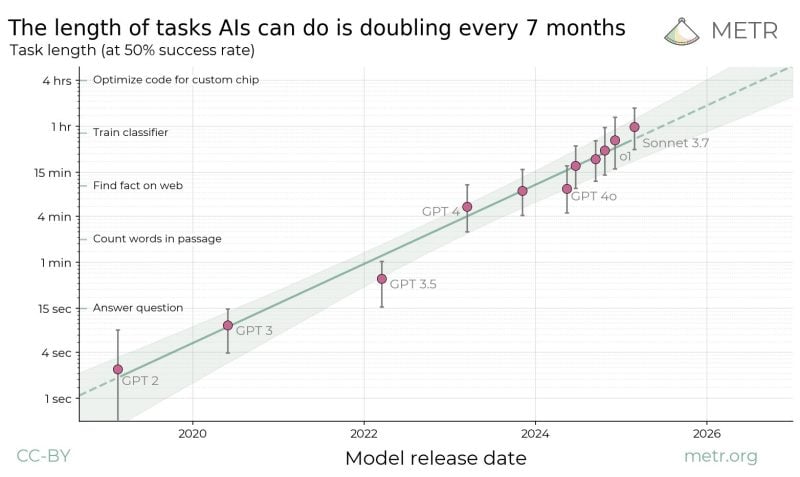
The optimistic case for AI is that we’re in the middle of an incredibly rapid improvement cycle. Since April 2023, the cost of running large language models has dropped anywhere from 9 times to 900 times, depending on the task. Like many new technologies,

AI may be going through a “J-curve” effect—where at first productivity dips, because people are still figuring it out. But once the tools improve and users adapt, growth takes off. Electricity took decades to transform factories, and even personal computers were slow to give a productivity boost. AI has the same potential—
Macro Economics of AI
But, what about the macroeconomics of artificial intelligence? Capital expenditure spending on AI contributed more to US economic growth in the past 2 quarters than the entire consumer spending. But, this capital expenditure is becoming a self-fulfilling boom. With investment running ahead of profitability. All it would take is for OpenAI to disappoint with revenues and then the whole logic of the massive investment boom looks over-egged. The boom in AI investment is already greater than the telecoms bubble of the early 1990s, although much less than the railway mania of the 1880s. Now the interesting thing is that although both investment bubbles burst, it also left behind great infrastructure in terms of both railways and fibre optic cables that are really useful. Investors weren’t completely wrong; they just got carried away. It is like the dotcom bubble. Amazon’s share fell 70% in 2000, but are worth infinitely more now.
So in those past bubbles, investors lost money and in the case of railways, caused a deep financial crash, but is AI infrastructure really as game-changing as those previous booms? It depends on whether the promises of productivity improvements materialise.
Electricity
One of the big bottlenecks in the expansion of AI is now electricity. AI consumes huge quantities, and it needs reliable power all year round, you can’t rely on just wind. For a country like the UK, it means more nuclear power and gas, but also AI means higher electricity prices. With demand rising faster than supply because of AI, it will harm households and industry. Even in the US, which is more suited to solar power because it is further south, the Trump administration’s blocking of renewable energy is causing electric shortages and higher prices. This is a hidden cost of AI
But, if AI transforms productivity, it will be worth it. Certainly, there are optimists in the AI industry who claim that AI will be doing things better than humans in just a few years. Even before the release of ChatGPT 5, CEO Sam Altman declared that using it would be the equivalent of having “a legitimate Ph.D.-level expert in anything” Having used ChatGPT 5, I have to say I’m not convinced
Diminishing Returns

Much of Silicon Valley holds it as gospel that the technology will have inevitable scaling laws of ever-improving quality and lower costs. But recent AI models have often failed to impress, with smaller-than-expected improvements. One problem is the lack of better data, with AI relying on scraping websites and social media platforms like Reddit, but posts about fattest bear of the year hardly gives you phD standards. Recent models have also proved more expensive, notwithstanding the Chinese claim that they have developed a model which uses a fraction of the power. If true, it is great news for users, but bad news for the profits of the big US tech firms.
Bubble Burst?
How much risk is there that a AI boom could harm the economy? If you look at the dotcom bubble, share prices collapsed in 2000, but it didn’t have any significant economic costs, because it was a fall in share prices rather than banks going bust like 2008 or the railway bust. A large part of AI investment is driven by revenues in terms of big tech firms. But, for newer startups, there is an increasing role of private debt, which is riskier for the banks lending the loans. If the industry contracts these newer startups could cause bad loans. But, even without this, there are risks. A fall in stock values of the big tech companies would have negative effects on household wealth and spending. It was also hit by confidence, given other headwinds in the economy such as tariffs, falling labour supply and inflation.
Who will Benefit?
Also, even if we take the optimistic view of AI, that it will deliver real productivity gains and ultimately replace human jobs, and do it better, that may well save the economy in terms of GDP per capita, but will it actually increase living standards? Who will AI save the economy for? The fear is that the gains of AI are secured by giant firms with monopoly power, but as workers lose jobs, they lose a sense of purpose and well-paid jobs. Now history suggests a fear of technology is often misplaced in the long-run. The tractor caused job losses in farming, but no one really wants to go back to back-breaking farm labour. But, a rapid shift in AI could cause the kind of labour market dislocation which causes structural unemployment, like we saw in the 80s and 90s, after deindustrialiation. GDP increased in the US, but median wages slowed behind. Is there anything about AI, which will enable a change in the economy?
Sources:
https://metr.org/blog/2025-07-10-early-2025-ai-experienced-os-dev-study/
https://www.nber.org/system/files/working_papers/w25148/w25148.pdf
https://www.noahpinion.blog/p/will-data-centers-crash-the-economy
https://ai-2027.com/?ref=wheresyoured.at
https://situational-awareness.ai/
https://garymarcus.substack.com/p/confirmed-llms-have-indeed-reached
About The Author
