
Readers Question: Who lends the government money?
Government debt is primarily sold to banks, pension funds, private investors and overseas investors. These financial institutions and individuals effectively lend the government money in return for gaining a safe investment (bond) with a guaranteed interest payment. Approx 27% is ‘lent’ by overseas investors.
Investors do not see themselves as ‘lending’ money to the government. From their perspective, government bonds provide a relative safe, secure, low-risk investment option. In an investment portfolio, government debt secures the low-risk, low yield aspect.
UK public sector debt in Aug 2017 was £1,773.3 billion equivalent to 88% of GDP. See: UK National Debt.
On this debt, the government have to pay interest payments, In 2016/17 this was £49.1bn – approx 2.5% of GDP billion a year. See: interest payments on UK debt.
To finance this national debt, bonds are sold through the Debt Management Office (DMO) on behalf of the government to the private sector. Most of this government debt is bought by financial institutions such as:
- Pension funds
- Building societies.
- Investment trusts
- Insurance companies
- Private individuals (UK households)
Therefore, the interest payment is paid to those who buy the government bonds and gilts.
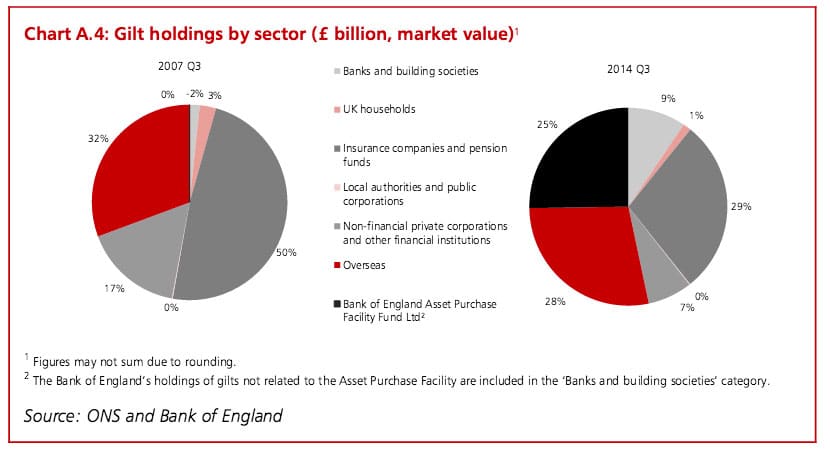
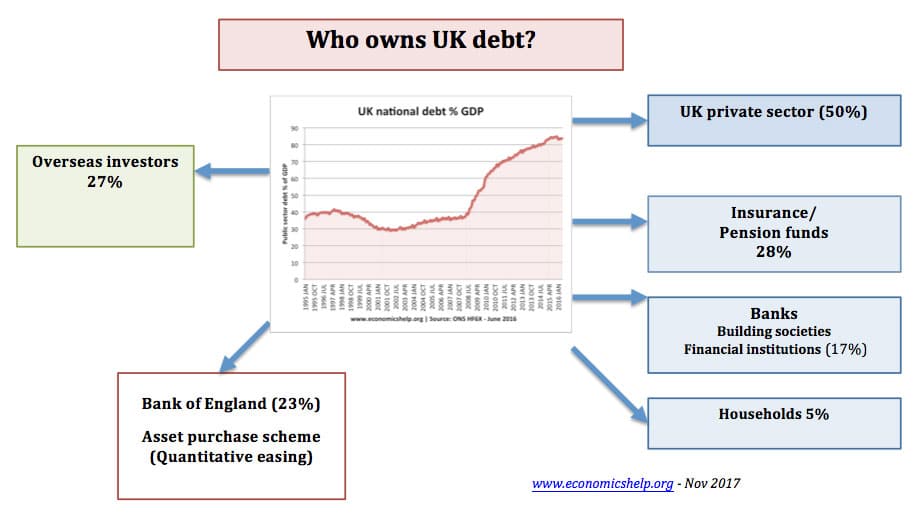
Since 2008, The Bank of England has purchased 25% of government gilt holdings as part of quantitative easing. This means a significant proportion of UK debt is being financed by Bank of England.
Trends on holdings of UK Gilts

The Bank of England has not taken nearly 30% of gilt holdings.
Foreign Holdings of UK Debt
The percent of UK government bonds bought by foreign financial institutions.
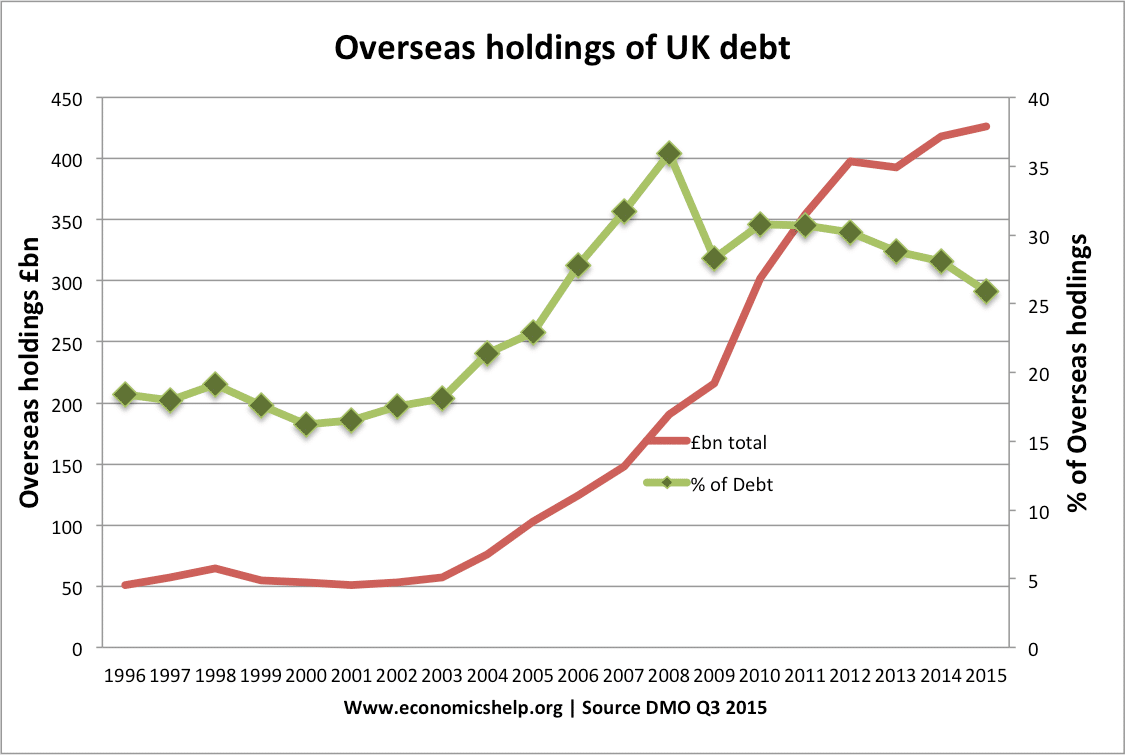
UK Debt held by oversees investors
Quantitative Easing and Government Debt
Since 2009, the Bank of England has used electronically created money to purchase government bonds. The initial wave of quantitative easing involved £200bn. Therefore, a significant part of the governments debt is held by the Bank of England. (21% at start of 2011)
Note: The purpose of quantitative easing is supposed to be – keep interest rates low, encourage bank lending. It isn’t meant as a way of financing government debt. After economic recovery, the Bank of England will sell these government bonds back onto the market. Thus debt will be held by the private sector again.
Related
About The Author

that is why greece had one bailout and now needs another and there debt is getting bigger, because they borrowed money at intrest so they stabilised for a while but mass intrest payments on the loan mean now they need another and whatever happens this time in two years they will need another, only by loaning intrest free then using austerity cuts can you reduce it
about why there is not enough money to pay debt, money is lent from central bank at intrest, which means there can never be enough money in circulation to pay it back, say if i borrowed 1000 pounds and had to pay back 1200 if i give all money back i still owe two hundred pounds that i dont have so the banks are creating a constant spiral of debt that is why every country is sinking deeper and deeper and it will never stop
THAT IS THE POINT!!!
Nobody lends the goverment money, they just take it and write it on our tab. Cash reserves and credit are used (read: money is robbed out of pensions & long term deposits, also known as your savings, that you ultimately pay back after they spend it)) and they bang it on to our tax bills, to complete a “world class rodgering”. Thank you Labor, although I do like a bit of slap & tickle first!
gordon states that the Govt. borrows money from the private sector. For that, read a private bank or banks. Formerly, the BoE was private of course. These private financiers are the likes of the Rockefellers (who also have a HUGE vested interest in the New York & Federal Reserve banks) and our old friends the Rothschilds.
You all know the tale of how the Rothschilds financed both sides fighting in the Napoleonic War, right? I hope so, as I don’t want to go over it again. Basically these private bankers plan the economy for the government departments, & allow the boom-bust actions we’ve seen all too often. The ‘ministers’ are just the mouthpiece, which of course makes it look like the Govt. is at the rudder steering us through the murky financial waters that are actually controlled by the 6 mega-banks who in turn control the markets.
watch money masters on u tube.it explains all this in great detail.3 1/2 hours long.
Now that would be ironic, borrowing money with interest from the very people who created the problem in the first place, seem like heads I win, tales you lose.