
Readers Question: Who lends the government money?
Government debt is primarily sold to banks, pension funds, private investors and overseas investors. These financial institutions and individuals effectively lend the government money in return for gaining a safe investment (bond) with a guaranteed interest payment. Approx 27% is ‘lent’ by overseas investors.
Investors do not see themselves as ‘lending’ money to the government. From their perspective, government bonds provide a relative safe, secure, low-risk investment option. In an investment portfolio, government debt secures the low-risk, low yield aspect.
UK public sector debt in Aug 2017 was £1,773.3 billion equivalent to 88% of GDP. See: UK National Debt.
On this debt, the government have to pay interest payments, In 2016/17 this was £49.1bn – approx 2.5% of GDP billion a year. See: interest payments on UK debt.
To finance this national debt, bonds are sold through the Debt Management Office (DMO) on behalf of the government to the private sector. Most of this government debt is bought by financial institutions such as:
- Pension funds
- Building societies.
- Investment trusts
- Insurance companies
- Private individuals (UK households)
Therefore, the interest payment is paid to those who buy the government bonds and gilts.
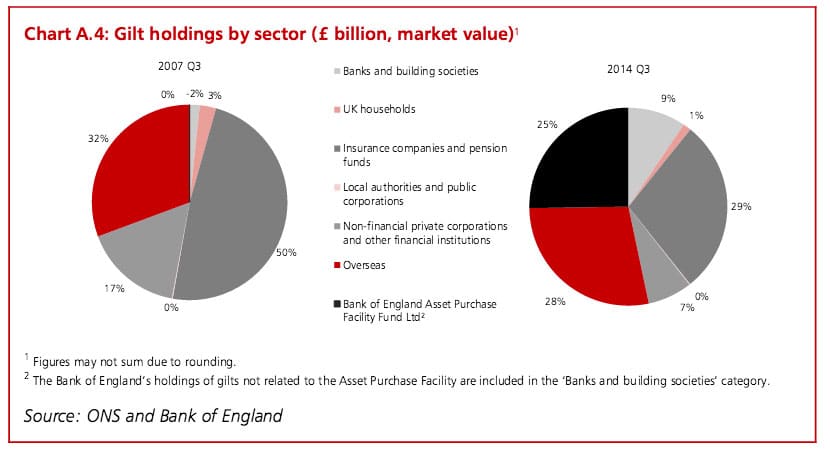
Since 2008, The Bank of England has purchased 25% of government gilt holdings as part of quantitative easing. This means a significant proportion of UK debt is being financed by Bank of England.
Trends on holdings of UK Gilts

The Bank of England has not taken nearly 30% of gilt holdings.
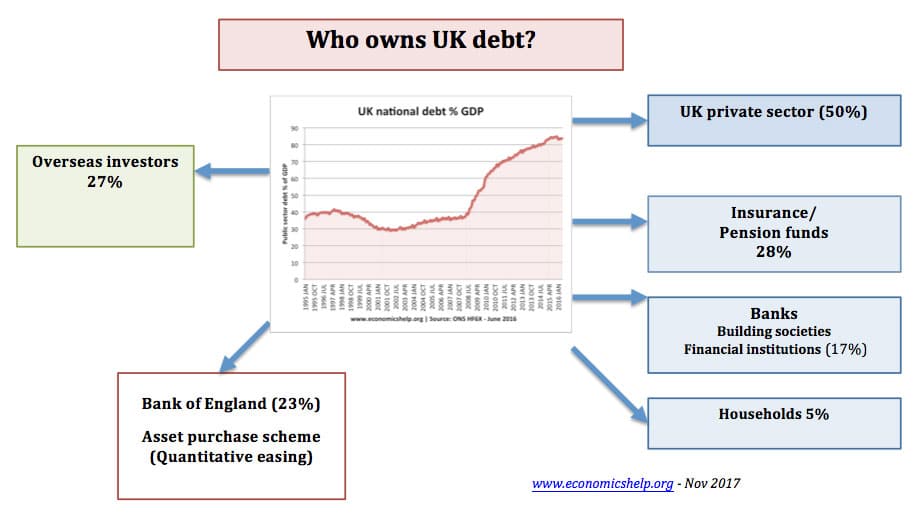
Foreign Holdings of UK Debt
The percent of UK government bonds bought by foreign financial institutions.
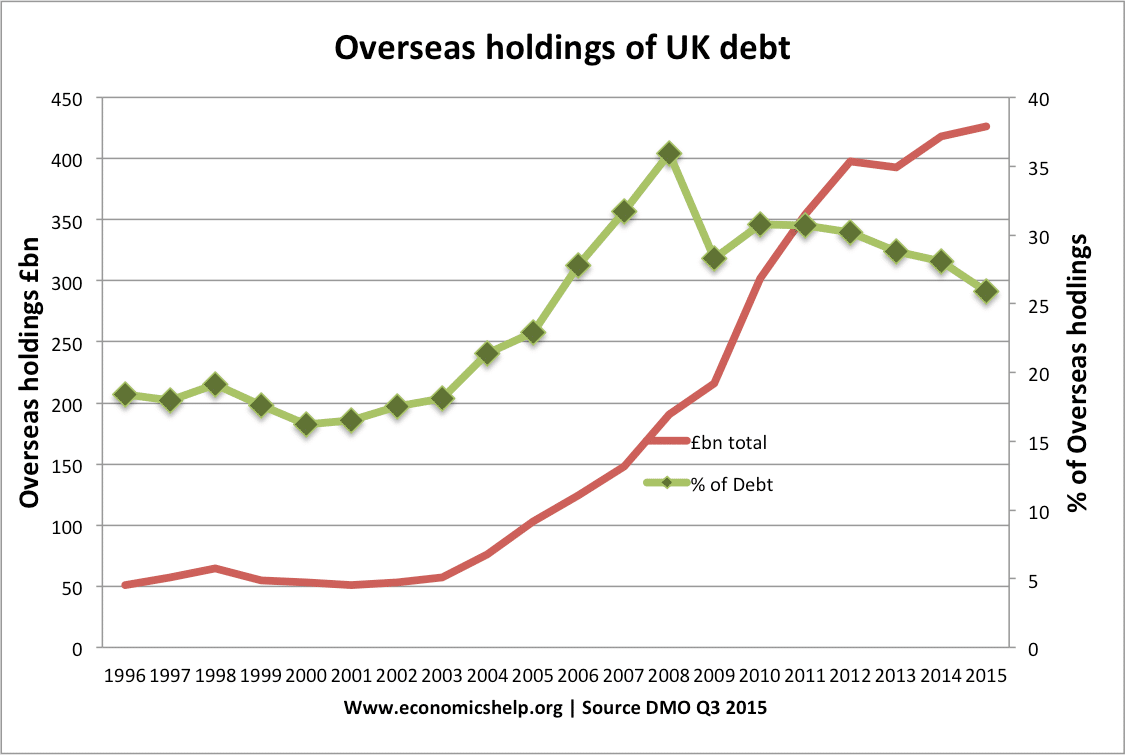
UK Debt held by oversees investors
Quantitative Easing and Government Debt
Since 2009, the Bank of England has used electronically created money to purchase government bonds. The initial wave of quantitative easing involved £200bn. Therefore, a significant part of the governments debt is held by the Bank of England. (21% at start of 2011)
Note: The purpose of quantitative easing is supposed to be – keep interest rates low, encourage bank lending. It isn’t meant as a way of financing government debt. After economic recovery, the Bank of England will sell these government bonds back onto the market. Thus debt will be held by the private sector again.
Related
About The Author

National Debt
The Government borrows money from the private sector. The borrowed money is the national debt.
Is there are list of the people/organisations/institutions who have loaned the government money?
How much of the money that the Government owes has been borrowed from UK banks – that have been rescued by the government?
We have given these people the authority to create money out of thin air and through that device they control everything. And if you want to win the battle to stop that you have to deny them the ability to create money.
Why in the world does the government borrow money from the bank, when they have the ability to create it themselves without borrowing and asking interest for it? And nobody can answer that question!
Broken Note – Let ‘Em Hang ;-)
i would like to know more on the issue of who exactly benefits from the uk national debt that my great grandchildren are going to be paying.
They just printing money which is NOT backed by Gold standard like it used to be! JUst like the Feds in the US, they print money and act like they borrowed from somewhere! Sometimes I begin asking question like “who did they borrow the money from?” and nobody can give you a significant answer to that
No one around me or in the media seems to know who the goverment is loaning the money from that they are giving to the banks. From the research I have done it seems to go around the houses and comes back to the goverment. So if it is that goverment is borrowing money from itself why is it charging itself (taxpayers) interest. Can anyone explain this to me?
why don’t the government -Bank of England instead of giving stupid banks money as if the banks are the sole of the country and instead lift the mood of the country by giving back to the people especially those who are in great financial problems so that they might continue to spending. The government needs to stop being greedy and see the bigger picture. Proposal, people who have savings of 20,000 do not need help of such but help the people out. japan did it. why not us.