
Readers Comment. Why doesn’t the Bank of England just print the money instead of borrowing the money?
Printing more money doesn’t increase economic output – it only increases the amount of cash circulating in the economy. If more money is printed, consumers are able to demand more goods, but if firms still have the same amount of goods, they will respond by putting up prices. In a simplified model, printing money will just cause inflation.
Video explanation
How printing money causes inflation – Example
- Suppose an economy produces $10 million worth of goods; e.g. 1 million books at $10 each. At this time the money supply will be $10 million.
- If the government doubled the money supply, we would still have 1 million books, but people have more money. Demand for books would rise, and in response to higher demand, firms would push up prices.
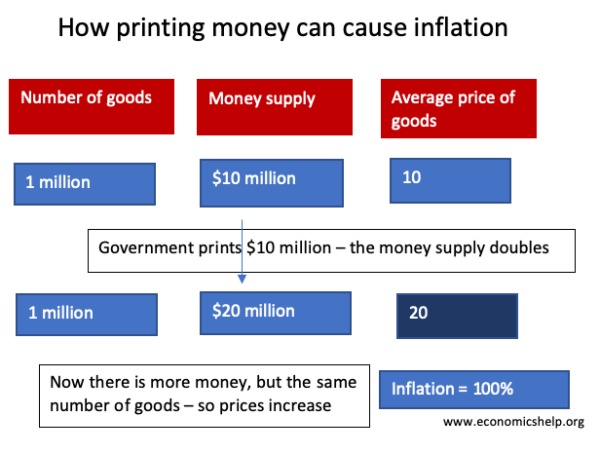
- The most likely scenario is that if the money supply were doubled, we would have 1 million books sold at $20. The economy is now worth $20 million rather than $10 million. But, the number of goods is exactly the same.
- We can say that the increase in GDP is a money illusion. – True you have more money, but if everything is more expensive, you are not any better off.
- In this simple model, printing more money has made goods more expensive, but hasn’t changed the quantity of goods.

Doubling the money supply, whilst output stays the same, leads to a doubling in price and inflation rate of 100%
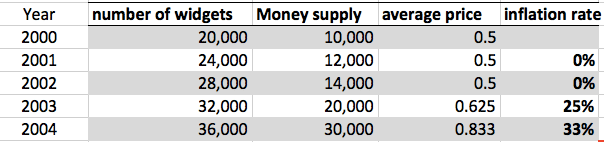
- From the year 2000 to 2001, the money supply increases without inflation.
- In 2001, the money supply increases 20%, and the number of widgets increases 20%. Therefore, prices stay the same – the extra money is matched by an equivalent rise in the money supply.
- It is only in 2003 when the money supply increases from 14,000 to 20,000 that the money supply increases at a faster rate than output and we start to get rising prices.
Problems of inflation
Why is inflation such a problem?
- Fall in value of savings. If people have cash savings, then inflation will erode the value of their savings. £1 million marks in 1921 was a lot. But, due to inflation, two years later, your savings would have become worthless. High inflation can also reduce the incentive to save.
- Menu costs. If inflation is very high, then it becomes harder to make transactions. Prices frequently change. Firms have to spend more on changing price lists. In the hyperinflation of Germany, prices rose so rapidly that people used to get paid twice a day. If you didn’t buy bread straight away, it would become too expensive, and this is destabilising for the economy.
- Uncertainty and confusion. High inflation creates uncertainty. Periods of high inflation discourage firms from investing and can lead to lower economic growth.
Printing money and national debt
Governments borrow by selling government bonds/gilts to the private sector. Bonds are a form of saving. People buy government because they assume a government bond is a safe investment. However, this assumes that inflation will remain low.
- If governments print money to pay off the national debt, inflation could rise. This increase in inflation would reduce the value of bonds.
- If inflation increases, people will not want to hold bonds because their value is falling. Therefore, the government will find it difficult to sell bonds to finance the national debt. They will have to pay higher interest rates to attract investors.
- If the government print too much money and inflation get out of hand, investors will not trust the government and it will be hard for the government to borrow anything at all.
- Therefore, printing money could create more problems than it solves.
- See also: Printing money and national debt
Hyperinflation in Germany during the 1920s
Inflation was so bad in Germany that money became worthless. Here a child is using money as a toy. Money was used as wallpaper and to make kites. Towards the end of 1923, so much money was needed, people had to carry it about in wheelbarrows. You hear stories of people stealing the wheelbarrow, but leaving the money.
Printing more money is exactly what Weimar Germany did in 1922. To meet Allied reparations, they printed more money; this caused the hyperinflation of the 1920s. The hyperinflation led to the collapse of the economy.
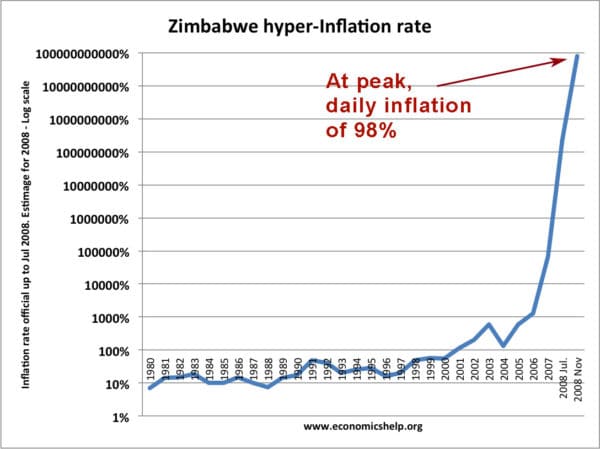
Hyperinflation also occurred in Zimbabwe in the 2000s.
Printing money and the value of a currency
If a country prints money and creates inflation, then there will be a decline in the value of the currency.
- Suppose inflation in Germany is 100%, and inflation in the UK is 0%.
- This means German prices are doubling compared to the UK.
- You will need twice as much German currency to buy the same quantity of goods.
- The purchasing power of the German currency is declining, therefore the value of mark will fall on exchange rates.
- See also: Printing money and the exchange rate
Value of one German Mark to US Dollar 1922-23

Hyperinflation in Germany causes a rapid fall in the value of the German mark to the dollar.
In a period of hyperinflation, investors will try and buy a stable foreign currency because that will hold its value much better.
Real Life example of Money Supply and Inflation
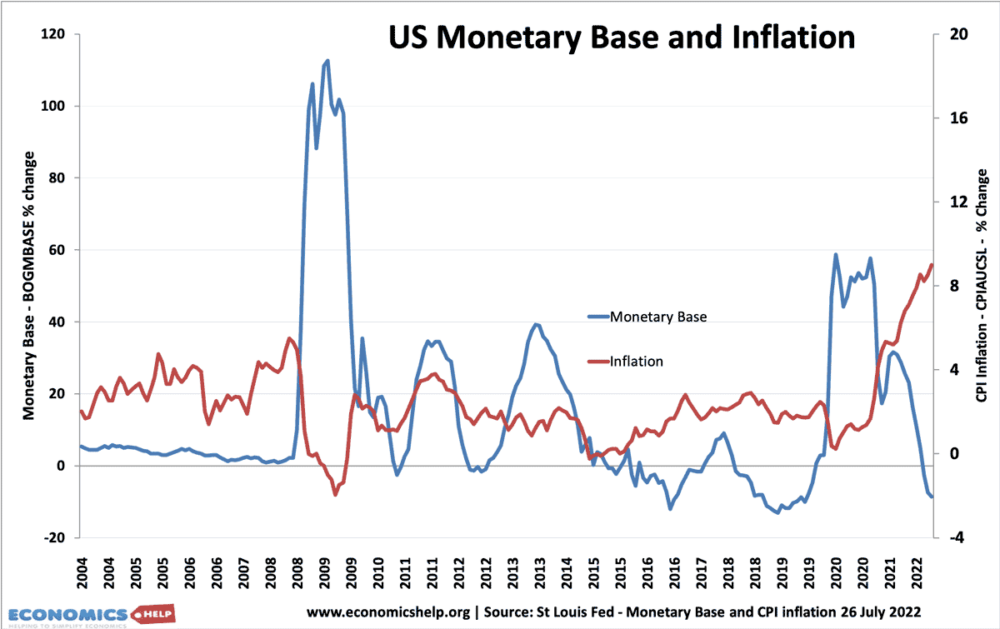
In a recession, with periods of deflation, it is possible to increase the money supply without causing inflation.
This is because the money supply depends not just on the monetary base, but also the velocity of circulation and the willingness of banks to lend. For example, if there is a sharp fall in transactions (velocity of circulation) then it may be necessary to print money to avoid deflation,
In the liquidity trap of 2008-2012, the Federal Reserve pursued quantitative easing (increasing the monetary base) but this only had a minimal impact on underlying inflation. This is because although banks saw an increase in their reserves, they were reluctant to increase bank lending.
However, if a Central Bank pursued quantitative easing (increasing the money supply) during a normal period of economic activity then it would cause inflation. In 2020, quantitative easing was pursued and a year later, inflation in the US rose. (though inflation also rose due to higher oil prices)

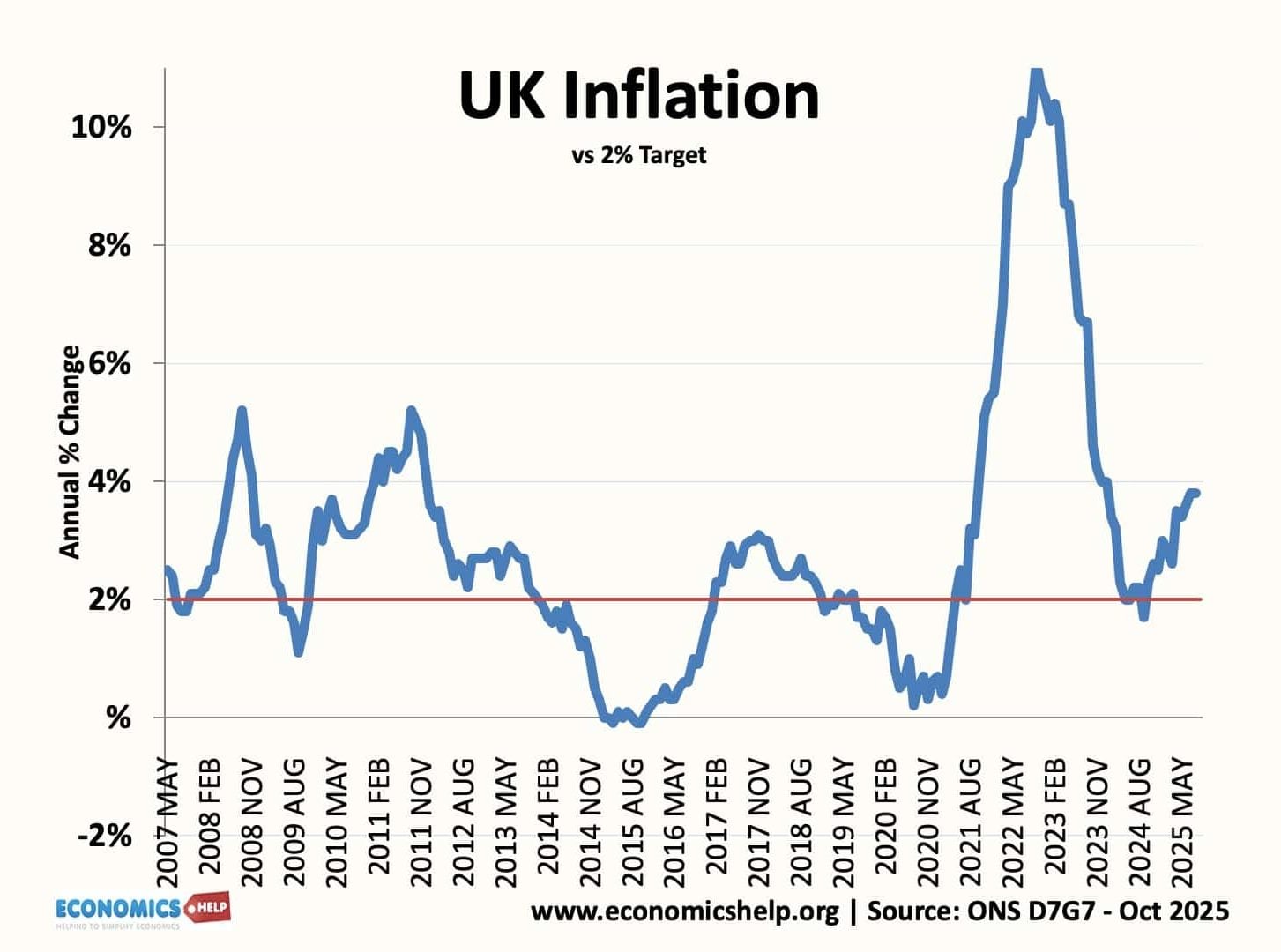
QE caused big increase in bank reserves at Bank of England, but limited impact on money supply and inflation. However, in 2021/22, inflation did pick up (primarily because of cost-push factors) but also strong demand at end of covid.
Related
Last updated: 26th July 2022, Tejvan Pettinger, www.economicshelp.org, Oxford, UK
About The Author

Teyvan,the world does not follow economic principals that are taught in universities.In the case of Germay at that time there were other reasons than money supply.Teaching economics as a perfect science is a joke and hoodwink by those who have something to gain over the gullible.Money can and is controlled by powerful people our current economy is based on exchange of currencies created by those people.Teach the reality,but then you cannot.The system would dispose of your position.
I understand the ECONOMIC explanation about “If government prints money to pay debt / to give to EVERYONE, there will be hyperinflation”
Now, I want to ask a question about ABUSE OF POWER to enrich a handful of INDIVIDUALS, NOT the institution of government as a whole:
1-What if the CB prints money NOT to give to everyone, but only to SOMEONE?
What is there to prevent the Central Bank, say, from printing money to benefit a mistress of the bank chief, by ‘creating’ new money into her bank account? Who is there to audit or monitor the CB?
What if this problem is writ larger — the ruling party ‘creating’ new money for itself by, say, buying up the private bonds of that party, while appointing party allies as the team of auditors to ‘audit’ the CB (and specifically, to whitewash all these questionable transactions)?
In other words, what if the central bankers are dishonest and not trustworthy BUT nobody outside the inner circle of power knows about it? This is a real possibility in authoritarian or corrupt countries
If they could keep this kind of abuse to a manageable extent, couldn’t they avoid creating appreciable inflation in the economy, eg. if they keep the ‘printing’ low, to, say, 0.01% of the CB’s balance sheet?
Sometimes, it’s all well and good to talk about abstract economic THEORIES, but we need to consider their real world consequences too
i like this kind of reasoning,when things are done outside the normal procedures it can create a debacle in the economy
“To meet Allied reparations, [Weimar Germany] printed more money; this caused the hyperinflation of the 1920s. The hyperinflation led to the collapse of the economy.”
This is not really true. The printing of money did accelerate hyperinflation, but it was not what had caused it. The main reason that the mark lost all its value in 1923-24 was that Germany had been invaded by French and Belgian troops looking to enforce the ‘Reparations’, which had gone unpaid for several months, and they occupied the Ruhr region for nearly a year. The Ruhr was Germany’s industrial heartland, and most German workers went on strike, refusing to manufacture goods while the occupation continued. The upshot of this was that the German industrial base was producing almost no goods, resulting in widespread shortages. With demand outstripping supply by many scales, prices for what few goods there were went spiralling upwards. With there being so little that the Deutschmark could be used to purchase, its value plummeted.
It was only after this process had already been well under way for some months, and the occupation was putting terrible pressure on the Weimar Government to co-operate with the ‘Reparations’, that the decision was made to print the money with which payments could be resumed.
This is not to imply that printing money is a harmless idea, it isn’t, but in small amounts in isolation, it does very little damage at all. Insufficient goods to meet demand was the cause of hyperinflation, not the printing of money.
“With demand outstripping supply by many scales, prices for what few goods there were went spiralling upwards.”
What you’ve described is one cause of inflation which always occurs for a short period of time when there is a shortage. You have then incorrectly attributed it to being a cause of hyperinflation.
Inflation due to shortages has a price ceiling before none of the goods are bought and/or alternative (cheaper) sources are found. That ‘new’ competition forces the previous suppliers to reset their prices lower or face the prospect of going out of business. Which is why inflation due to shortages doesn’t last long in a free society and absent any money printing.
If instead of allowing that cycle to play out, money is printed without restraint, it is that printing and that printing alone which causes hyperinflation – not the shortages. There has never been a single case of hyperinflation without printing.
Shortages can ONLY ever cause inflation which in Germany, as you said, had only been underway for ‘months’.
Printing is the cause of hyperinflation and not only does it increase the extent of the damage but extends its duration to many years rather than weeks or months.
“If instead of allowing that cycle to play out, money is printed without restraint, it is that printing and that printing alone which causes hyperinflation – not the shortages. There has never been a single case of hyperinflation without printing.”
You have neither explained nor demonstrated why.
That’s right, but we had to scroll all the way down to get this. We are not living in ‘normal’ times and normal rules of capitalism don’t apply. People have no money.
How about you print a load of money – set the inflation rate and make sure that everybody sticks to rate of inflation/by making this the law – and then the price of a book will by law will only be able to go up by the amount of inflation therefore the book will not cost double and there will still be more money to go around, why set an inflation rate anyway no one sticks to it, every day you go into the shop everything has gone up by way more than inflation