
Readers Comment. Why doesn’t the Bank of England just print the money instead of borrowing the money?
Printing more money doesn’t increase economic output – it only increases the amount of cash circulating in the economy. If more money is printed, consumers are able to demand more goods, but if firms still have the same amount of goods, they will respond by putting up prices. In a simplified model, printing money will just cause inflation.
Video explanation
How printing money causes inflation – Example
- Suppose an economy produces $10 million worth of goods; e.g. 1 million books at $10 each. At this time the money supply will be $10 million.
- If the government doubled the money supply, we would still have 1 million books, but people have more money. Demand for books would rise, and in response to higher demand, firms would push up prices.
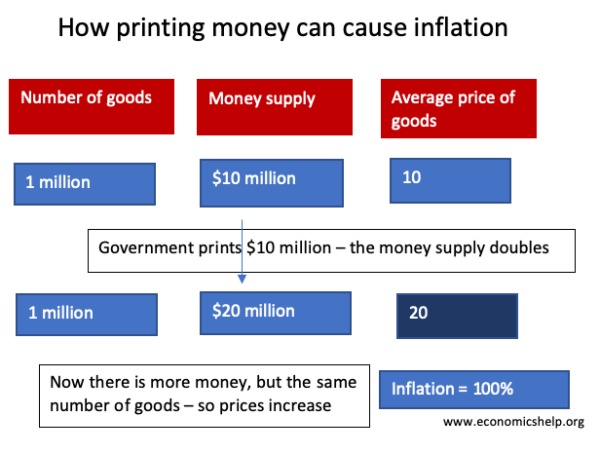
- The most likely scenario is that if the money supply were doubled, we would have 1 million books sold at $20. The economy is now worth $20 million rather than $10 million. But, the number of goods is exactly the same.
- We can say that the increase in GDP is a money illusion. – True you have more money, but if everything is more expensive, you are not any better off.
- In this simple model, printing more money has made goods more expensive, but hasn’t changed the quantity of goods.

Doubling the money supply, whilst output stays the same, leads to a doubling in price and inflation rate of 100%
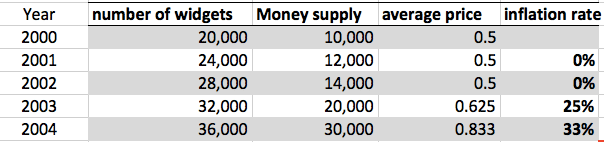
- From the year 2000 to 2001, the money supply increases without inflation.
- In 2001, the money supply increases 20%, and the number of widgets increases 20%. Therefore, prices stay the same – the extra money is matched by an equivalent rise in the money supply.
- It is only in 2003 when the money supply increases from 14,000 to 20,000 that the money supply increases at a faster rate than output and we start to get rising prices.
Problems of inflation
Why is inflation such a problem?
- Fall in value of savings. If people have cash savings, then inflation will erode the value of their savings. £1 million marks in 1921 was a lot. But, due to inflation, two years later, your savings would have become worthless. High inflation can also reduce the incentive to save.
- Menu costs. If inflation is very high, then it becomes harder to make transactions. Prices frequently change. Firms have to spend more on changing price lists. In the hyperinflation of Germany, prices rose so rapidly that people used to get paid twice a day. If you didn’t buy bread straight away, it would become too expensive, and this is destabilising for the economy.
- Uncertainty and confusion. High inflation creates uncertainty. Periods of high inflation discourage firms from investing and can lead to lower economic growth.
Printing money and national debt
Governments borrow by selling government bonds/gilts to the private sector. Bonds are a form of saving. People buy government because they assume a government bond is a safe investment. However, this assumes that inflation will remain low.
- If governments print money to pay off the national debt, inflation could rise. This increase in inflation would reduce the value of bonds.
- If inflation increases, people will not want to hold bonds because their value is falling. Therefore, the government will find it difficult to sell bonds to finance the national debt. They will have to pay higher interest rates to attract investors.
- If the government print too much money and inflation get out of hand, investors will not trust the government and it will be hard for the government to borrow anything at all.
- Therefore, printing money could create more problems than it solves.
- See also: Printing money and national debt
Hyperinflation in Germany during the 1920s
Inflation was so bad in Germany that money became worthless. Here a child is using money as a toy. Money was used as wallpaper and to make kites. Towards the end of 1923, so much money was needed, people had to carry it about in wheelbarrows. You hear stories of people stealing the wheelbarrow, but leaving the money.
Printing more money is exactly what Weimar Germany did in 1922. To meet Allied reparations, they printed more money; this caused the hyperinflation of the 1920s. The hyperinflation led to the collapse of the economy.
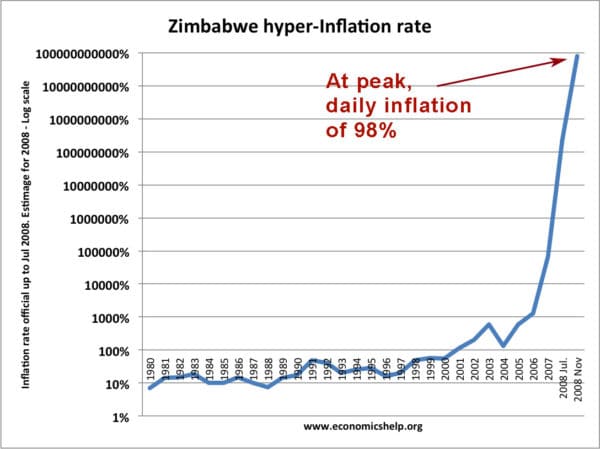
Hyperinflation also occurred in Zimbabwe in the 2000s.
Printing money and the value of a currency
If a country prints money and creates inflation, then there will be a decline in the value of the currency.
- Suppose inflation in Germany is 100%, and inflation in the UK is 0%.
- This means German prices are doubling compared to the UK.
- You will need twice as much German currency to buy the same quantity of goods.
- The purchasing power of the German currency is declining, therefore the value of mark will fall on exchange rates.
- See also: Printing money and the exchange rate
Value of one German Mark to US Dollar 1922-23

Hyperinflation in Germany causes a rapid fall in the value of the German mark to the dollar.
In a period of hyperinflation, investors will try and buy a stable foreign currency because that will hold its value much better.
Real Life example of Money Supply and Inflation
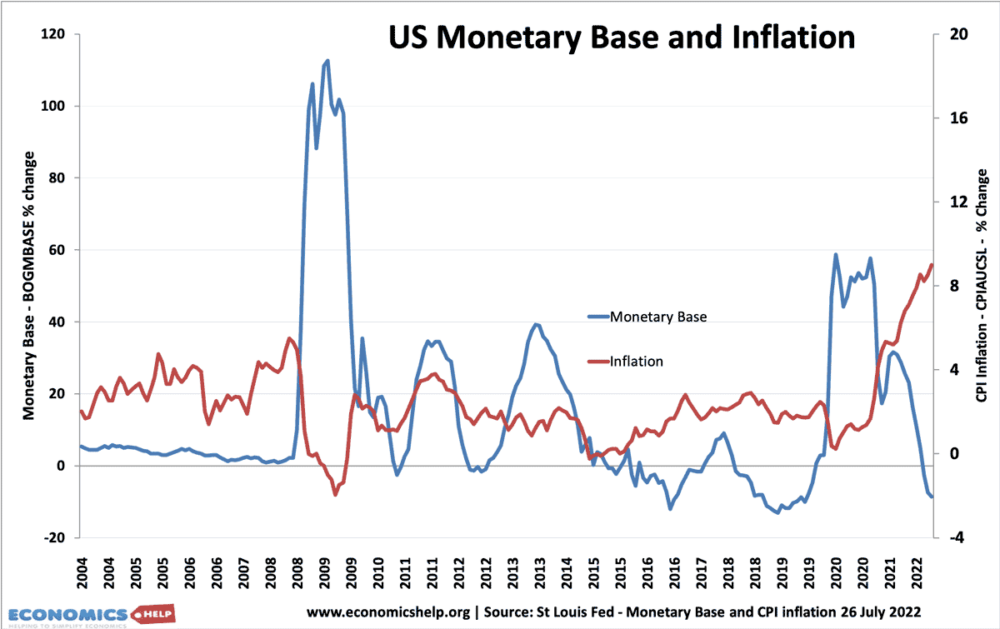
In a recession, with periods of deflation, it is possible to increase the money supply without causing inflation.
This is because the money supply depends not just on the monetary base, but also the velocity of circulation and the willingness of banks to lend. For example, if there is a sharp fall in transactions (velocity of circulation) then it may be necessary to print money to avoid deflation,
In the liquidity trap of 2008-2012, the Federal Reserve pursued quantitative easing (increasing the monetary base) but this only had a minimal impact on underlying inflation. This is because although banks saw an increase in their reserves, they were reluctant to increase bank lending.
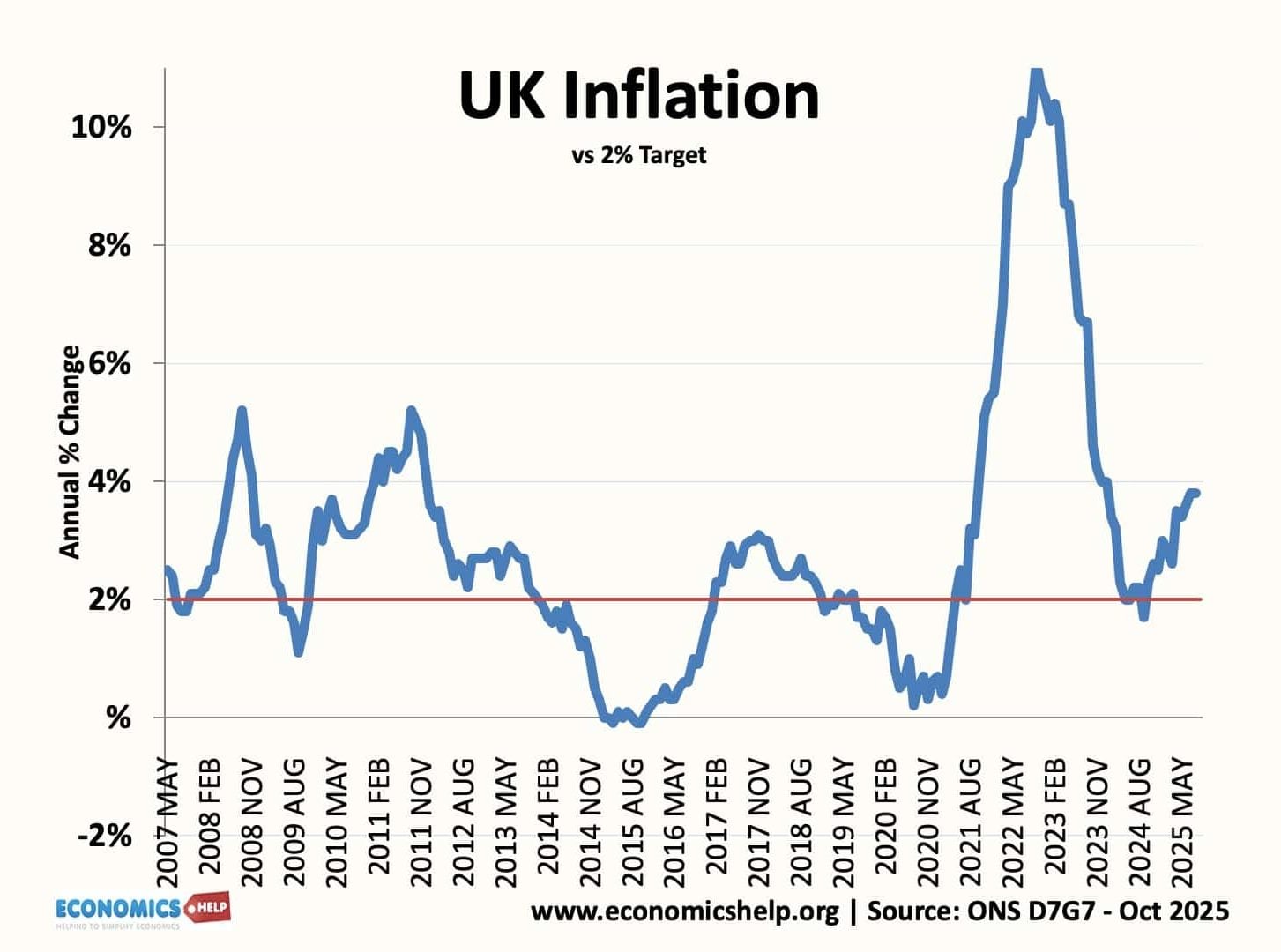
However, if a Central Bank pursued quantitative easing (increasing the money supply) during a normal period of economic activity then it would cause inflation. In 2020, quantitative easing was pursued and a year later, inflation in the US rose. (though inflation also rose due to higher oil prices)

QE caused big increase in bank reserves at Bank of England, but limited impact on money supply and inflation. However, in 2021/22, inflation did pick up (primarily because of cost-push factors) but also strong demand at end of covid.
Related
Last updated: 26th July 2022, Tejvan Pettinger, www.economicshelp.org, Oxford, UK
About The Author

Good exchange of ideas, Keynesian theory etc. I have a decent grasp of micro and macro economics, however, am not well-read on the subject of currency exchange (or just don’t remember from college).
My question for Tejvan is about our current crisis. We know from the 08/09 financial crisis that banks won’t necessarily distribute money that the government loans/gives in the U.S. and other countries. The direct payments to U.S. citizens which started a few weeks ago in addition to the increase in unemployment benefits will certainly be an interesting study in 12 months. With so many capital intensive industries around the world in serious “free fall”, what is your view on global inflation if world governments have to continually inject money for the next 4-6 quarters? What role does the IMF and World Bank play in attempting to “balance” such unprecedented government intervention? With each passing day, it seems that we are in for 20%-25% unemployment levels in a year or less without repeated government support. This support may take the form of “welfare/public assistance”, forgivable loans to corporations and concepts yet to be discovered and tested. Is the CV-19 pandemic calling for world governments to print money, sensibly distribute, track and keep inflation in check? Thanks
I think the main goal is to stave off serious depression and deflation. Printing money will be desirable because output will fall so much. It would require a lot of money printed before inflation is an issue.
Surely a government like the UK can inject more money by printing it, into the economy for targeted things. Pay of dept, build hospitals, pay living wage etc. If this is controlled properly then it could work. Many of the posts on here speak about extreme cases where a wheel barrow of money was required for a loaf. In a controlled process it will not get out of hand, except where those in finance cause it to!. They are scared in case their bubble bursts and they become joe public like most of us. It is more to do with the share of money in the country, not how much is circulating. An extra £500m printed for the NHS can be controlled surely!
The answer to counter inflation and still provide stimulus packages for the poor, vulnerable and emergency cases may be Crypto Currency.
Seperate to the main economy if used right then Block chain can help manage temporary to long term crisis.
Dollars are international base currency so far that dollars in overseas countries are seen as safe investments. Then printing money without increase of productivity will mean that dollars will go out of US to pay for goods they (US) do not have. But dollars will have to be reinvested in US which means that more and more of US debt will be under foreign hands. And the real assets of US will have to non US owners. Then average Americans won’t be as rich, the others will be not as poor. And then how long can American investments be attractive?
Then let me ask you another question. If the reason why you are selling those books is to make money, why go through the trouble of making more when you can just increase the price of those books?
If you decide to make another million books, you now have double the number of books to sell, but your number of potential customers didn’t change. Do you see how this can be a problem?
It is much easier to increase the price of your goods than to find new customers to try and sell to. So when you increase the money supply of your current customers by giving them more money to spend (printing more money) it becomes a no brainer to just increase the price of your books by the same relative amount as the increase of money given to your customers.
Say your customers start out with 100$ to spend, your 10$ book costs them 10% of their available supply. If the government comes in and decides to give them all 100$ more, they now all have 200$ to spend. If you raise the price of your books to 20$ would they become reluctant to buy it? More than likely they would pay those extra 10$ because the book still costs 10% of their available money supply.
So by that rationale, one million books at $10,$10 million dollars, why would the price go up? Seems like a pretty stupid thing to me. why not just make more books?
It can be difficult to increase output