
In the past two decades, the UK has experienced a steady flow of net migrants into the economy. The 2016 Brexit vote has led to a sharp fall in net EU migration, but has been offset by a rise in non-EU migration. This net migration has had a wide-ranging impact on the UK population, wages, productivity, economic growth and tax revenue. Does net migration benefit the UK economy?

- Net Migration peaked in late 2023 at over 900,000.
- Since then net migration has started to fall.
History of Migration

Until 1990, the UK usually had met emigration. This was often emigration to countries like Australia, New Zealand, US and Canada. In the late nineteenth century it was often emigration to the Empire. Note in the 1950s and 60s, there were high levels of immigration (from West Indies, Pakistan and India), but this was offset by even high levels of emigration (people leaving)
Inflows and Outflows

We have seen a rise in both immigration and emigration. But, since 2023, we are starting to see a big fall in net migration.
EU migration

Until the Brexit vote in 2016, net migration was driven by EU migration – in particularly Eastern European countries like Poland, Czech, Romania and Hungary. But, now there are greater outflows of EU migrants than inflows. The migration surge of 2022/23 was driven by non-EU migrants taking advantage of the post-Brexit visa rules.
Traditionally non-EU immigrants are more likely to come for family reasons, whilst EU migration has been focused on work.
Impact of Net Immigration on UK Economy
1. Increase in Labour Force
Migrants are more likely to be of working age. The majority of migrants come for work or study (students) They may bring dependents, but generally net immigration leads to an increase in the labour force, a decline in the dependency ratio and increases the potential output capacity of the economy.
2. Increase in aggregate demand and Real GDP
Net inflows of people also lead to an increase in aggregate demand. Migrants will increase the total spending within the economy. As well as increasing the supply of labour, there will be an increase in the demand for labour – relating to the increased spending within the economy. Ceteris paribus, net migration should lead to an increase in real GDP. The impact on real GDP per capita is less certain.
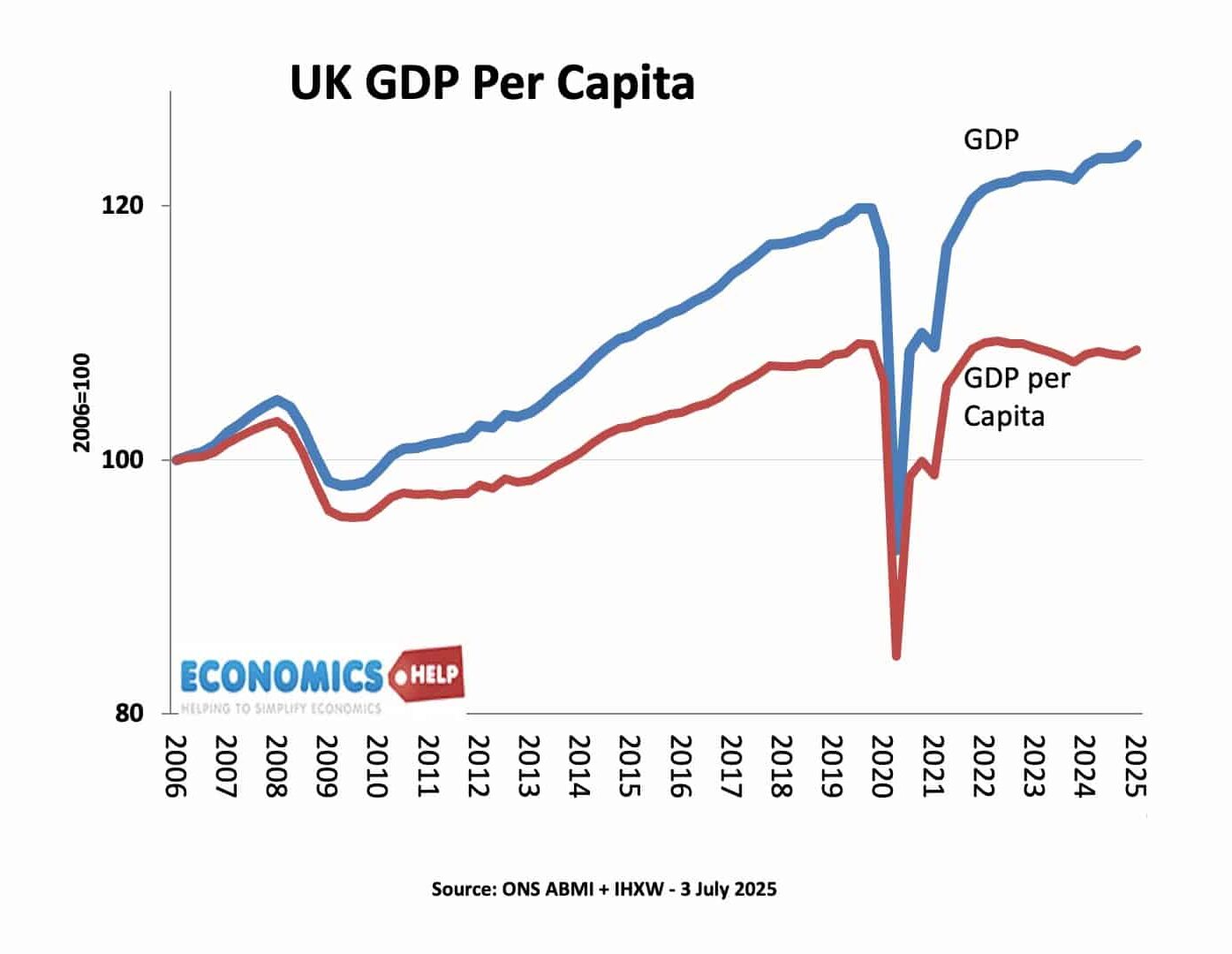
In fact, net migration can make economic growth look stronger than it is. In the period 2005-2025, UK real GDP has increased significantly faster than GDP per head. See GDP per capita for more info.
3. Labour Market Flexibility
Net migration could create a more flexible labour market. Migrants will be particularly attracted to move to the UK if they feel that there are job vacancies in particular areas. For example, during the mid-2000s, there was a large inflow of workers from Poland and other Eastern European economies – helping to meet the demand for semi-skilled jobs, such as builders and plumbers. The government has also sought to attract migrants from various countries to meet shortfalls in job vacancies in key public sector jobs, such as nursing.
- In theory, a period of higher unemployment might discourage migrants (this has occurred in the case of Ireland). However, the UK aw continued net migration despite higher unemployment 2008-12. Since 2012, unemployment has fallen considerably and migration has remained fairly constant.
4. Positive impact on the dependency ratio

With an ageing population, the UK is forecast to see an increase in the dependency ratio. However, net migration helps to reduce the dependency ratio. Migrants are more likely to be a source of working-age people, and this helps to reduce the ratio of retired to working people. The Migration Observatory reports, that in 2019, 70% of the foreign born were aged 26-64, compared to 48% of the UK born (link). This younger population has benefits for the government’s budget. If migrants are of working age, they will pay income tax, VAT – but will not be claiming benefits.
5. Impact on particular sectors
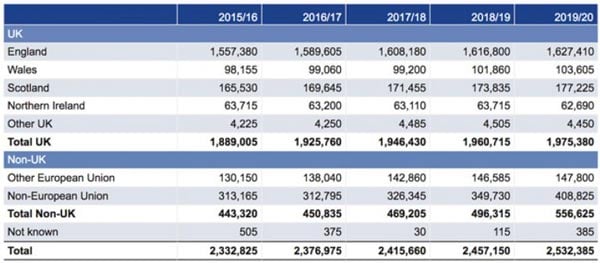
An important reason for net migration is higher education. In 2019/20, according to Higher Education Statistics Agency (HESA) there were 556,625 international students (link), studying in the UK. These students may not show up in long-term migration trends. But, the short-term effects are quite important. The London Economic analysis estimate that students of 2018-19 contributed a net £25.9 billion to the UK economy (link – pdf). A very significant contribution. These payments also help to finance higher education for domestic students.

The latest ONS report suggests formal study is the biggest reason for net migration into the UK. See also: reasons for net migration into the UK
6. Social issues
Another issue felt keenly in the UK, is the concept that we are already ‘overcrowded’ In this case, a rapid increase in the population due to migration could lead to falling living standards. For example, the UK faces an acute housing shortage, but also an unwillingness to build on increasingly scarce green belt land. In many cities, it is difficult to build more roads because of limited space. The increased population could increase congestion and urban pollution. Therefore, the increase in real GDP has to be measured against these issues which affect the quality of life.
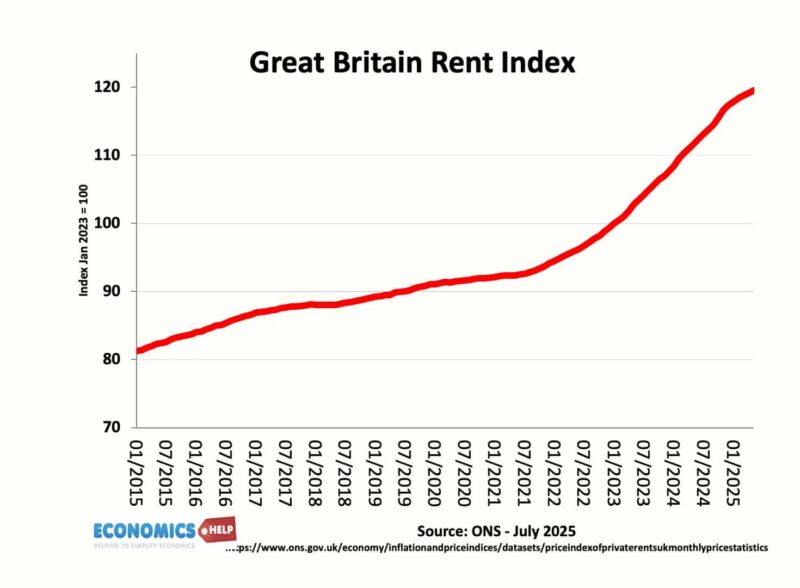 Rents increased significantly during years of high net migration
7. Economies of scale
Others may argue that concepts of ‘overcrowding’ are misplaced. In the nineteenth century, people were already worried about overcrowding. But higher population densities are in one sense more efficient and have a lower environmental impact. Other countries like Belgium have an even greater population density than the UK. Also, if migrants help to grow the economy, there will be more tax revenue to finance public infrastructure.
8. Welfare benefits
A popular idea is that immigrants are more likely to receive welfare benefits and social housing. The suggestion is that Britain’s generous welfare state provides an incentive for people to come from Eastern Europe and receive housing and welfare benefits. While immigrants can end up receiving benefits and social housing. A report by the University College of London, suggests that :
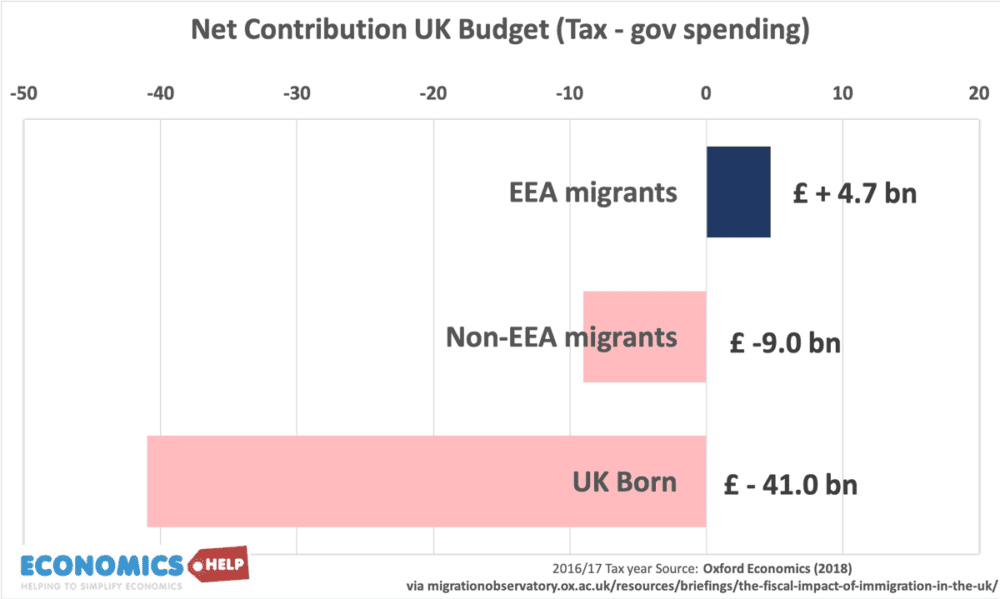
- However, despite the positive figures in the decade since the millennium, the study found that between 1995 and 2011, immigrants from non-EEA countries claimed more in benefits than they paid in taxes, mainly because they tended to have more children than native Britons.
In recent years, claiming unemployment benefits in the UK is quite strict – the claimant count measure of unemployment is much less than the Labour Force Survey (see: Unemployment stats). People have to prove they are looking for work. Also, the criteria to be given an immigration visa from non-EU countries is increasingly strict. The migrant often have to show they have a degree of savings or an offer of a good job. The UCL report on immigration suggested that immigrants tend to be more highly skilled than native workers.
- In 2011, 32% of recent EEA immigrants and 43% of non-EEA immigrants had university degrees, compared with 21% of the British adult population.
Does Immigration Cause Unemployment?

There is no clear link between migration and unemployment. Net migration occurred with falling unemployment 1991-2005, but rising unemployment from 2008-12. The fall in unemployment since 2012 may have attracted more migrants coming to work.
A common question people often ask – is whether immigration causes unemployment? Migrants have often been blamed for ‘taking our jobs’ – especially in periods of high unemployment, and in local areas of above-average unemployment.
Firstly, net migration is compatible with low unemployment. Net migration helped the US population to increase drastically around the turn of the century, but this didn’t cause unemployment. Migrants bring both an increased supply of labour and higher demand for labour. In the 1990s, net migration was consistent with falling unemployment in the UK.
However, in periods of high unemployment, it may be much more difficult for migrants to find work. This may be exacerbated if the migrants have poor English, low skills and or suffer racial discrimination. In this case, net migration could add to the unemployment problem. However, the underlying cause of unemployment is not net migration, but the recession.
Qualifications of Migrants
Another factor that determines the impact on unemployment is the skills and qualifications of immigrants. If migrants have low skills, they are more likely to experience structural unemployment. In the 1950s, immigration into the UK from the Caribbean was encouraged for manual labour (driving buses e.t.c.) to fill job vacancies. However, when the period of full employment ends, migrants may be more liable to be unemployed if they lack the skills to find new work.
The impact on unemployment in the current crisis depends on the type and skills of workers who are migrating into the UK.
 Source: Centre for Economic Performance, LSE
This shows that the unemployment rate for immigrants tends to be higher than for UK born workers. This gap is especially true during recessions. One reason put forward is that immigrants tend to be more likely to be working on short-term contracts, and so in a downturn are more likely to be laid off.

Source: Employment studies
This shows that the fall in unemployment corresponded with rise in EU net migration 2012-2015
Does Immigration Push Down Wages?

This shows that higher levels of net migration did correspond to lower growth in real income. Though innumerable factors affect wage growth other than migration. Since 2008, it was an era of low productivity growth.
Theoretical explanation
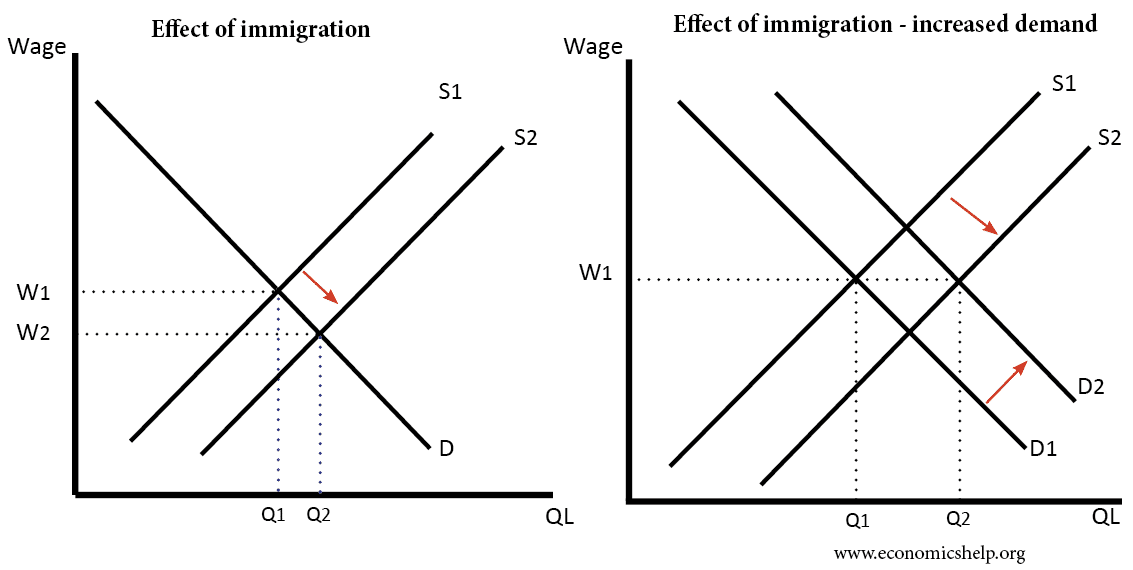
From one perspective an increase in the labour supply may push down wages. This is especially true if migrants are keen to accept lower wages (e.g. willing to bypass traditional union bargaining). However, again, net migration doesn’t have to push down wages. The massive immigration into the US, during the twentieth century, was consistent with rising real wages. Increased migration, will also affect demand for labour due to higher spending in the economy. Immigration increases labour supply – but also increased labour demand.
However, particular labour markets may notice lower wages if there is a concentration of immigrants willing to work. For example, if wages are high in a particular agricultural market, migration from a low-income country may lead to falling wages in these specific markets.
Also, some migrants may be more vulnerable and more willing to work in the black market (e.g. accept a wage below the equilibrium).
Further reading: Lump of labour fallacy – the fallacy that increased labour supply always pushes down wages.
Bank of England study on wages and immigration
A Bank of England found a rise in immigration had a tiny impact on overall wages – with a 10% increase in immigration – wages fall by 0.31%. However, the negative effect was greater for semi/unskilled workers in the service sector, with a 10% rise in immigration reducing wages the equivalent of 2%. B of E report. However, this explains only a small fraction of the real wage decline since 2007.
Video on Immigration
Evaluation of Immigration
The impact of net immigration depends on:
- The skills and qualifications of migrants. The UK is increasingly strict on allowing only skilled workers.
- How easy do migrant find it to assimilate in the destined country? E.g. in the 1950s and 1960s, migrants from the Indian sub-continent / Caribbean may have found it more difficult to find employment due to poor English / racial discrimination.
- It depends on the age profile of migrants. If a high % are young workers, then this can help reduce the dependency ratio – a crucial issue for the government budget.
- It depends on the current economic climate. In a recession, migrants will find it harder to gain employment.
- It depends on the type and skills of migrants. Migrants from Eastern Europe may be more flexible and return home if the economic situation deteriorates. Low skilled migrants are more likely to be structurally unemployed.
- Migrants can be a source of foreign income, e.g. tuition fees from foreign students. However, migrants may also send a substantial portion of their earnings to relatives abroad – reducing the wealth of UK.
- Can the Economy absorb a greater population? For example, what are the impact on public services, levels of congestion, and housing?
Impact of Immigration on Housing
Positive net migration levels are a significant factor in increasing the number of households in the UK. Given limited housing supply (and difficulties of increasing supply), this is putting upward pressure on UK house prices and the price of renting.
Related posts
- Reasons for net migration into the UK
- Immigration and the black market
- Flexible labour markets and immigration
- Long-term migrants data at ONS
NOTE: EEA – European Economic Area – EU, plus EFTA countries Norway, Iceland and Liechtenstein.
About The Author

Productivity in the UK has barely grown since the late 90s because of underinvestment in industry.
Capital has been routed to infrastructure to support a larger population: roads, hospitals, schools in particular.
Historical investments in infrastructure, both public and private, after allowing for depreciation/obsolescence represent over £1million/head.
Only looking at income, benefits, and tax contributions misses the balance sheet impact of too fast growth.
Once productivity/head falls too far behind the UK’s competitors in high-tech industries it will be very hard to attract future investment in order to catch-up
well detailed report, in 1999 to 2009 immigrants have done significant contribution to increase the economy of the eastern part of England. those immigrants were students from Africa, offered cheap skilled and non skilled labor to numbers of high tech industries in east England,also pay school fees, taxes , spend a lot of money in restaurant, supermarket, shopping mall and majority of the never ever claimed benefits,it is not true that majority of migrants claimed more benefit than paying taxes as spelled out by Prof Christian Dustman
I am interested in having a copy of Professor Christian Dustman’s report supporting his assertion that majority of immigrants claim more benefit than paying taxes.
Great article, I’ve been thinking about this subject all day today, especially that the new EU referendum has just been announced for 23rd of June.
I’m an immigrant from Eastern Europe, and I’m proud that I came to the UK and serve this nation with my skills and talent. However, whoever says that immigrants are damaging the economy or that are pulling down wages, I must say they are fairly stupid (sorry). I’m a highly skilled automotive paint sprayer, and I earn just over 40K a year (yes, that’s £20/hour).
Now £40K for a paint sprayer is a colossal sum, even for a native worker, the average paint sprayer earns around £25K-£28K a year. So I’m obviously not pulling down wages, but the opposite: I’m motivating other people to work harder and earn more. The matter of fact here is that I, just like hundreds of thousands of other highly skilled immigrants, am not providing value to the nation by offering cheap labour, but instead, by offering talent, ambition, motivation, unique skills and extremely fast work. Something that hundreds of companies wouldn’t get, if it wasn’t for us.
And we also spend a lot of money and pour it back into the economy to “make the engine turn” – me and my wife are injecting more than £2.7K every month back into the system (well, we are humans as well we go to the pub, we go to restaurants, we eat fish and chips, we drive our car, we pay our rent and bills, etc.), plus we pay hundreds of pounds of taxes, and we never ever claimed benefits.
Just look at the US: it accepted millions of immigrants that literally built the country from scratch, and they are still accepting immigrants that are driving innovation and creating companies over companies, and using their talent to boost the economy and the country is booming with companies that can compete on a global scale because they have access to great talent and great people.
I’m telling you my friends, a country that would close the door to immigrants, will also close the door to innovation, unique talent, and would be a lot less competitive on the global market. Hopefully, the UK won’t be that country :)
All the best,
Fery
I agree with your comment, I’m a native but understand and agree that many skilled hard working people bring innovation and creative progression as a nation. Unfortunately there is a balance on both ends of hard working. One may work hard to gain at others expense then you have hard workers who work hard for a better future for everyone.
I agree with you , one part of immigrants help boost UK’s economy,they are hard working and pay tax,but there are other part of immigrants who came to UK to claim benefits.
Overall, looking at GDP growth for last 50 years, immigration demonstrably has no effect on economic growth.
Queries on Grubb:
Stone and Rowthorn are outliers in terms of researchers, their views are not definitive.
A fiscal spend that does not take place is not then a fiscal spend?
The £20bn you estimate is not provided free to immigrants, they pay for their accommodation and so it does not ‘have to be found’.
If you were correct then Sir Nickells’ conclusion would not stand, but most do economists accept that the surprising thing about immigration seems to be how little it affects unemployment or the per capita income of incumbents. For example, as with David Card’s research and that of NIESR.
A major benefit ignored here is the OBR’s estimate of significant government debt ratio reduction to 2060 as total GDP grows even if per capita stays broadly the same.
Query on Ross: If GDP per capita remains constant, what is the point of any immigration? If doesn’t benefit the incumbents, and the incumbents are so strongly opposed to it, why have any at all since it only allows benefits the elite? I thought income inequality was thought to be a serious problem, if not THE problem?
Any estimate on debt ratio reduction to 2060 would seem likely to be purely speculative, and based on the ONS projection of a UK population of over 100 million by 2114. It’s hard to imagine what that would look like – hardly a “green and pleasant” land – with the majority of any benefits that accrue disappearing offshore.
Roger: Immigration greatly benefits immigrants at no cost to incumbents- surly that matters? But I accept that immigration is a social issue even if it is not an economic one.
The OBR forecast is out to 2060 ie. not that speculative for the foreseeable future
Thanks for the information, especially highlighting the fact that so much migration into the UK is to do with study, which brings millions of pounds into the economy. I am interested to know if there is any way to calculate how much money has come into the UK due to rich migrants fleeing war zones in the Middle East. My local neighbourhood has seen a noticeable influx of rich Iraqis and later rich Syrians over the last 15 years so I often wonder how much the UK profits from these wars. Also, I recently read an article about how instability in Turkey was leading rich Turks to invest in more property in London, and in many cases they were thinking of sending their children to university in London. I think the UK is seen as a safe bet in times of global instability.