
Readers Question: Has Japanese government debt always been so high, or is this a recent phenomenon, caused by the high public spending during the country’s ‘lost decade’?
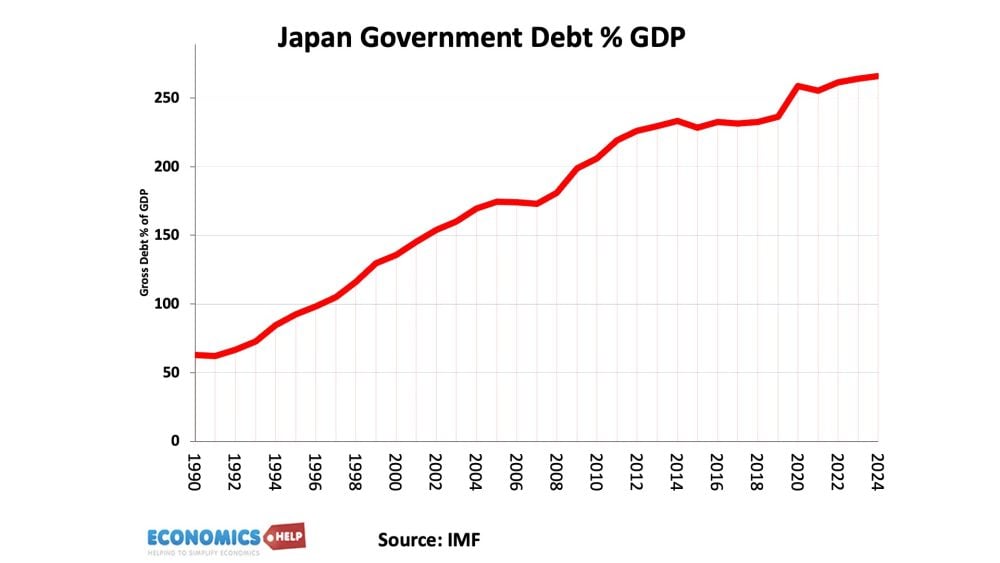
No, Japan’s national debt has definitely increased since the bubble burst in the late 1980s. Debt as a % of GDP has increased because of various spending increases to overcome the recession (construction pork barrelling which failed because of the endemic deflation)
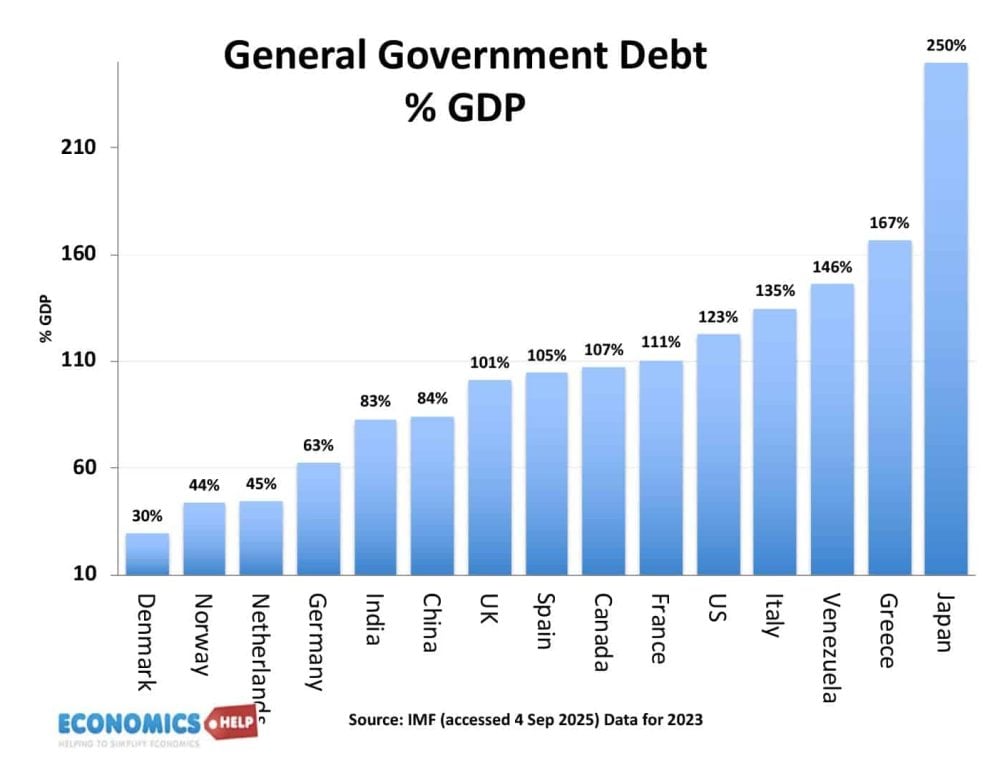
But, also the sluggish growth has meant debt / GDP ratio has risen.
Also, the cost of servicing national debt is placing a great strain on any attempts to reduce debt. I have seen various figures for Japanese national debt, depending on which measure you use. But, national debt in Japan is 260% of GDP (2025) – more than twice the US and is a much more serious problem than many seem to think. How long can Japan continue to fund such massive deficits?
Japan’s Debt and Assets.

Japanese debt is slightly misleading because the government has very high levels of assets. (Japan is biggest net creditor) Bank of Japan holds substantial part of Japanese government debt.
It’s net public liabilities was 78% in 2025 (Fred St Louis)
The reason for high levels of debt in Japan are
- High savings ratio
- Ageing Population
- Slower growth
- Low inflation (until Recently)
- Low Debt
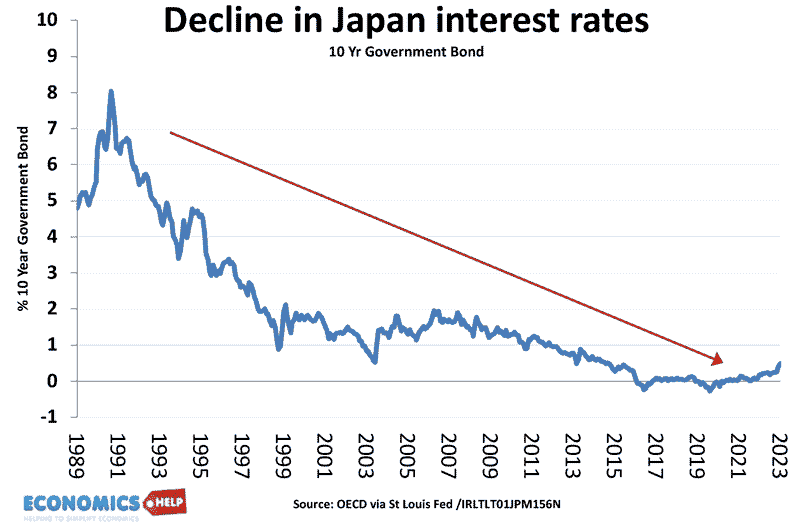
Japanese interest rates fell from 1989 to 2022, though have started to increase as markets expect more inflation.


Graph showing Cost of Servicing Japan’s national debt
This graph shows how the cost of servicing Japan’s National debt has increased since the 1970s. It is a salutary reminder of the cost involved in a large public sector debt. The cost would be even higher if interest rates were not so low in Japan.
Note: the cost of servicing national debt is not just the interest payment but includes a redemption cost (cost of repaying the bond at end of period – say 60 years)
(i.e. Cost of servicing National debt = interest payments + bond redemption + administrative costs) as a percentage of the central government’s retained tax revenue (=tax and stamp revenue – local tax transfers).
Another measure is –
Interest payments on debt as % of government revenue
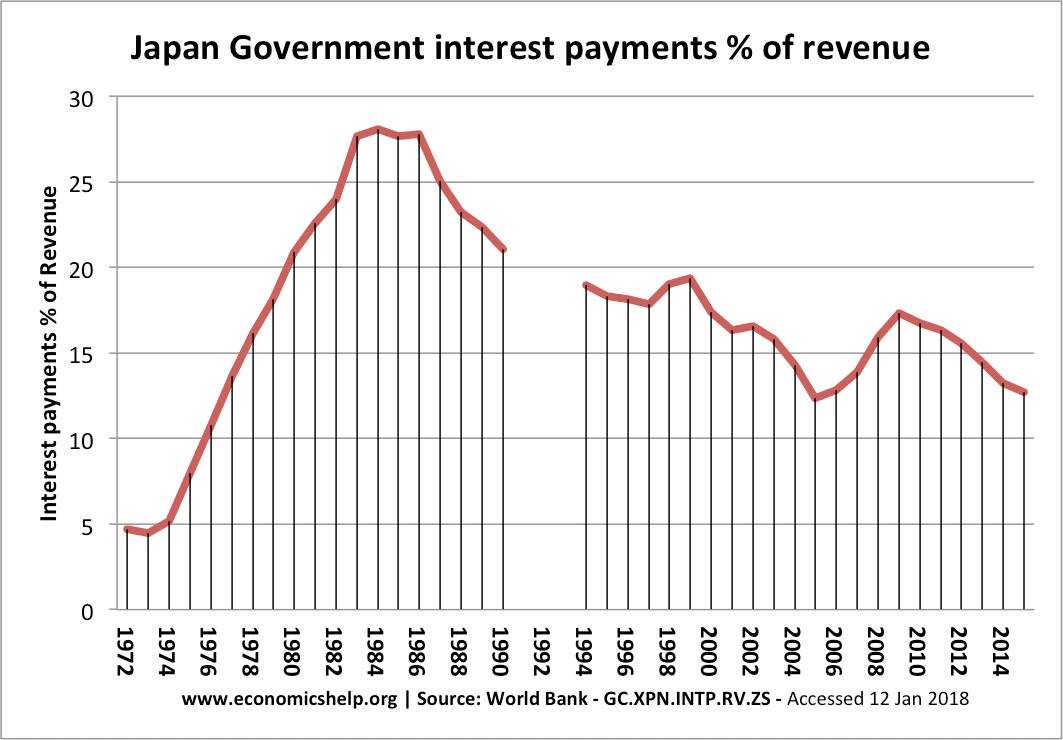
Source: World Bank (link)
About The Author

George, if greek debt is denoted in EUROs, reimporting the drachme as a national currency isn’t going to do much good. With a sure devaluation of the drachme relative to the EURO, debt would only rise.
Since its entry into the Eurozone in 2001 Greece has been drifting into the strong currents of river euro to its downfall. The river cannot be turned back. Here and now, Greece must exit this river and return to the calm waters of its own drachma that has carried Greece gloriously over the centuries. After all the drachma was invented by the ancient greeks and the modern greeks will be better off to listen to their ancestors and not to the German sirens that have become now the skylla and xarubdis of the IMF and the Eurofin.
Noted. Thanks a lot!
Yes, I’ve seen different figures. e.g.
https://www.cia.gov/library/publications/the-world-factbook/geos/ja.html#Econ
say public debt is 170% in 2008 (est) – though other stats estimate it at 195%
The 135% was from an outdated figure in 2001, so I updated.
There can also be different ways of measuring outstanding public debt.
Hi just little bit confused on the figure you use. Sometimes you mentioned that Japan’s National debt is 195% of its GDP and here you quote it as only 130% twice the size of US economy?