
Q. How does the Bank of England decide and set interest rates?

- The Bank of England set the repo rate. This is sometimes known as the ‘base rate’. It is the interest rate at which commercial banks (like Lloyds and Natwest) borrow from the Bank of England.
- The Bank of England can control liquidity and money supply, so commercial banks need to borrow short-term money from the Bank of England.
- This means this repo rate is important for commercial banks. Therefore, if the Bank of England increases their repo rate, commercial banks tend to increase their interest rates too.
- Note: banks are not obliged to follow the Bank of England rate decisions. (e.g. when the Bank of England cut interest rates to 0.5%, many mortgage companies didn’t cut their own interest rates)
- However, generally, the Bank of England base rate, determines all the main saving and borrowing rates in the economy.
- The aftermath of the credit crunch was unusual in that bank lending rates didn’t immediately follow the Bank of England base rate. In fact the Bank of England introduced quantitative easing to try and reduce bond yields further.
What determines interest rate decisions?
- The Monetary Policy Committee of the Bank of England, meet every month to decide whether the interest rate should be changed.
- They have an inflation target of CPI – 2%+/-1. This means they try to keep inflation close to 2% (between 1% and 3%).
- If inflation increases above the target (or is forecast to rise above the target) then the Bank of England are likely to increase interest rates.
- Higher interest rates increase the cost of borrowing and make saving more attractive. This tends to reduce consumer spending and investment and reduce the growth of aggregate demand. Therefore, economic growth tends to slow down and this reduces inflationary pressure.
- If inflation is below the target, then they may cut interest rates to boost spending and economic growth.
- The MPC tries hard to predict future inflation by looking at many economic variables – inflation forecasts
Example
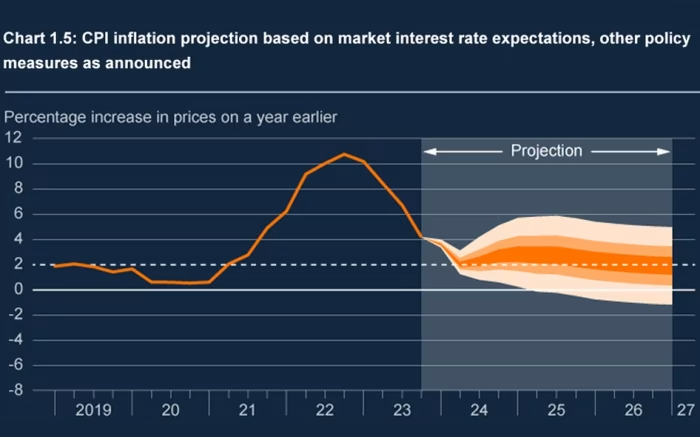
In 2023, the Bank were predicting inflation would fall to 2% target and stay pretty close, therefore, this would enable them to cut interest rates or keep them the same. In actuality, inflation turned out to be higher than their central forecast rising to 3.8%
In late 2025, inflation started to fall, and with a fall in wage growth and weak economic growth they started to cut interest rates again.
Factors influencing inflation forecasts of Bank of England
- Wage rates – rising wages can cause both cost-push and demand-pull inflation.
- Rate of economic growth compared to long-run trend rate
- Commodity prices – rising oil prices may cause inflation.
- Consumer spending levels
- Investment levels
- Consumer confidence.
- Value of Pound. A devaluation will tend to increase import prices and cause inflation.
Other Important Variables – Growth
As well as trying to target inflation, the Bank of England considers other aspects of the economy. In particular, they need to consider the impact of monetary policy on economic growth and unemployment.
Therefore, it is possible that inflation can go above target, but they feel they need to keep interest rates low. e.g. currently, growth is fragile and unemployment high, this encourages the bank to keep interest rates low.
Type of Inflation
- There are different causes of inflation. If inflation occurs because the economy is overheating and there is rampant wage inflation – this presents a stronger case for raising interest rates to moderate economic growth and prevent boom and busts.
- If it is caused by cost-push inflation (e.g.) caused by higher oil prices and in which case, the Bank may need to accept higher inflation because with cost-push inflation, the economy is already slowing down.
- If inflation rises because of temporary factors like volatile energy prices or indirect taxes, this is likely to be less cause for concern.
What type of inflation –
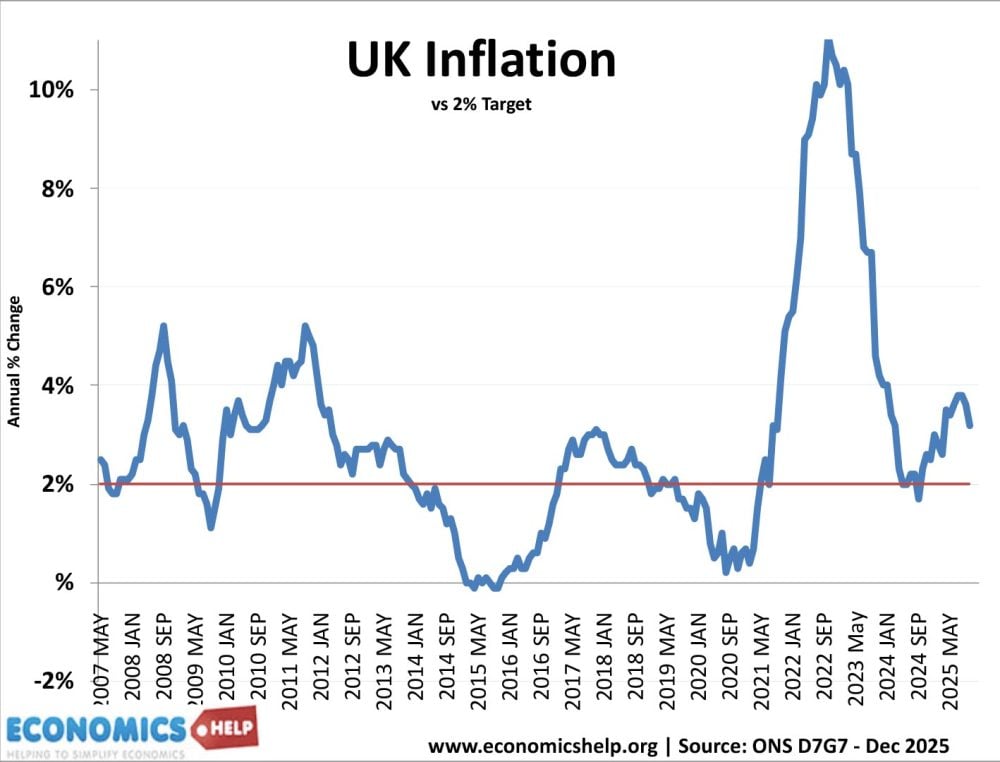
In 2008 and 2011, the UK had a spike in inflation, but the Bank of England did not increase interest rates. In fact they were at 0.5%. This was because
- Economic growth was very weak
- The inflation was due to temporary factors, such as higher oil prices and effect of devaluation (making imports more expensive)
2022 Inflation Shock
The problem is that at the end of Covid, the Bank of England thought the inflation of 2022 was a similar shock, but it ended up being much more serious and they were accused of being too slow to act
Difficulty of using interest rates
Often it is difficult to rely on interest rates to control the economy. To give just a few examples.
- Liquidity trap – zero interest rates may be insufficient to boost growth
- Cost-push inflation – high inflation and high unemployment means interest rates can’t target both
- Impact on asset prices. Low-interest rates may cause a boom in bank lending and asset prices. In the ‘great moderation’ of the 2000s, inflation was low, but, there was a boom in bank lending and asset prices. Arguably the economy needed more than just relying on interest rates.
What interest rates do the Bank of England set?
The Bank of England only set the base rate. The rate at which commercial banks borrow from Bank of England. But, changes in the base rate will have influence over other interest rates in the economy.

Banks are free to set their own rates for lending and savings. If base rates change then invariably they will change their Standard variable rates. However, this is not always the case. The shortage of funds in the global credit markets after 2008 credit crunch meant banks faced increased cost of interbank lending and also there was a shortage of liquidity.

The yield on short-term gilts tends to follow base rate quite closely. The yield on long-term gilts is influenced by other factors.
The Bank of England can also try to influence gilt yields through QE and open market operations
Related
External link
- How Monetary policy works – at Bank of England
About The Author

The lack of reference to supply in relation to demand and that increasing supply can help contain inflation is a massive, but all too frequent ommission.
The emphasis on wage inflation is absurd. Wages follow inflation, not the other way round.
It is because there are different account holders with different interests ranging from individuals,firms and governments.