
Readers Question: Who lends the government money?
Government debt is primarily sold to banks, pension funds, private investors and overseas investors. These financial institutions and individuals effectively lend the government money in return for gaining a safe investment (bond) with a guaranteed interest payment. Approx 27% is ‘lent’ by overseas investors.
Investors do not see themselves as ‘lending’ money to the government. From their perspective, government bonds provide a relative safe, secure, low-risk investment option. In an investment portfolio, government debt secures the low-risk, low yield aspect.
UK public sector debt in Aug 2017 was £1,773.3 billion equivalent to 88% of GDP. See: UK National Debt.
On this debt, the government have to pay interest payments, In 2016/17 this was £49.1bn – approx 2.5% of GDP billion a year. See: interest payments on UK debt.
To finance this national debt, bonds are sold through the Debt Management Office (DMO) on behalf of the government to the private sector. Most of this government debt is bought by financial institutions such as:
- Pension funds
- Building societies.
- Investment trusts
- Insurance companies
- Private individuals (UK households)
Therefore, the interest payment is paid to those who buy the government bonds and gilts.
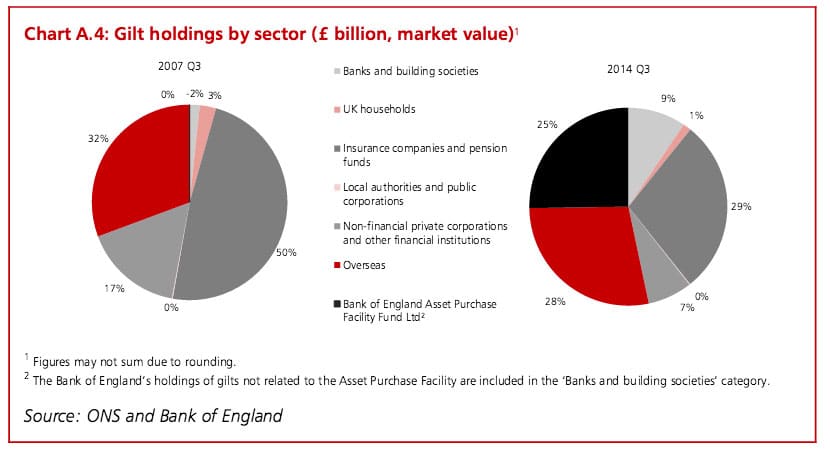
Since 2008, The Bank of England has purchased 25% of government gilt holdings as part of quantitative easing. This means a significant proportion of UK debt is being financed by Bank of England.
Trends on holdings of UK Gilts

The Bank of England has not taken nearly 30% of gilt holdings.
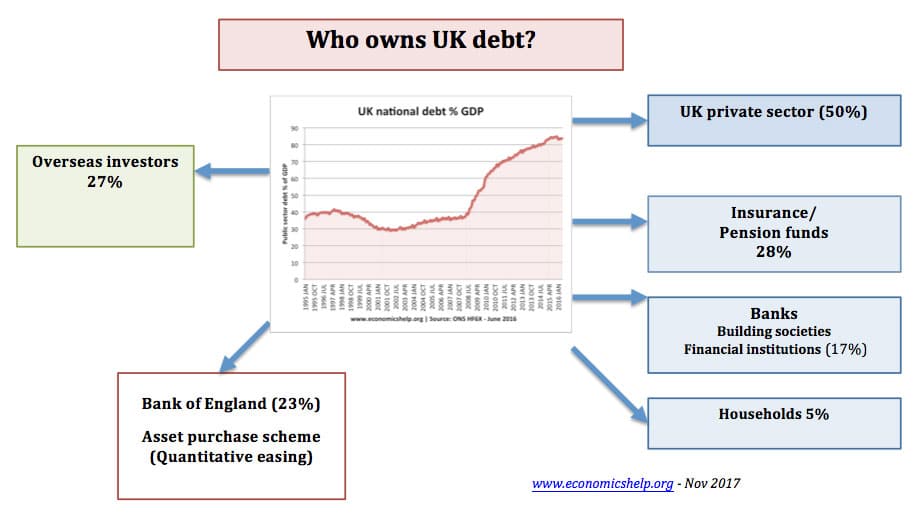
Foreign Holdings of UK Debt
The percent of UK government bonds bought by foreign financial institutions.
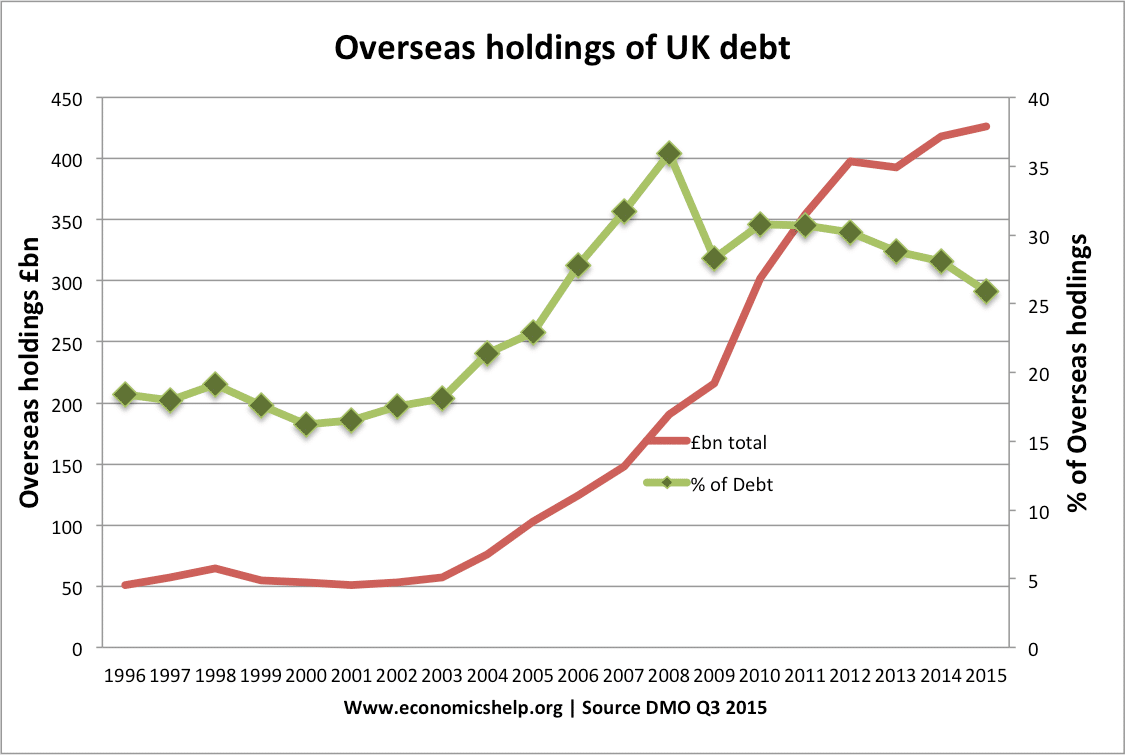
UK Debt held by oversees investors
Quantitative Easing and Government Debt
Since 2009, the Bank of England has used electronically created money to purchase government bonds. The initial wave of quantitative easing involved £200bn. Therefore, a significant part of the governments debt is held by the Bank of England. (21% at start of 2011)
Note: The purpose of quantitative easing is supposed to be – keep interest rates low, encourage bank lending. It isn’t meant as a way of financing government debt. After economic recovery, the Bank of England will sell these government bonds back onto the market. Thus debt will be held by the private sector again.
Related
About The Author

Lucien Crofts.
Apt spelling of Gilts. Was it deliberate?
The buyers of bonds would lose confidence in the us gov, they would then demand higher interest on the bonds they purchase,
Question…feel free to scrutinise.
In theory whats to stop a powerful country such as the US lending a heap of money and then saying to the lender..”actually, i dont think im going to pay you back. And theres nothing you can do about it…i control the military. And now we are going to print our own money to avoid paying interest”
I know it sounds stupid but why not? whats stopping them!
Secondly, the UK does not want to get a reputation as a weak economy, because that would increase the interest rate it has to pay to borrow money.
It is the same as an individual trying to take out a loan from a bank: if the bank is absolutely confident that the individual has enough money coming in to pay back the loan then it will charge a much lower interest rate than it will for somebody it is a bit less sure about.
as the bbc says.
basically interest is charged because to a greater or lesser extent the lender isn’t expecting to get the money back.
One important point that that throws a spanner in the works. The bank of England is buying ever increasing government debt in the form of guilts. And yet the The Bank of England is wholly owned by the British government! This is shunting part of the national debt sideways. Nothing is being reduced or payed off, it has been moved to a different ledger within the same system.