
Readers Comment. Why doesn’t the Bank of England just print the money instead of borrowing the money?
Printing more money doesn’t increase economic output – it only increases the amount of cash circulating in the economy. If more money is printed, consumers are able to demand more goods, but if firms still have the same amount of goods, they will respond by putting up prices. In a simplified model, printing money will just cause inflation.
Video explanation
How printing money causes inflation – Example
- Suppose an economy produces $10 million worth of goods; e.g. 1 million books at $10 each. At this time the money supply will be $10 million.
- If the government doubled the money supply, we would still have 1 million books, but people have more money. Demand for books would rise, and in response to higher demand, firms would push up prices.
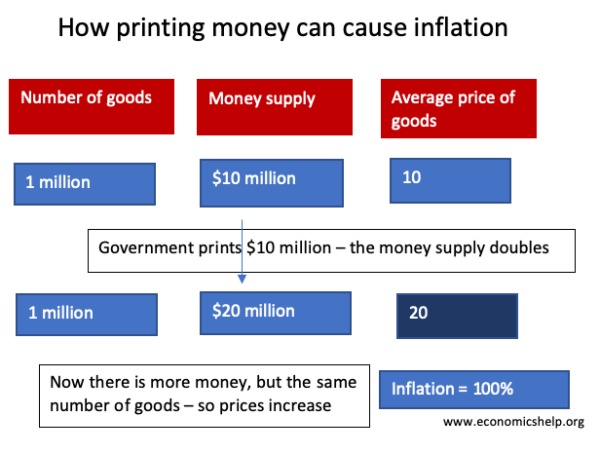
- The most likely scenario is that if the money supply were doubled, we would have 1 million books sold at $20. The economy is now worth $20 million rather than $10 million. But, the number of goods is exactly the same.
- We can say that the increase in GDP is a money illusion. – True you have more money, but if everything is more expensive, you are not any better off.
- In this simple model, printing more money has made goods more expensive, but hasn’t changed the quantity of goods.

Doubling the money supply, whilst output stays the same, leads to a doubling in price and inflation rate of 100%
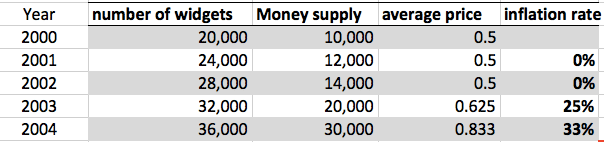
- From the year 2000 to 2001, the money supply increases without inflation.
- In 2001, the money supply increases 20%, and the number of widgets increases 20%. Therefore, prices stay the same – the extra money is matched by an equivalent rise in the money supply.
- It is only in 2003 when the money supply increases from 14,000 to 20,000 that the money supply increases at a faster rate than output and we start to get rising prices.
Problems of inflation
Why is inflation such a problem?
- Fall in value of savings. If people have cash savings, then inflation will erode the value of their savings. £1 million marks in 1921 was a lot. But, due to inflation, two years later, your savings would have become worthless. High inflation can also reduce the incentive to save.
- Menu costs. If inflation is very high, then it becomes harder to make transactions. Prices frequently change. Firms have to spend more on changing price lists. In the hyperinflation of Germany, prices rose so rapidly that people used to get paid twice a day. If you didn’t buy bread straight away, it would become too expensive, and this is destabilising for the economy.
- Uncertainty and confusion. High inflation creates uncertainty. Periods of high inflation discourage firms from investing and can lead to lower economic growth.
Printing money and national debt
Governments borrow by selling government bonds/gilts to the private sector. Bonds are a form of saving. People buy government because they assume a government bond is a safe investment. However, this assumes that inflation will remain low.
- If governments print money to pay off the national debt, inflation could rise. This increase in inflation would reduce the value of bonds.
- If inflation increases, people will not want to hold bonds because their value is falling. Therefore, the government will find it difficult to sell bonds to finance the national debt. They will have to pay higher interest rates to attract investors.
- If the government print too much money and inflation get out of hand, investors will not trust the government and it will be hard for the government to borrow anything at all.
- Therefore, printing money could create more problems than it solves.
- See also: Printing money and national debt
Hyperinflation in Germany during the 1920s
Inflation was so bad in Germany that money became worthless. Here a child is using money as a toy. Money was used as wallpaper and to make kites. Towards the end of 1923, so much money was needed, people had to carry it about in wheelbarrows. You hear stories of people stealing the wheelbarrow, but leaving the money.
Printing more money is exactly what Weimar Germany did in 1922. To meet Allied reparations, they printed more money; this caused the hyperinflation of the 1920s. The hyperinflation led to the collapse of the economy.
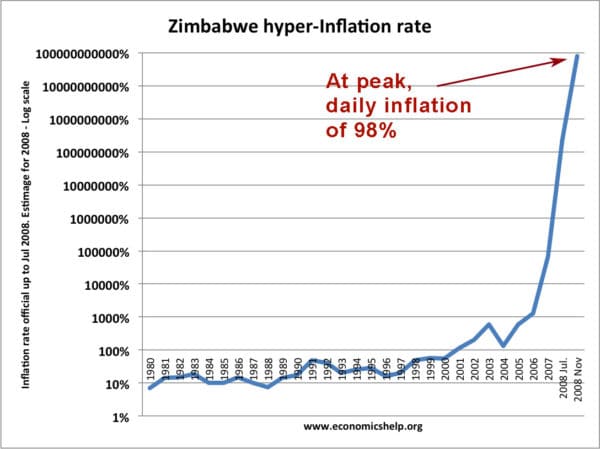
Hyperinflation also occurred in Zimbabwe in the 2000s.
Printing money and the value of a currency
If a country prints money and creates inflation, then there will be a decline in the value of the currency.
- Suppose inflation in Germany is 100%, and inflation in the UK is 0%.
- This means German prices are doubling compared to the UK.
- You will need twice as much German currency to buy the same quantity of goods.
- The purchasing power of the German currency is declining, therefore the value of mark will fall on exchange rates.
- See also: Printing money and the exchange rate
Value of one German Mark to US Dollar 1922-23

Hyperinflation in Germany causes a rapid fall in the value of the German mark to the dollar.
In a period of hyperinflation, investors will try and buy a stable foreign currency because that will hold its value much better.
Real Life example of Money Supply and Inflation
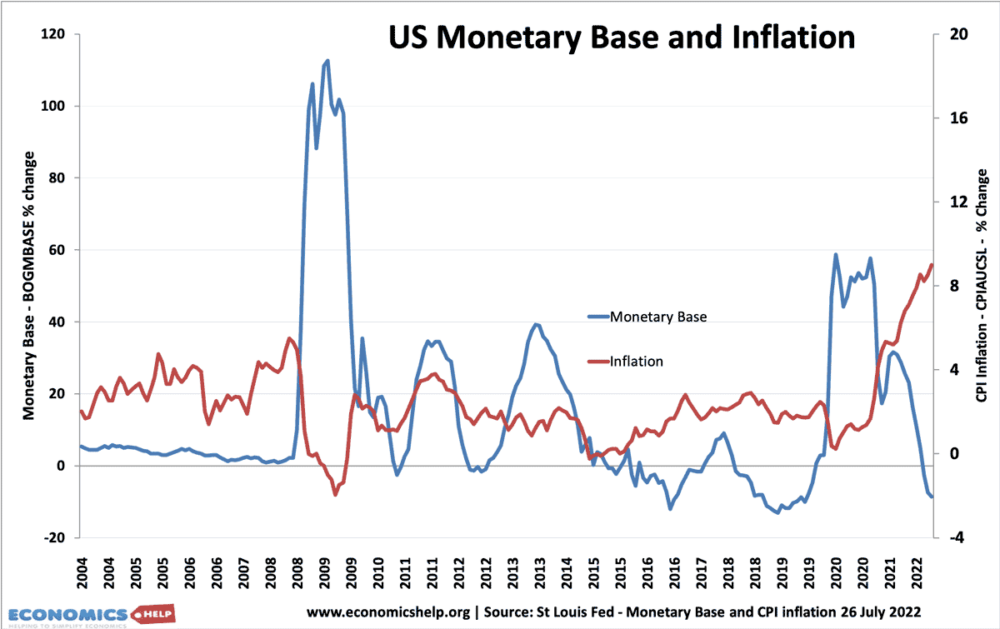
In a recession, with periods of deflation, it is possible to increase the money supply without causing inflation.
This is because the money supply depends not just on the monetary base, but also the velocity of circulation and the willingness of banks to lend. For example, if there is a sharp fall in transactions (velocity of circulation) then it may be necessary to print money to avoid deflation,
In the liquidity trap of 2008-2012, the Federal Reserve pursued quantitative easing (increasing the monetary base) but this only had a minimal impact on underlying inflation. This is because although banks saw an increase in their reserves, they were reluctant to increase bank lending.
However, if a Central Bank pursued quantitative easing (increasing the money supply) during a normal period of economic activity then it would cause inflation. In 2020, quantitative easing was pursued and a year later, inflation in the US rose. (though inflation also rose due to higher oil prices)

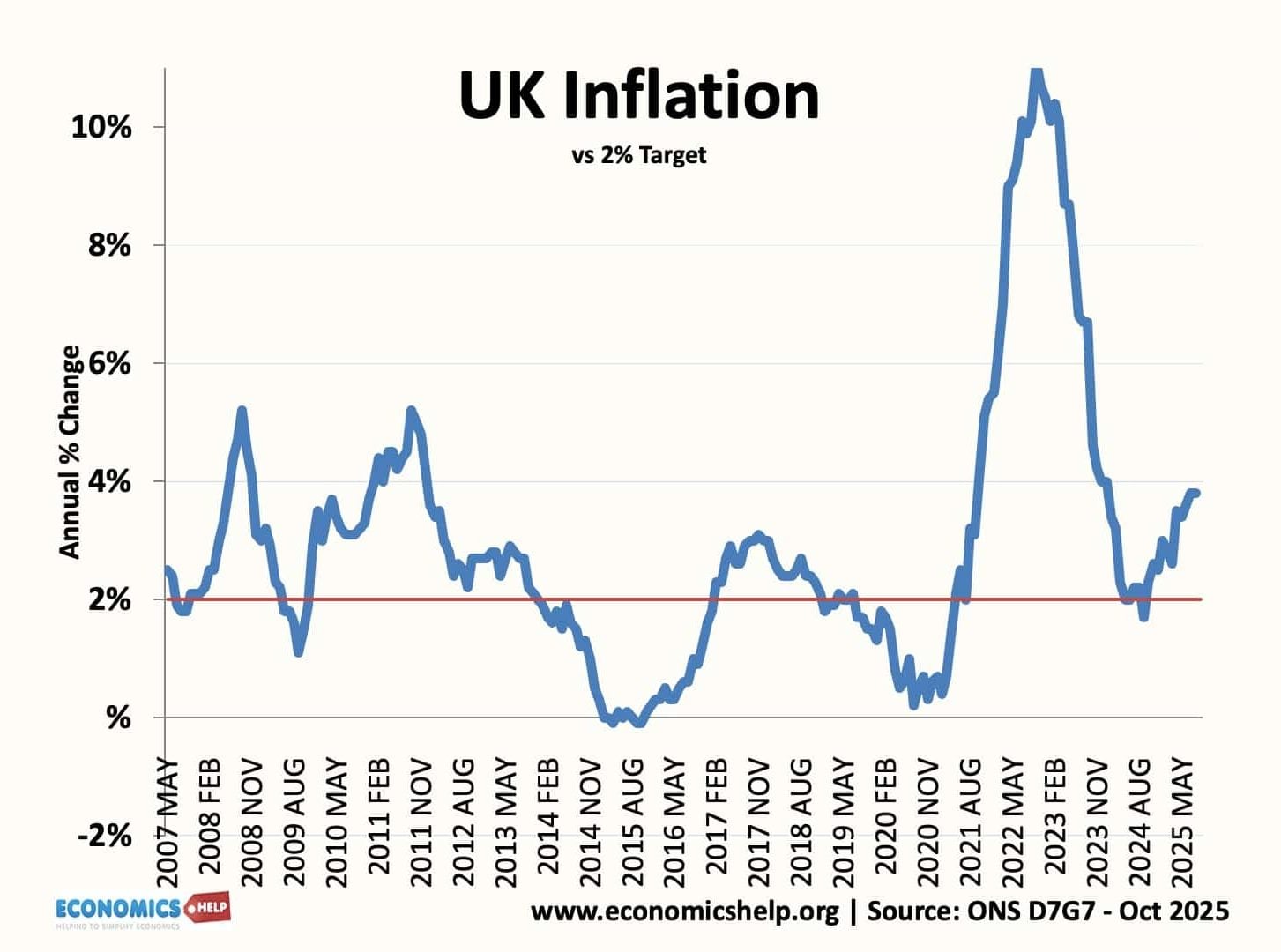
QE caused big increase in bank reserves at Bank of England, but limited impact on money supply and inflation. However, in 2021/22, inflation did pick up (primarily because of cost-push factors) but also strong demand at end of covid.
Related
Last updated: 26th July 2022, Tejvan Pettinger, www.economicshelp.org, Oxford, UK
About The Author

Bekaar hai yai Sara don’t see this
I’m in Seattle and here the housing prices have double in the last four years in many parts of the city. In fact it seems housing prices have gone up at least 50% all over the state. Is this due to the Fed and quantitative easing policy of injecting 100s of billions of money into the US economy? In spite of the rapid rise in housing prices salaries have remained nearly the same as they were four years ago except the minimum wage has gone from $8 per hour to $16 per hour. I don’t own a home and am wondering if I should buy at this time or just move to another country?
If govt prints money and use it to buy imports. The imported goods are used as free raw materials to produce cheap goods some of which are exported. The lower inflation (due to cheaper goods) will boost the exports and counter the downward pressure on currency caused from imports in the first place. It feels like a free lunch.
Thoughts?
Printing money will devalue the currency so imports become more expensive. – not cheaper.
The money won’t get devalued if it is used for exports.
Think about it this way..
Maybe the government borrows 500m dollars for importation of ambulances.
Why don’t it just print those monies and use it to import those stuff.
At least the printed money is out of the country and prices wouldn’t necessarily go up.
And maybe it can reduce it’s national debt.
I understand that printing more money would cause that currency circulation in the world economy to increase and devalue, but i think it wouldn’t have a major effect if the government introduces policies that would actually cause people outside the country to demand the currency more.
Example is very good tourism policies and investment
But when we import or export things and use printed money like you say,,The problem with that is we will have to make payment in US dollars so of course we will buy dollar meaning exchange money causing shortage of dollars in country and money back to community causing inflation and let’s say for the argument sake the country is able to make payment in their own currency for instance Rupee for export,, So money went out of the country and you bought some services.
But the problem is that money is bound to come back as those companies will take money and exchange in their country resulting money back to country causing inflation again
My point is the money went out of country cannot be used in their countries so eventually will be back to country once exchanges elsewhere.
If the money is used to pay for imports, the transaction would have been made in dollars. Lets assume payment was in rupees. In that case the exporter will have rupees which we will have to use. The only way he can use it is spend it in India or else where which will basically increase the currency supply & drive inflation. It does not matter where the money is spent.
Money with which you buy imports will again return to you by the same country as the country purchases your products. Just as the case in Iran when the USA imposed sanctions on it. India bought oil from Iran with Indian currency in exchange they bought our agriculture products. So in either way, the money which you print is again getting into the market which makes it surplus indirectly causing higher demand ultimately leading to inflation.
If I need to but imports in FX, then printing money locally will simply mean that I will have to pay the FX for more expensive. The good here is the FX which does not cause direct inflation but devaluation
The imports are in USD and as per my understanding other than US no other country can print the dollars whereas any country can print its own currency so to import they need to use their foreign reserves that’s USD so printing local currency will aid in inflation only
printing money is not always the solution to our economic problem.Central bank should know the total money in circulation to avowed inflation like the hyper inflation that occured in Germany in the year 1920.
What will happen if money is printed new and distributed equally to every citizen of our country
Why can’t we have the government create a new independent agency to be responsible for the money supply. The most important thing to keep the money as money, by avoiding inflation, and deflation at all costs. If too much inflation happens, normal society can completely break down (which is the main cause of world war two). What sort of system can be created? My opinion is, the new system can create the money, and the way they introduce it is, zero-interest loans to everyone, amount being dependent on their credit and the economy as a whole. This can allow opportunities to skyrocket, since now people are given a chance to try their ideas, without immense risk to their livelihood. The way they can decrease the money supply if necessary, to avoid inflation is paid back loans, plus they can use the same system the feds use, creating bonds and selling them. There would be much less ability from the banks to exploit those that need capital, and M1 would shrink, giving more ability for the new system to create more M0, to be distributed to the population. Opportunities will be available for a lot more people now, not just those who have succeeded in the past, and the wealth gap will shorten. More job opportunities will be created, and wages will increase to bid on new employees, making the amount the employee and employer’s earnings more equal. This can also solve the serious college debt issue, the country is currently facing. Congress, not needing to give out welfare as much, can spend less money (yeah right), and they can receive more taxes which could balance out the budget, possibly without a deficit, and pay off the national debt. Now that we would not have to control the banks’ interest rates, the economy instead of having good periods when there is more lending, and bad when there is less. The economy can remain more stable for the long term, instead of having boom and busts economies like we currently have.
I understand why printing more money is not the final solution but I could see no argument here which can prove that it is harmful, only speculation. In fact the central banks are printing money all the time, more so in last few years than ever but inflation hasn’t gone through the roof, so as long as they keep that in check, they can keep printing money.
Why do you think when all the billion dollar companies go bust the world hardly notices, it’s because the money still keeps flowing from the government.