Revenue Maximisation

revenue-maximisation

Revenue is the total income a firm receives. Revenue = total sales X average price. To maximise revenue, the firm will set a price where the marginal revenue of last good sold is zero. We can explain with this diagram below. Concepts Total Revenue (TR) = Price × Quantity Average Revenue (AR) = TR ÷ …

Read more

The relationship between economics and politics

Readers question: Why cannot politics and economics be seen in isolation?

Economics is concerned with studying and influencing the economy. Politics is the theory and practice of influencing people through the exercise of power, e.g. governments, elections and political parties.

In theory, economics could be non-political. An ideal economist should ignore any political bias or prejudice to give neutral, unbiased information and recommendations on how to improve the economic performance of a country. Elected politicians could then weigh up this economic information and decide.
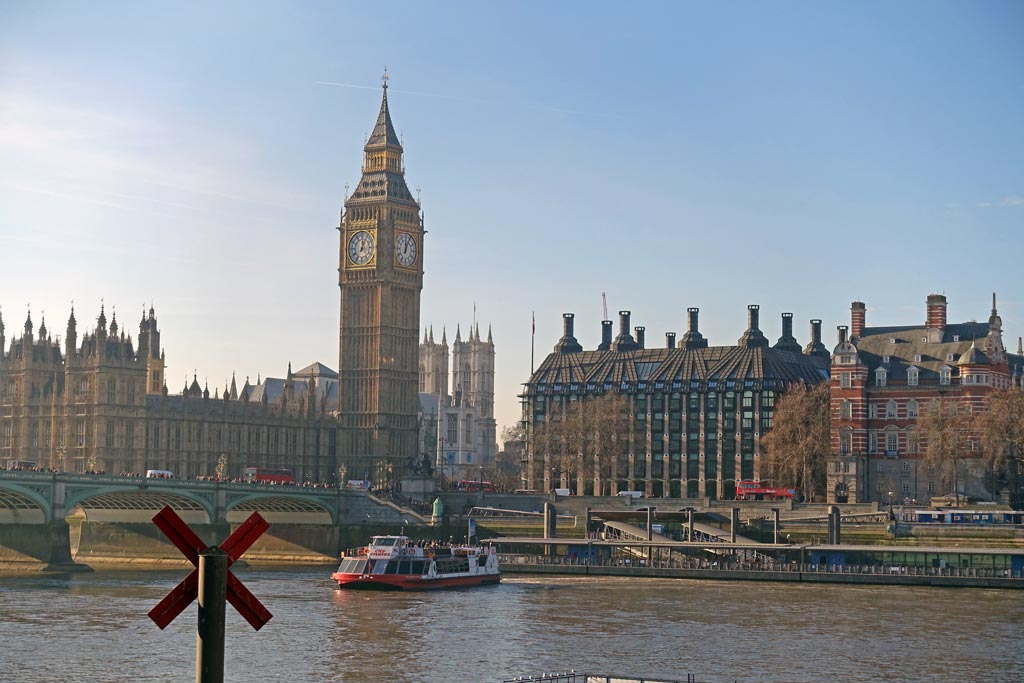
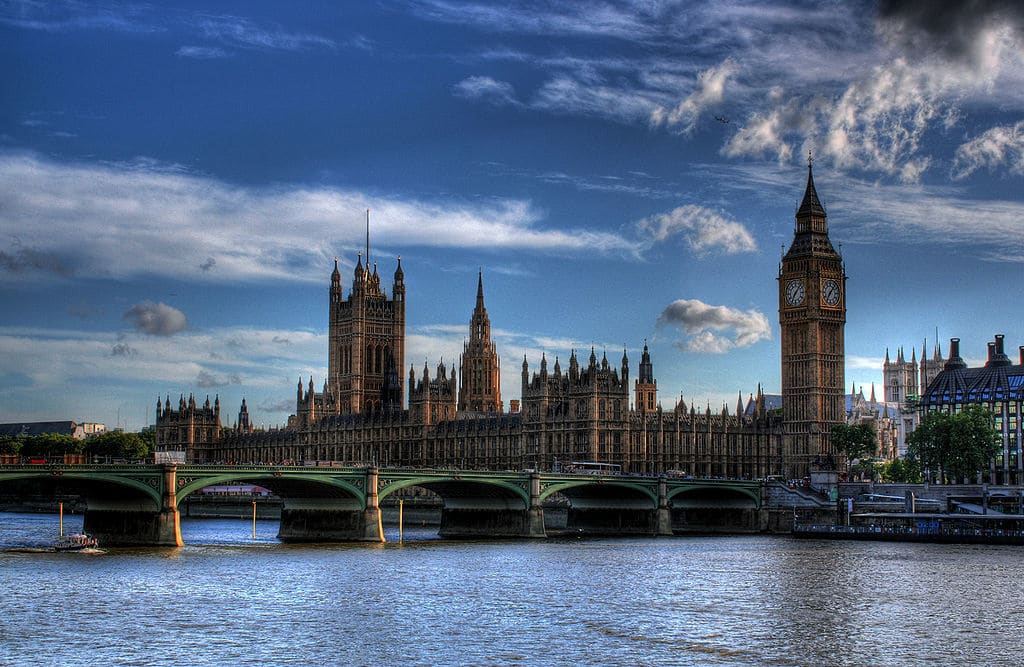
Houses of Parliament london

In practice there is a strong relationship between economics and politics because the performance of the economy is one of the key political battlegrounds. Many economic issues are inherently political because they lend themselves to different opinions.

Political ideology influencing economic thought

Many economic issues are seen through the eyes of political beliefs. For example, some people are instinctively more suspicious of government intervention. Therefore, they prefer economic policies which seek to reduce government interference in the economy. For example,  supply side economics concentrates on deregulation, privatisation and tax cuts.

On the other hand, economists may have a preference for promoting greater equality in society and be more willing to encourage government intervention to pursue that end.

If you set different economists to report on the desirability of income tax cuts for the rich, their policy proposals are likely to reflect their political preferences. You can always find some evidence to support the benefits of tax cuts, you can always find some evidence to support the benefits of higher tax.

Some economists may be scrupulously neutral and not have any political leanings (though I haven’t met too many). They may produce a paper that perhaps challenges their previous views. Despite their preferences, they may find there is no case for rail privatisation, or perhaps they find tax cuts do actually increase economic welfare.

However, for a politician, they can use those economists and economic research which backs their political view. Mrs Thatcher and Ronald Reagan were great champions of supply-side economists like Milton Friedman, Keith Joseph, and  Friedrich Hayek. When Reagan was attempting to ‘roll back the frontiers of the state,’ – there was no shortage of economists who were able to provide a theoretical justification for the political experiment. There were just as many economists suggesting this was not a good idea, but economists can be promoted by their political sponsors. In the US, the Paul Ryan budget proposals were welcomed by many Republicans because they promised tax cuts for better off, cutting welfare benefits and balancing the budget. (1) A popular selection of policies for Republicans.

Economic thought independent of politics

On the other hand, economists who stick to data and avoid cherry picking favourable statistics may well come up with conclusions and recommendations that don’t necessarily fit it with pre-conceived political issues.

Many economists may be generally supportive of the EU and European co-operation, but the evidence from the Euro single currency is that it caused many economic problems of low growth, deflation and trade imbalances.
Read more

Keynesianism vs Monetarism

Readers Questions: Could you please explain the comparison between the Keynesianism & monetarism? Keynesian approach Keynesianism emphasises the role that fiscal policy can play in stabilising the economy. In particular Keynesian theory suggests that higher government spending in a recession can help to enable a quicker economic recovery. Keynesians say it is a mistake to …

Read more

Is there a hope for UK? And Other Reader Questions

uk-recessions

Q. Is there hope for the UK economy? There is hope for the UK, despite very poor past 15 years, it is still a moderately wealthy country, with reasonably basic economic institutions. We are not in the same league as Latin American countries with chronic bouts of hyperinflation. Economies are also more resilient than we …

Read more

Sectors of the Economy

sectors-of-the-economy

The main sectors of the economy are: Primary sector – extraction of raw materials – mining, fishing and agriculture. Secondary / manufacturing sector – concerned with producing finished goods, e.g. Construction sector, manufacturing and utilities, e.g. electricity. Service / ‘tertiary’ sector –  concerned with offering intangible goods and services to consumers. This includes retail, tourism, …

Read more

Trickle down economics

trickle-down-effect

Trickle down economics is a term used to describe the belief that if high-income earners gain an increase in salary, then everyone in the economy will benefit as their increased income and wealth filter through to all sections in society.

How the trickle-down effect may work in theory

trickle-down-effect

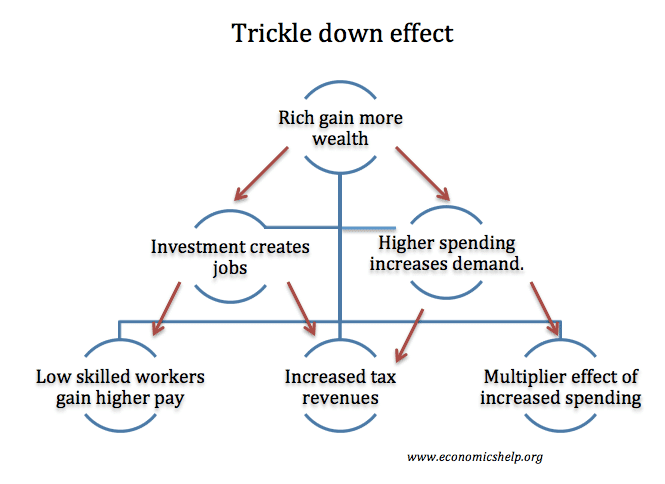
If the richest gain an increase in wealth, then

  • They will spend a proportion of this extra wealth.
  • The extra wealth will cause an increased demand for goods and services, causing higher employment and a rise in wages.
  • The higher wages will also cause a multiplier effect, e.g. if more chauffeurs are employed by the rich, the chauffeur will gain increased income and, in turn, they will increase spending in local businesses.
  • A cut in taxes increases the incentive to work. Lower income tax encourages people to work longer. Lower corporation tax encourages business to invest, creating wealth.
  • Alternatively, the wealthy may invest their increased wealth. If the wealth is invested in new businesses, it will create new jobs and increase the incomes of those employed.
  • Higher spending and investment will stimulate economic activity leading to a rise in tax revenues (higher income tax, higher VAT).
  • Higher tax revenues can fund public programmes such as healthcare, education and welfare payments to the poor.

Trickle-down effect and tax cuts

An important element of the trickle-down effect is with regard to income tax cuts for the top-income earners. It is argued that cutting income tax for the rich will not just benefit high-earners, but also everyone. The argument is as follows:

  1. If high-income earners see an increase in disposable income, they will increase their spending and this creates additional demand in the economy. This higher level of aggregate demand creates jobs and higher wages for all workers.
  2. Alternatively, increased profits for firms may be reinvested into expanding output. This again leads to higher growth, wages and incomes for all.
  3. Lower income taxes increase the incentive to for people to work leading to higher productivity and economic growth.
  4. The Laffer curve suggests cutting tax can even cause an increase in tax revenues as the lower tax rates are offset by higher growth.

A study by NBER June 1997 Engen and Skinner conclude that:

“cutting marginal tax rates across the board by 5 percentage points and cutting average tax rates by 2.5 percentage points would increase the growth rate of U.S. GDP by 0.3 percentage points per year.”

Video on Trickle-down economics

Criticisms of trickle-down economics

I have a joke about trickle-down economics. Only 99% of you will get it.

trickle-down-effect-criticism

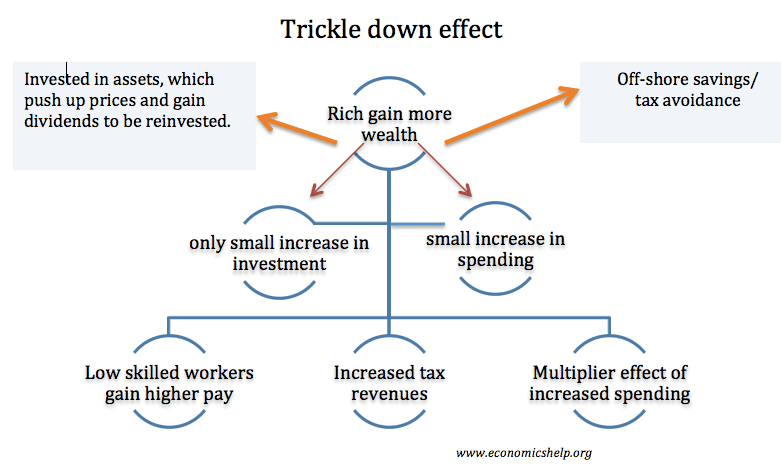
Many economists are sceptical of the belief in ‘the trickle-down’ effect. One reason, the wealthy have a higher marginal propensity to save, and also n recent years, wealth has been saved in off-shore accounts to avoid paying tax. Therefore, when the wealthy gain extra income, only a small percentage may filter through to low-income workers.

Also, some studies suggest that increased income inequality can lead to this inequality being solidified through educational opportunities, wealth accumulation and the growth of monopoly/monopsony power. Furthermore, increased inequality may lead to lower rates of economic growth.

Tax cuts have no clear impact on growth. In The Economic Consequences of Major Tax Cuts for the Rich (2020), by David Hope and Julian Limberg, the authors found tax cuts for the rich, had no statistical effect on economic growth. They looked particularly at the 1980s in UK and US, where significant taxes were cut.

“The results also show that economic performance, as measured by real GDP per capita and the unemployment rate, is not significantly affected by major tax cuts for the rich. The estimated effects for these variables are statistically indistinguishable from zero.” (LSE)

A report by the IMF (2015) found increasing income share of the poor increased economic growth, but increasing income share of the rich, led to lower growth.

“We find that increasing the income share of the poor and the middle class actually increases growth while a rising income share of the top 20 percent results in lower growth.”

Real GDP and Median wages in the US


real-median-incomes-gdp

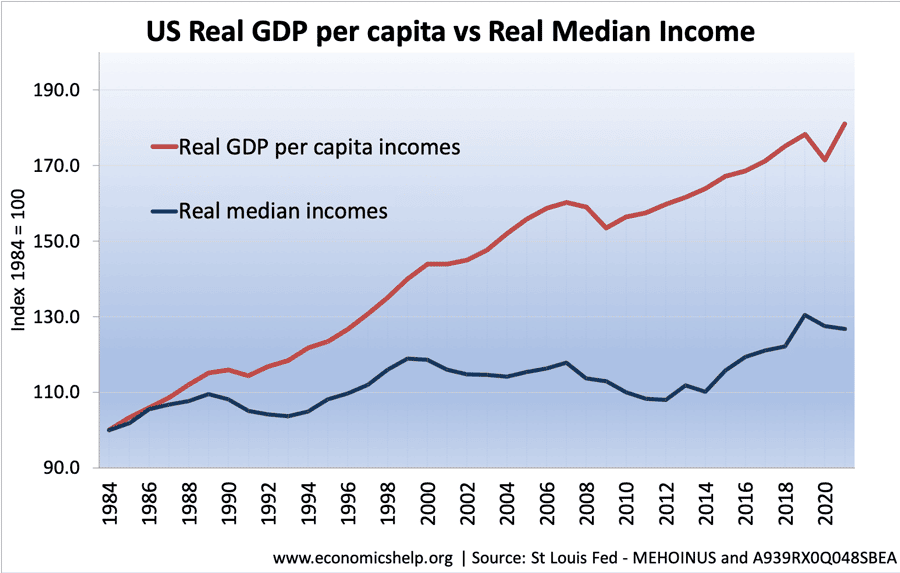
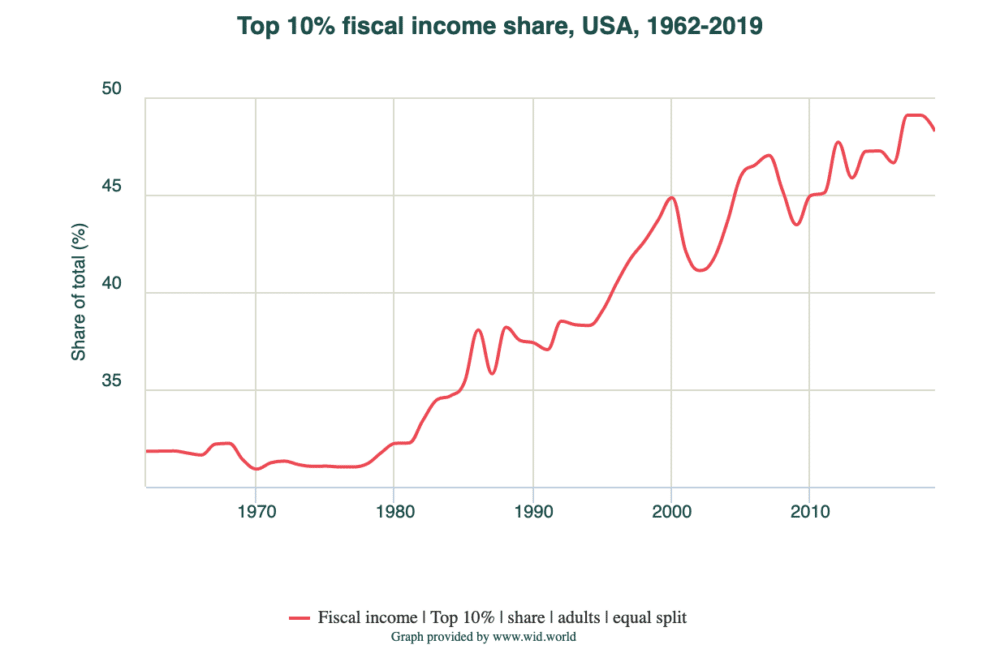
In the US, real GDP has grown faster than median wages since the early 1980s. In the 1980s, taxes were cut for high earners and there was a significant increase in inequality. Proponents of the Reagan tax cuts and supply-side economics argue it was worth it because everyone benefitted from rising GDP. However, the median wage, (which is the wage the middle-income earners actually receive has increased slower than real GDP, suggested not all the gains of the top 1% have trickled down to average workers.

income-share-top-10%

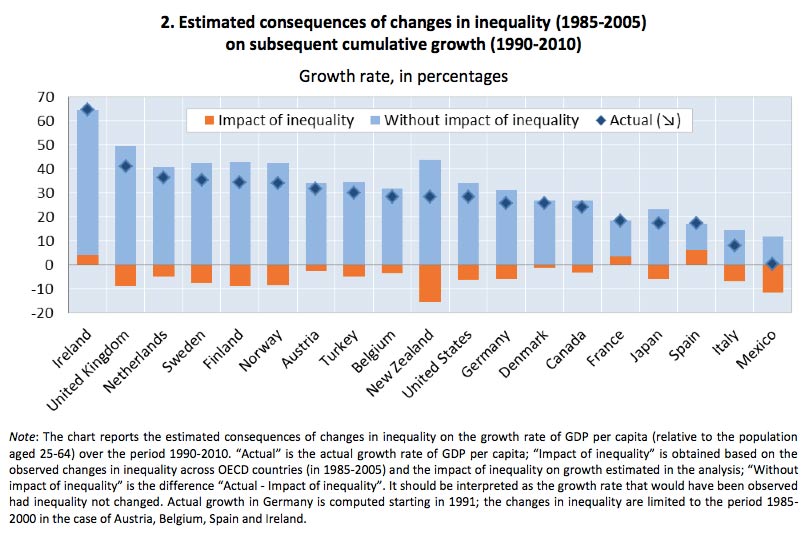
Inequality and lower growth. A recent report by the OECD found that since the start of the credit crisis in 2008, inequality has widened in many countries; however, this inequality has led to lower rates of economic growth not higher.

This graph from an OECD report suggests that inequality is responsible for lower GDP. The OECD estimates that the UK economy would have been more than 20% bigger had the gap between rich and poor not widened since the 1980s.

oecd-inequality Source: OECD Focus – Inequality and Growth 2014

Read more

Economies of scale examples

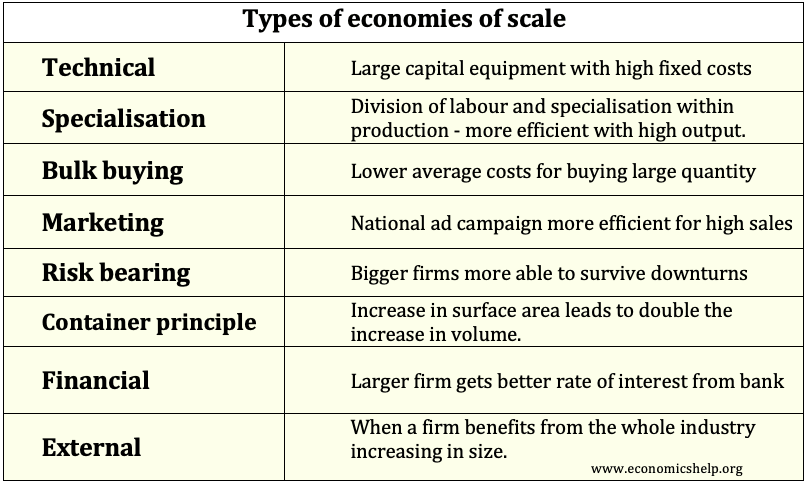
types-of-economies-of-scale

Economies of scale occur when increased output leads to lower unit costs. (lower average costs) Diagram Economies of Scale This diagram shows that as firms increase output from Q1 to Q2, average costs fall from P1 to P2. There are many different types and examples of how firms can benefit from economies of scale – …

Read more

Item added to cart.
0 items - £0.00