
Readers Question: evaluate the economics for and against the uk government further increasing the tax on alcohol in order to reduce its consumption?
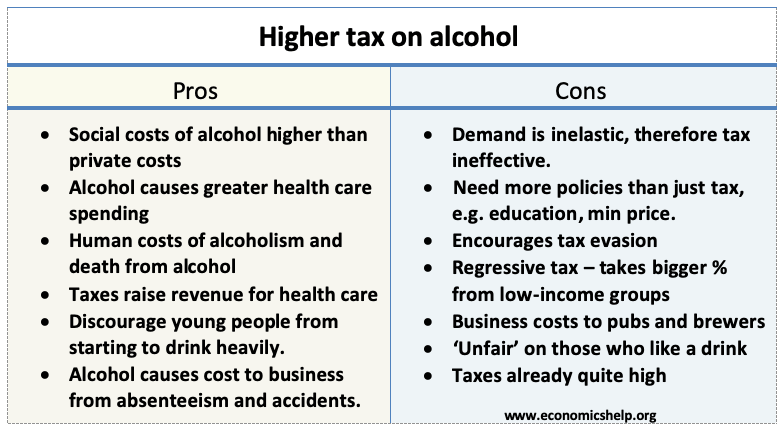
Alcohol is considered a demerit good. Overconsumption can cause health problems, which involve external costs to the rest of society. Therefore, there is a strong reason to increase tax on alcohol, reduce binge drinking, improve the nation’s health and raise money to spend on health care and policing associated with alcohol.
However, others argue there are drawbacks to raising taxes on alcohol. This include – increased risk of tax evasion, business costs for pubs and the fact taxes are already high compared to our European neighbours.
Advantages of raising taxes on alcohol
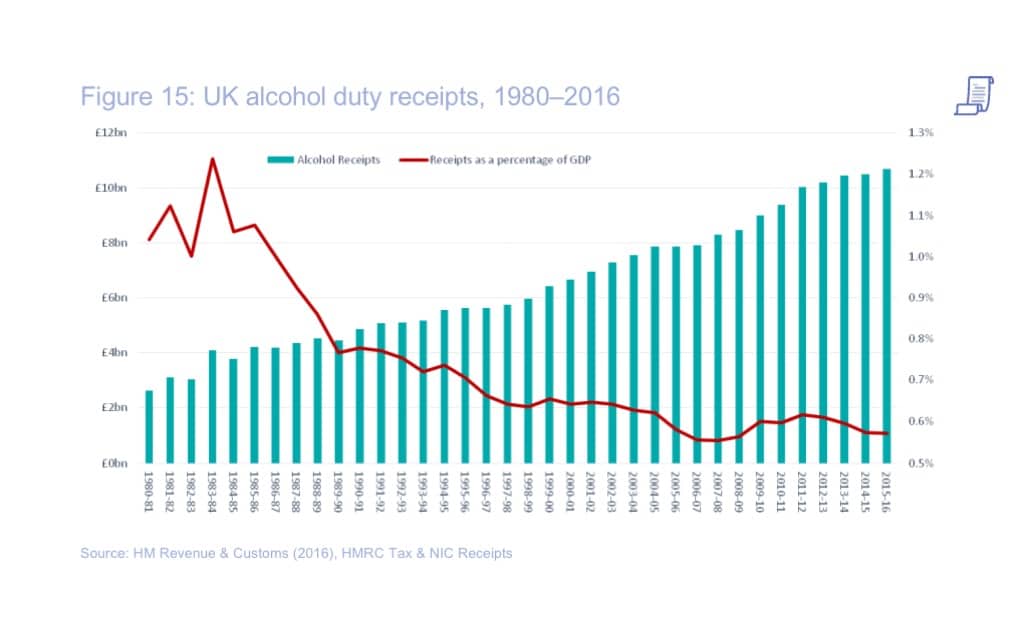
- Raise revenue for the government. Demand for alcohol is quite price inelastic, therefore, higher tax will lead to an increase in tax revenue from the government. In 2018/19, the UK government raised £10.7bn from taxes on alcoholic drinks. As a percentage of GDP, this has fallen to 1.2% in 1981 to 0.55% in 2017.
- The social cost of alcohol are significantly higher than the private cost. Drinking alcohol has external costs for the rest of society. These external costs include
- Health care costs of treating illness related to alcohol. One report estimates a conservative cost of £3.4 bn a year in NHS treatment of alcohol. (Guardian) Of 1.6 million inpatients in UK hospitals, 20% use alcohol harmfully
- Alcohol is a factor in accidents and violent crime. This imposes costs on both health care and the police service. In 2016, an estimated 240 people were killed in road traffic accident where at least one driver was over the drink-drive limit. (NHS)
- Accidents at home. Less publicised is the fact alcohol can be calculated to be involved in one third off all fatal home accidents. British Medical Bulletin, Glucksman, E (1994)
- Time lost at work. Alcohol consumption is a major factor in causing people to take sick days off work. This leads to higher costs for business and lost productivity. The IEAS estimate costs to business of absenteeism, accidents and lost work is £7.3 billion.
- Human costs of dealing with death, ill-health and alcoholism. These costs are not always immediately quantifiable, but for families dealing with alcoholism, there is a very high cost. According to Prof Sir Ian Gilmore “More than 80 people die of alcohol-related causes across the UK every day, and there are more than 1m alcohol-related hospital admissions every year in England alone.
The social cost of alcohol in the US estimated at “$184.6 billion dollars per year in health care, business and criminal justice costs, and cause more than 100,000 deaths.” alcohol costs
The many external costs of alcohol mean that the social cost (total cost to society) is far greater than the individual private cost. Therefore, in a free market, there would be over-consumption of alcohol because when drinking we tend to ignore the effects on others. This leads to a deadweight welfare loss. Economics suggests that if we place a tax on the good and make people pay the full social cost, demand will fall, we will reduce a significant portion of the social costs and achieve a more socially efficient level of alcohol consumption.
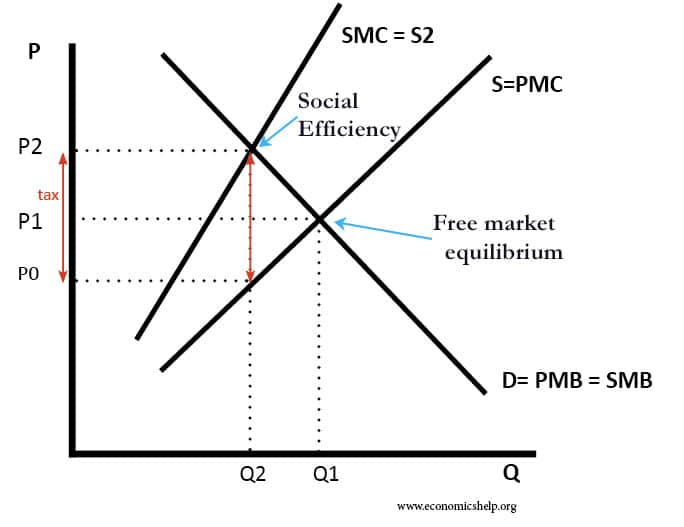
Because the social cost of alcohol is very high, it may require a significant tax to reduce demand sufficiently
- Alcohol is a demerit good. Another aspect of alcohol is that drinkers often underestimate their personal cost of drinking excessively – i.e. alcohol is one of the main causes for premature death amongst young adults, it is also one of the main causes of fatal accidents. Some drinkers can become addicted and alcoholics. A higher price of alcohol can discourage excessive drinking and even discourage people from starting to drink in the first place.
Arguments against raising tax on alcohol
- Tax is already high. In the UK, alcohol taxes are already quite high.
- Demand price inelastic. Higher taxes do not have much impact on reducing demand – especially for most vulnerable alcohol users (those who are addicted). Therefore, to deal with the problems arising from alcohol we need a broad range of policies than just tax. This may involve education, support for recovering alcoholics and banning advertising. Higher tax alone will not change the culture around tax.
- Regressive tax. Alcohol tax is quite regressive. It takes a bigger percentage of tax from those on low-income than those on high-income. Families with heavy drinkers may see a decline in living standards from higher taxes.
- Black market. Higher taxes would encourage black market consumption and imports from Europe. The higher the tax is, the greater the incentive to avoid it. This could involve people brewing their own beer/spirits or importing from the continent. Already, UK business loses out to ‘booze-cruises’ across the channel.
- Pubs will suffer a decline in business. Already pubs are struggling to compete in a modern world, where fewer people are going out to drink, but buying cheap alcohol from supermarkets. Pubs are important to local communities.
- A better solution to reducing problems with alcohol may be a minimum price – this directly targets young and problem drinkers seeking to find the cheapest way to get drunk.
- Higher taxes on alcohol may encourage young people to switch to cheaper drugs like cannabis.
Conclusion
Alcohol has significant social costs, and there is a strong justification to impose taxes on consumption. Taxes help to reduce over-consumption and raise revenue to help fund the NHS. Given the scale of alcohol-related admissions and accidents, there is a strong case to further increase taxes on alcohol. The difficulty is working out the optimal tax because taxes on alcohol are already relatively high. Also, with higher taxes, we need to prevent tax evasion.
Related
- Minimum price for alcohol – pros and cons
Those that can drink responsible ashould not suffer, it is unjust!
I think that the government should use other campaign tactics to reduce binge drinking, which are aimed at young people.
I believe that alcohol tax should be raised init but only for cheap, younger-influenced drinks, yo.