
The Great Depression was a period of unprecedented decline in economic activity from 1929 to well into the 1930s. The trigger was the Wall Street Crash of 1929, which led to bank losses, bank failures and a collapse in the money supply and normal economic confidence. The main causes were bank closures, fall in the money supply, a collapse in confidence, tariffs reducing trade, the gold standard and a failure of policy response.
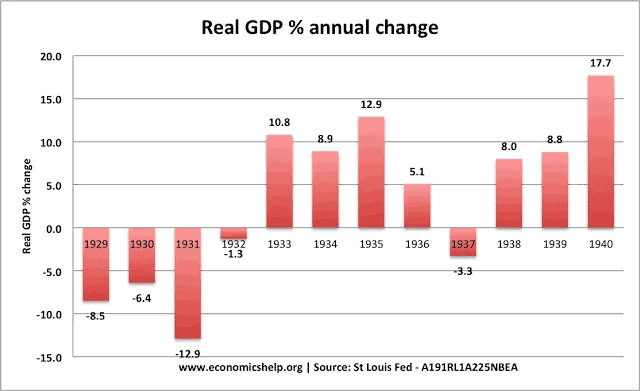
An unprecedented fall in GDP. The worst of the depression was between 1929 and 1939. Although parts of the economy had begun to recover by 1936, high unemployment persisted until the Second World War.
Background to the Great Depression

- The 1920s witnessed an economic boom in the US (typified by Ford Motor cars, which made a car within the grasp of ordinary workers for the first time). Industrial output expanded very rapidly.
- Sales were often promoted through buying on credit. However, by early 1929, the steam had gone out of the economy and output was beginning to fall.
- The stock market had boomed to record levels. Price-to-earnings ratios were above historical averages.
- The US Agricultural sector had been in recession for many years.
- The UK economy had been experiencing deflation and high unemployment for much of the 1920s. This was mainly due to the cost of the First World War and attempting to rejoin the Gold standard at a pre-World War 1 rate. This meant Sterling was overvalued, causing lower exports and slower growth. The US tried to help the UK stay in the gold standard. That meant inflating the US economy, which contributed to the credit boom of the 1920s.
Causes of the Great Depression
1. Stock Market Crash of October 1929
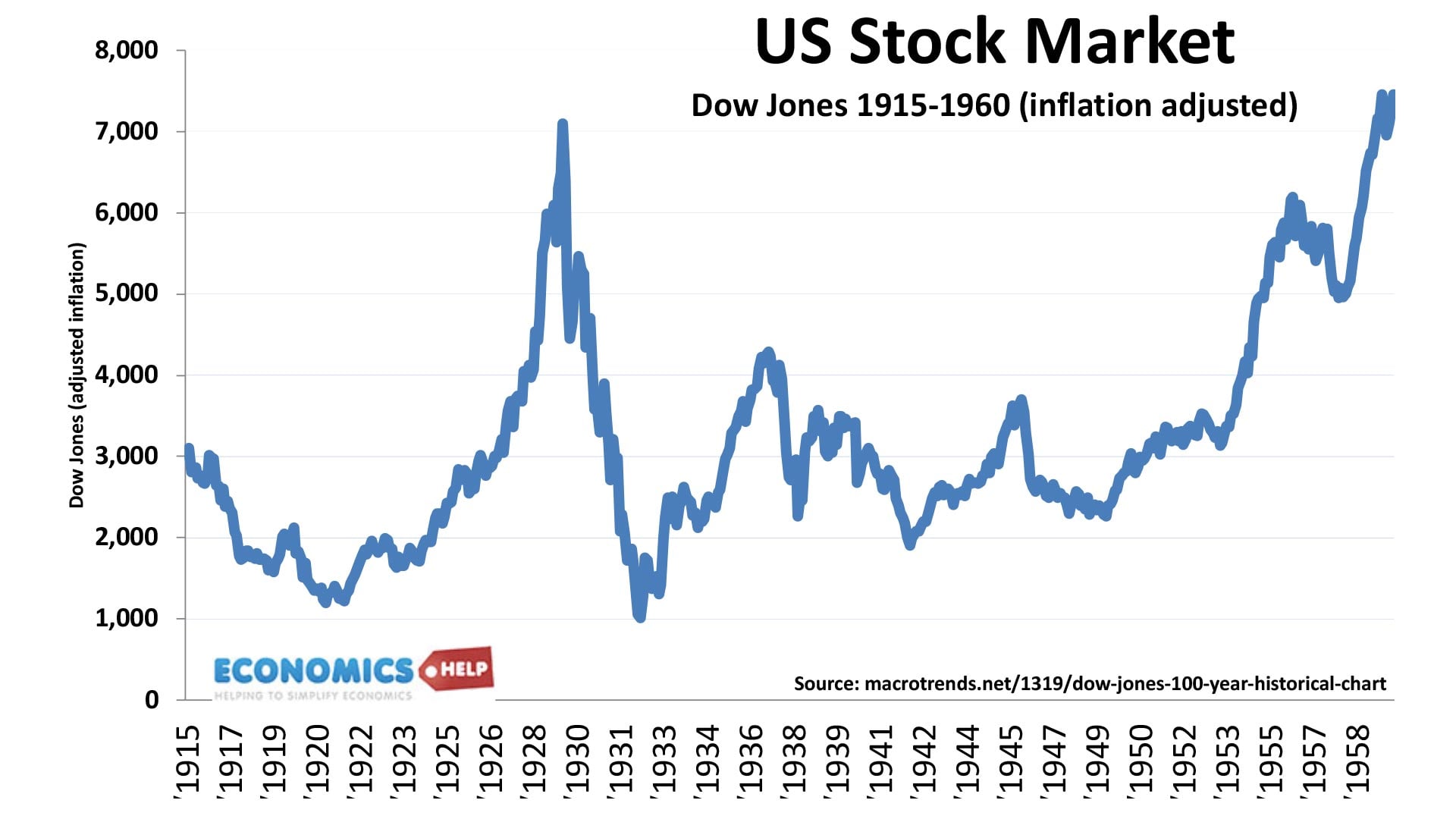
During September and October, a few firms posted disappointing results, causing share prices to fall. On October 28th (Black Monday), the decline in prices turned into a crash, as share prices fell 13%. Panic spread throughout the stock exchange as people sought to unload their shares. On Tuesday, there was another collapse in prices known as ‘Black Tuesday’. Although shares recovered a little in 1930, confidence had evaporated and problems spread to the rest of the financial system. Share prices would fall even more in 1932 as the depression deepened. By 1932, the stock market fell 89% from its September 1929 peak. It was at a level not seen since the nineteenth century.
- Falling share prices caused a collapse in confidence and consumer wealth. Spending fell and the decline in confidence precipitated a desire for savers to withdraw money from their banks.
- Falling share prices were magnified because people had borrowed to buy into the ‘booming’ share price
2. Bank Failures
With people losing money on the stock market, savers needed to withdraw more money than usual. But, the real problem is the catastrophic losses and collapse in confidence caused people to fear that their bank savings might be at risk. At that time the US banking system was highly deregulated with no central bank acting as lender of last resort. Banks only kept a small % of their assets in cash in the bank. The system relied on confidence in their deposits. But, waves of panic spread. As people started to queue, rumours spreadthat banks were going bust, so people rushed to the bank to withdraw savings. But, banks didn’t have the liquid cash to meet the demands. So the fears of bank collapse became self-fulfilling.
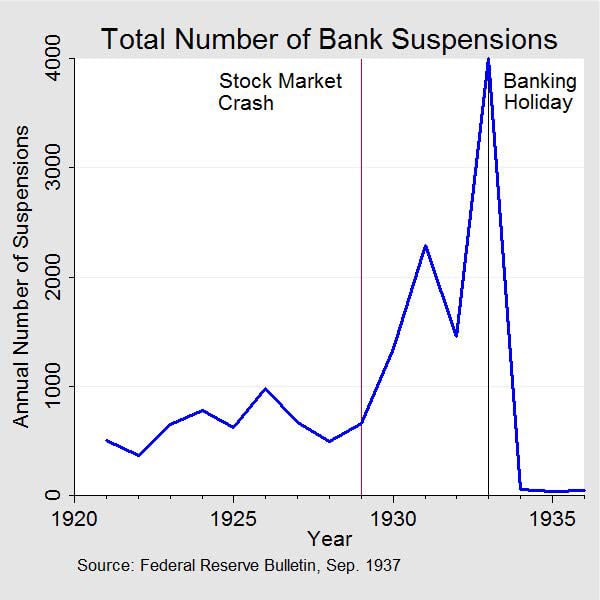 11b Chart 1: Bank Suspensions 600×600
In the first 10 months of 1930 alone, 744 US banks went bankrupt and savers lost their savings. In a desperate bid to raise money, they also tried to call in their loans before people had time to repay them. This further decreased economic activity and also reduced confidence further. As banks went bankrupt, it only increased the demand for other savers to withdraw money from banks.
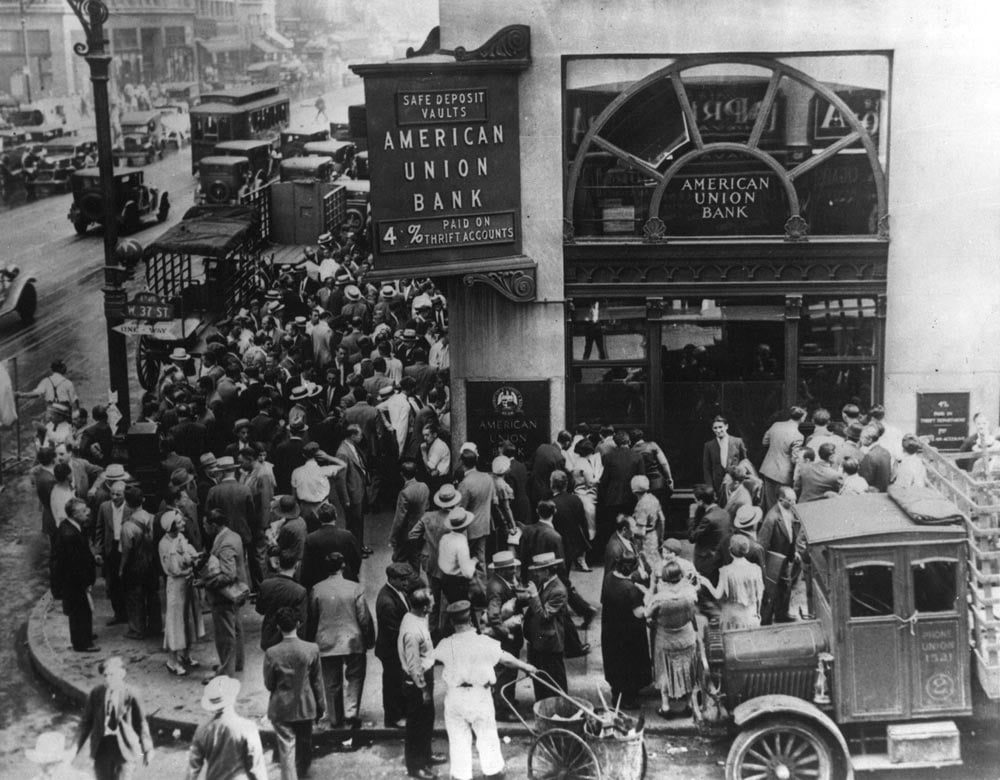
A typical scene outside a bank.
Long queues of people wanting to withdraw their savings was a common sight. The authorities appeared unable to stop bank runs and the collapse in confidence in the banking system. Many agree, that it was this failure of the banking system which was the most powerful cause of economic depression.
 Source: Fed Bank of SF
- Because of the banking crisis, Banks reduced lending, there was a fall in investment. People lost savings and so reduced consumer spending. The impact on economic confidence was disastrous.
Why didn’t Government/bankers intervene to save banking system?
In 1930, wealth bankers looked into bailing out The Bank of United States (New York, 1930). This was a private bank, specialising in loans to Jewish and Eastern European immigrant communities in New York. It had over 400,000 depositors, mostly small savers. The likes of J.P. Morgan & Co. and First National Bank met to decide whether to bailout the bank, they declined for a number of reasons.
- Fear of revealing hidden losses from the 1920s real estate boom
- The idea of moral hazard, the idea saving ‘weak’ banks, encouraged more bad lending practices
- Ethnic prejudice about bailing out ‘immigrant’ savers. Not explicitly stated, but underlying sentiment
- No federal deposit insurance scheme. Private bankers are reluctant to take on a government role.
As a result, $200 million in deposits were frozen (a huge amount then) and it caused ripple effects throughout New York, which later spread to the rest of the country. Milton Friedman argues a decisive bailout could have changed the course of the great depression.
Why did the government not bailout banks?
President Herbert Hoover was an adherent of the orthodox economic view that governments should intervene because of fears over increasing the money supply would damage the gold standards. There were also fears of moral hazard. There was a sentiment that bank failures and recession could shake up the rotten system and enable more efficient firms to eventually come through. There was no historical precedent for widespread federal intervention in banking system.
3. Money Supply and Deflation
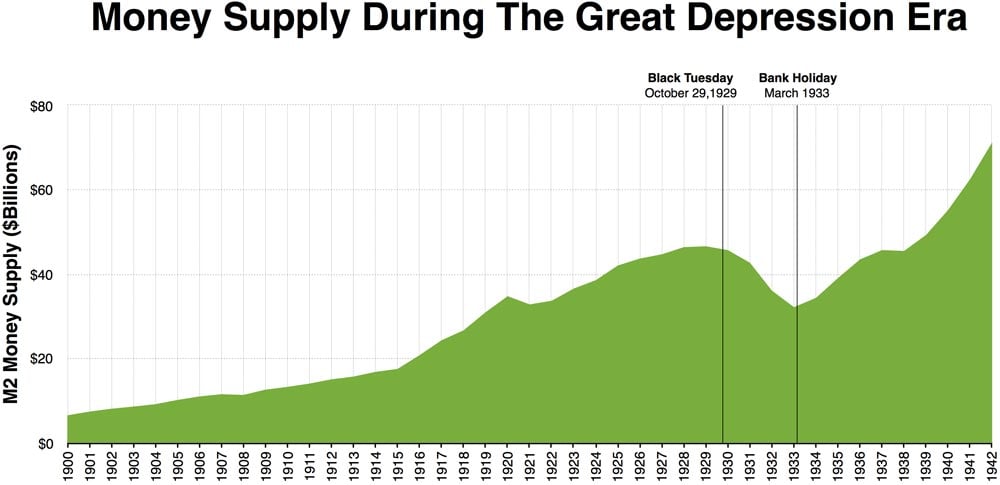
The combined effect of bank failures, collapse in lending and asset values, was a sharp fall in the money supply. This led to deflation – prices and wages fell.
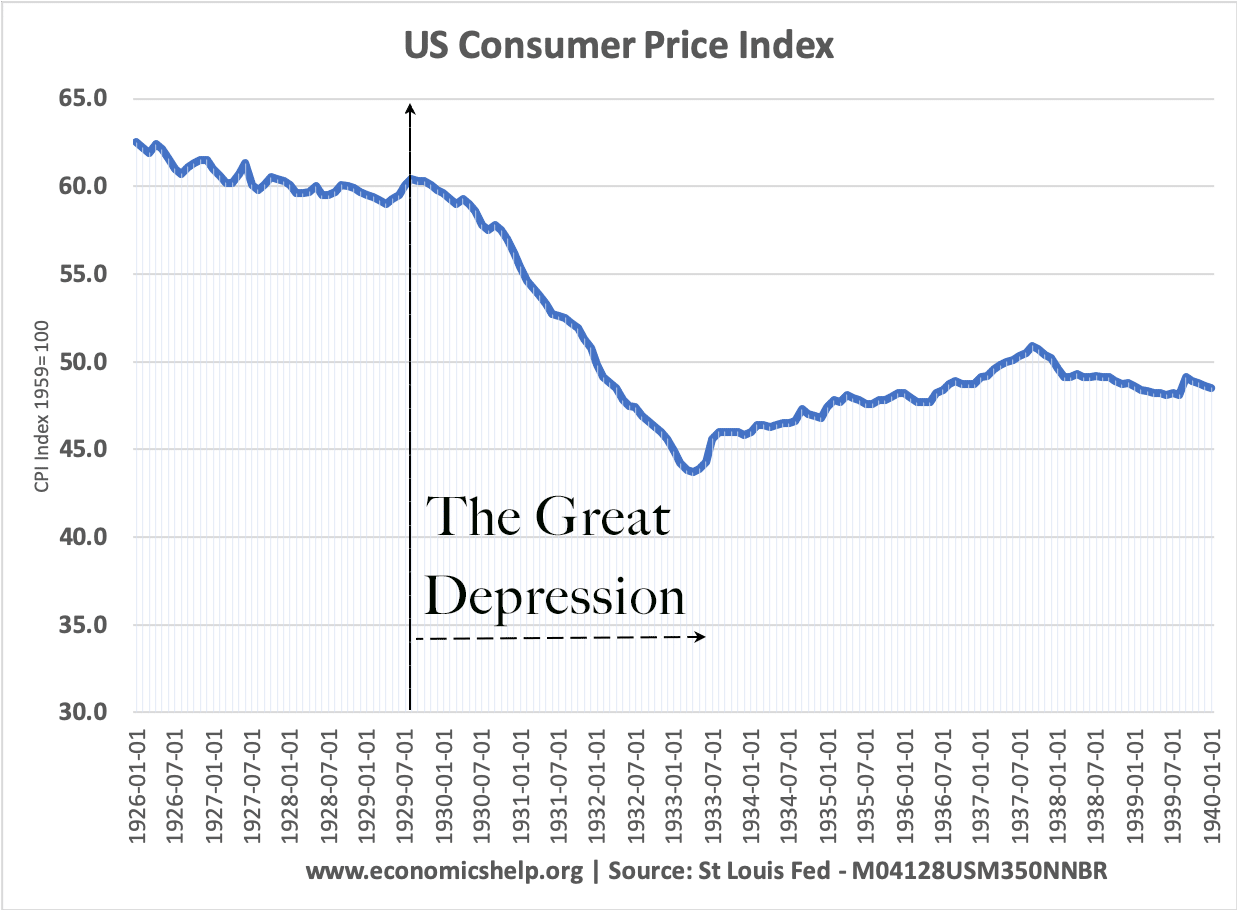
The problem is that falling prices and falling wages have a very negative effect on economic activity.
- Delay purchases If prices and wages are falling, consumers delay purchases because goods will be cheaper later. Combined with fall in confidence, this reduces demand, slows growth, and can push prices down further.
- Deflation increases the real burden of debt. When prices and incomes fall, debts become harder to repay. Households, firms, and governments must devote more income to servicing loans, leaving less for spending and investment, worsening recessions and debt-to-GDP ratios.
- Deflation raises real interest rates. Even with interest rates near zero, falling prices push real rates higher (e.g., −4% inflation = +4% real interest). Saving becomes more attractive, borrowing less so, tightening monetary conditions and reducing growth.
- Deflation can cause real-wage unemployment. Because workers resist nominal wage cuts, falling prices mean real wages rise, making labour more expensive and potentially increasing unemployment.
4. Unemployment and Negative Multiplier Effect
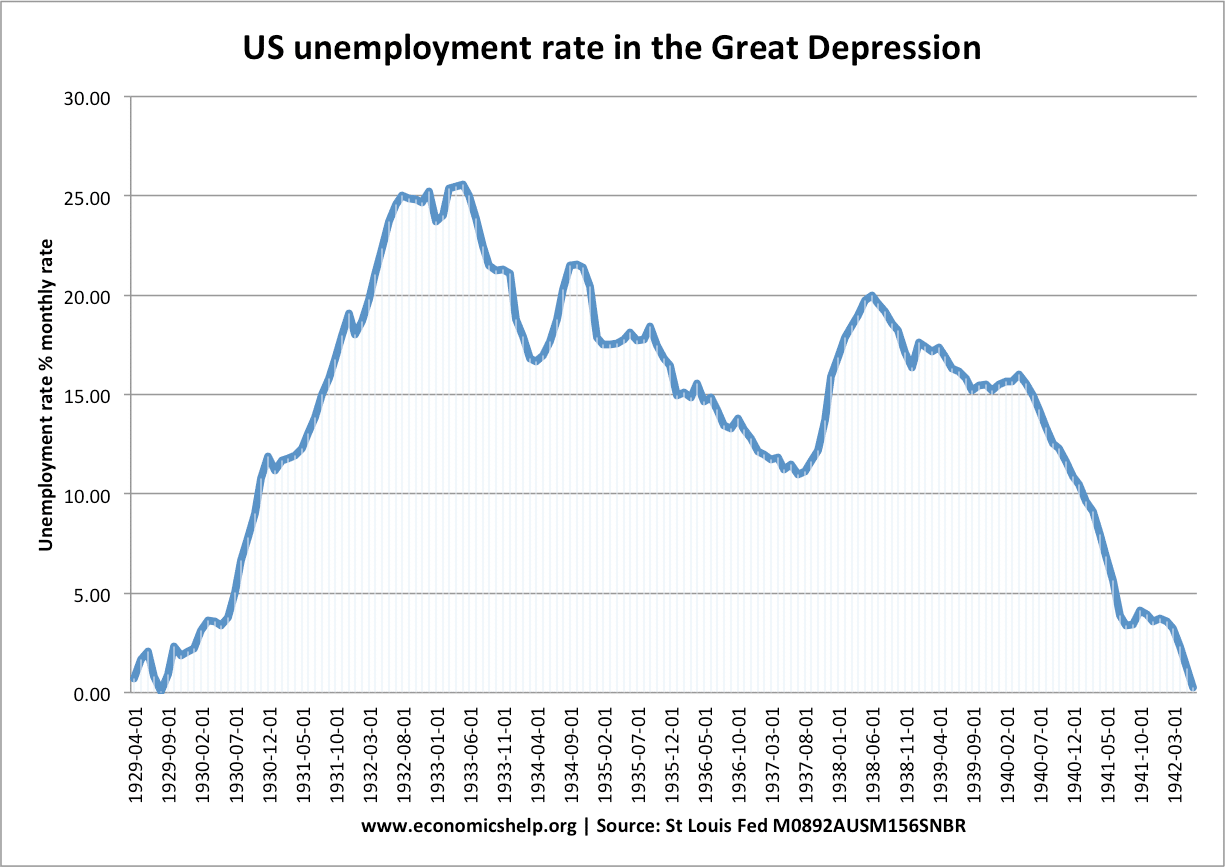
US unemployment rose from zero in 1929 to over 25% in 1932 – indicating the severity and seriousness of the decline in economic activity.
As banks went bankrupt, consumer spending and investment fell dramatically. Output fell, unemployment rose causing a negative multiplier effect. In the 1930s, the unemployed received little relief beyond the soup kitchen. Therefore, the unemployed dramatically reduced their spending.
5. Global Downturn
America had lent substantial amounts to Europe and the UK, to help rebuild after First World War. Therefore, there was a strong link between the US economy and the rest of the world. The US downturn soon spread to the rest of the world as America called in loans, Europe couldn’t afford to pay back. This global recession was exacerbated by imposing new tariffs such as Smoot-Hawley which restricted trade further.

In the early 1930s, US pushed up tariffs, reducing global trade, worsening the existing recession.
6. Gold Standard
“In truth, the gold standard is already a barbarous relic.” — John Maynard Keynes(1923)

Different views of the Great Depression
Monetarists View
Monetarists highlight the importance of a fall in the money supply. They point out that between 1929 and 1932, the Federal Reserve allowed the money supply (Measured by M2) to fall by a third.
“Let me end my talk by abusing slightly my status as an official representative of the Federal Reserve. I would like to say to Milton and Anna: Regarding the Great Depression, you’re right. We did it. We’re very sorry. But thanks to you, we won’t do it again.”
— Ben S. Bernanke
In particular, Monetarists such as Friedman criticise the decisions of the Fed not to save banks going bankrupt. They say that because the money supply fell so much, an ordinary recession turned into a major deflationary depression.
Austrian View
The Austrian school of Economists such as Hayek and Ludwig Von Mises place much of the blame on an unsustainable credit boom in the 1920s. In particular, they point to the decision to inflate the US economy to try and help the UK remain on the Gold standard at a rate which was too high. They argue after this unsustainable credit boom a recession became inevitable. The Austrian school doesn’t accept the Friedman analysis that a falling money supply was the main problem. They argue it was the loss of confidence in the banking system which caused the most damage.
Keynesian View
Keynes emphasised the importance of a fundamental disequilibrium in real output. He saw the Great Depression as evidence that the classical models of economics were flawed.
- Classical economics assumed Real Output would automatically return to equilibrium (full employment levels), but the great depression showed this to be untrue.
- Keynes said the problem was a lack of aggregate demand. Keynes argued passionately that governments should intervene in the economy to stimulate demand through public works scheme, higher spending and borrowing. Something Roosevelt tried after 1932 to a limited extent.
- Keynes heavily criticised the UK government’s decision to try balance the budget in 1930 through higher taxes and lower benefits. He said this only worsened the situation.
- Keynes also pointed to the paradox of thrift.
Marxist View
The Marxist View saw the Great Depression as heralding the imminent collapse of global capitalism. With unemployment over 25%, Marxists held that this showed the inherent instability and failure of the capitalist model. Furthermore, they pointed to the Soviet Union as a country which was able to overcome the great depression through state-sponsored economic planning.
How important was the Stock Market Crash of 1929?
The stock market crash of October 1929, was certainly a factor which precipitated events. It did cause a decline in wealth and severely affected confidence. However, changes in share prices were a reflection of the underlying boom and bust in the economy. Also, a collapse in share prices might not have caused the great depression if bank failures had been avoided. In October 1987, share prices fell by even more (22%) than black Monday. But, it didn’t cause an economic recession.
UK experience of Great Depression
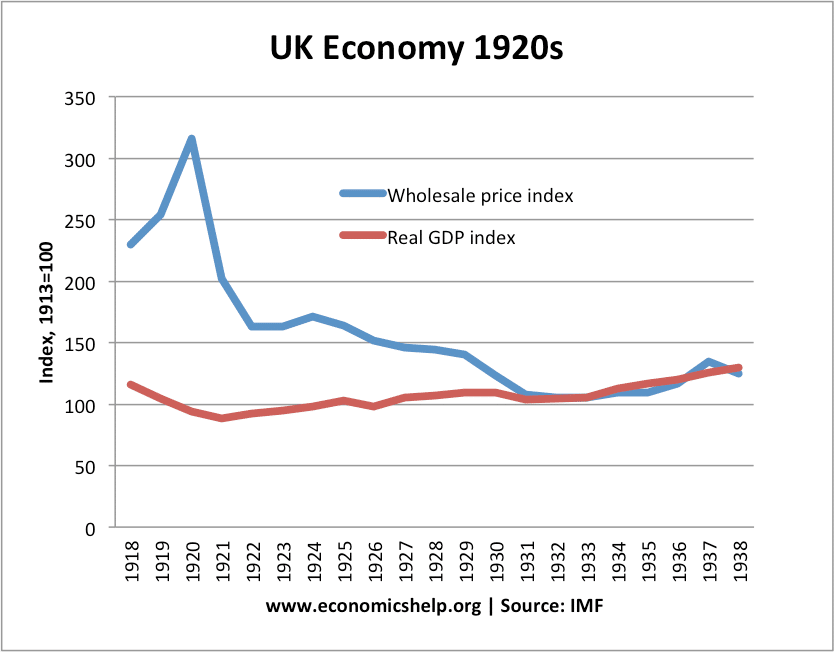
The UK also experienced a long period of deflation in the 1920s and 1930s. With falling output and prices falling, even before the Great Depression. Deflation created additional problems.
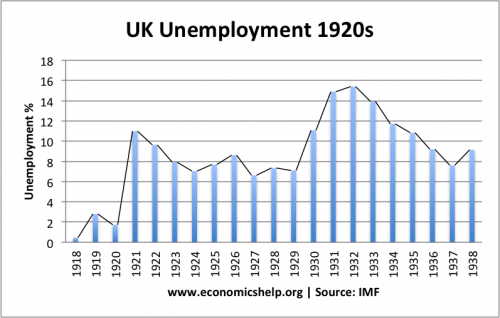
Unemployment was high even before great depression started
Related
Sources
https://www.economist.com/free-exchange/2011/02/18/the-golden-fetters-in-our-minds
About The Author
