
Government debt under Labour was a major factor in the elections of 2010 and 2015. But to what extent did the Labour government really plunge the economy into debt during 1997-2007?
Usually, when people say ‘it’s debt that got us into this mess’. They tend to view all types of debt as the same – equating government debt to financial debt incurred from selling sub-prime mortgages in the US. However, this is deeply misleading. The consequence of bad debt defaults in the financial system is very different to government debt financed through selling bonds.
Government debt
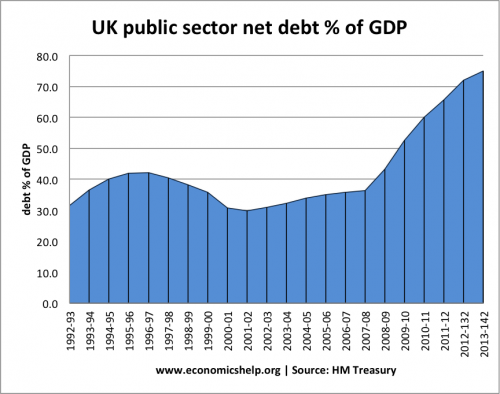
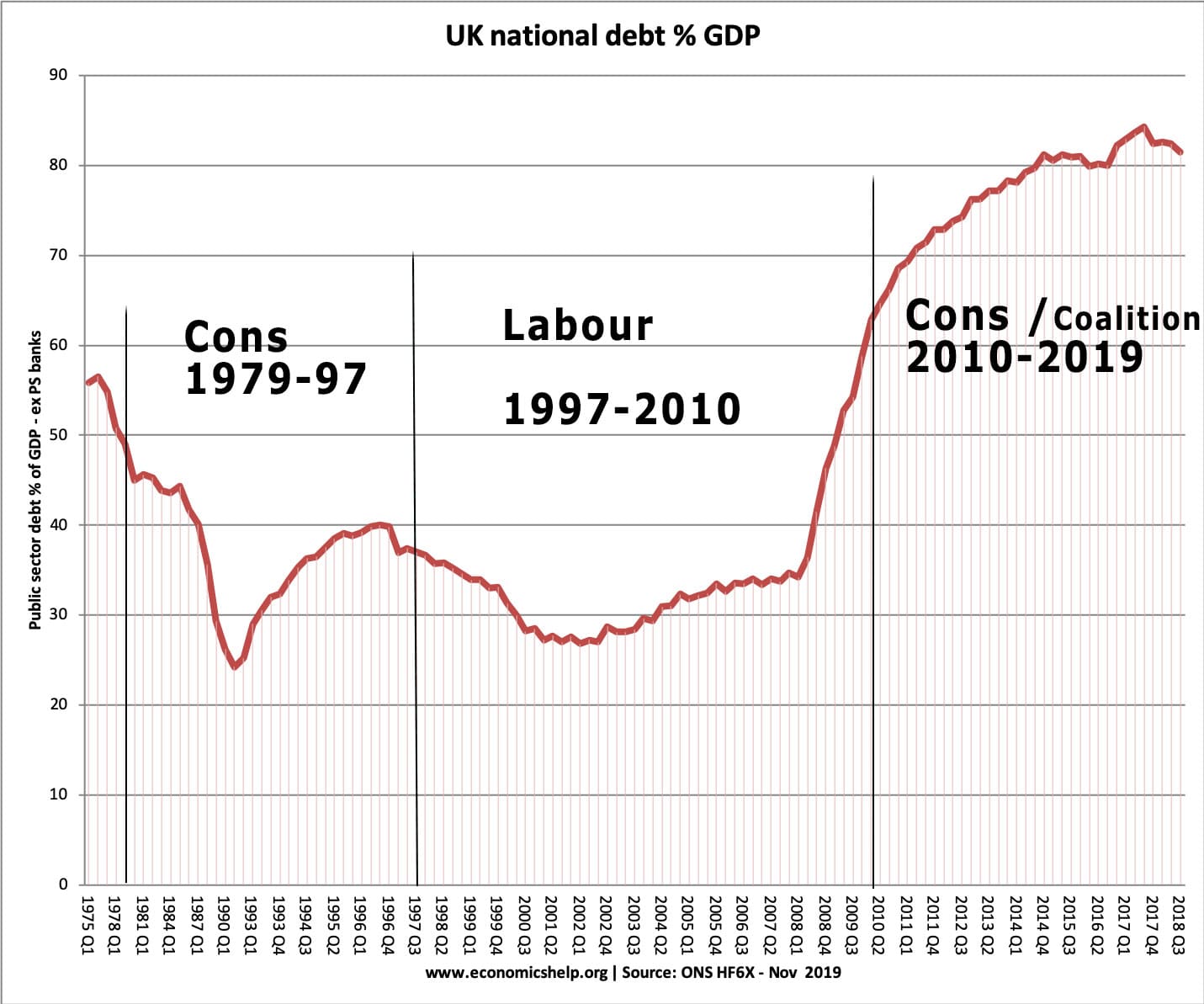
In 1997, public sector debt as % of GDP:
- 1997/98 – 40.4% of GDP
- 2007/08 – 36.4% of GDP
- 2010/11 – 60.0% of GDP.
- May 2019 – 82.9% of GDP
At the start of the great recession in 2007, public sector debt had fallen from 40.4% of GDP to 36.4% of GDP. This was despite increased real government spending. After the start of the crisis, public sector debt almost doubled in the space of three years.
If we look at just actual government debt, there is a significant increase.
In 1997, the total public sector debt was:
- 1997/98 – £352 bn
- 2007/08 – £527 bn
- 2010/11 – £902 bn
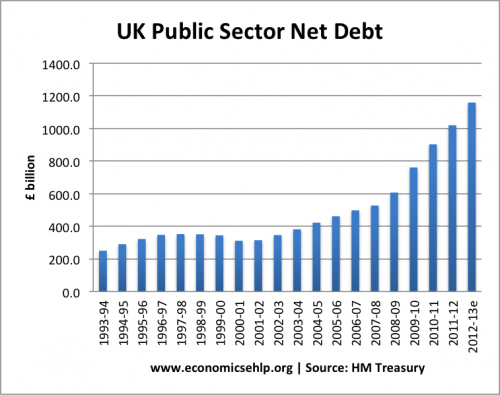
Debt to GDP statistics were helped by the period of strong economic growth – a reminder that economic growth is as important at debt levels. It is also worth bearing in mind UK public sector debt in comparison to the post-war period.
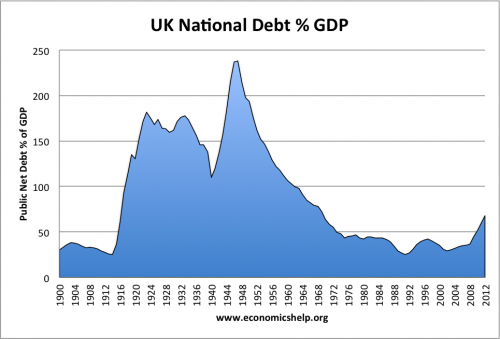
Even public sector debt of 60% of GDP is quite low compared to the historical average of public sector debt in the UK during the twentieth century. The very high period of debt in the 1950s was not a barrier to economic expansion.
Budget Deficit
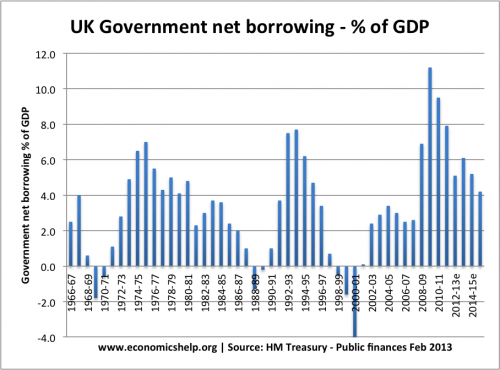
The level of Net government borrowing at 2011/12 prices
- 1997-98 – £ 7.8 bn
- 2007-08 – £ 40.3 bn
- 2010-11 – £ 145.1 bn
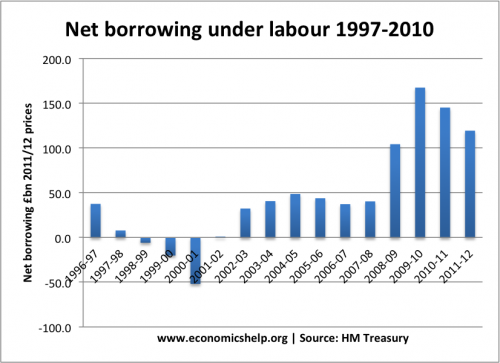
Government borrowing as a % of GDP.
Commentary
At the start of 2007, there were few economists expressing concern at government debt running at 36% of GDP. By post-war standards, UK government debt was very low and the government appeared to be meeting its own reasonable fiscal targets.
Given the period of strong economic growth, it is unsurprising that Labour wished to increase spending on health care and education. If the financial crisis hadn’t materialised, we may have looked back on the great moderation with kinder eyes.
However, a critic would point out that we did have a financial crisis and running a budget deficit during an unsustainable economic boom was irresponsible. In retrospect, Labour would have been better reducing the public sector debt further. This would have given the government even more room for manoeuvre during the crisis of 2008-12. Also, with growth strong, this was the best time to reduce the budget deficit. The mantra of Keynesians during the crisis has been – a recession is the wrong time to reduce a budget deficit. Given high growth in the 2000s, it would have been better to be stricter with public spending. Even countercyclical fiscal policy measures such as higher income tax, higher stamp duty may have reduced the housing and financial bubble and made the subsequent crash less dramatic.
This is a fair point. It was a mistake to be running budget deficits of 3% of GDP towards the end of the boom. However, the mistake is relatively minor. The boom was in finance and housing; inflation was running low (unlike say the 1980s boom) Most of the economic profession never saw the extent of the forthcoming recession. From a macro perspective, it didn’t look like a classic boom and bust (high growth and inflation)
Of course, it is easier to be wise after the event. If we were more aware of the dangers inherent in the financial system, we should have exercised much more caution. But, when looking at the causes of the great recession – government spending levels and budget deficits of the preceding years bear little if any cause.
It is also worth noting that when the recession hit, the government did initially pursue expansionary fiscal policy – there was no panic in the bond market. Bond yields have fallen throughout the crisis. Although debt increased rapidly, there was no danger of a fiscal cliff, like say Greece.
The switch towards austerity post-2010 was largely a self-created panic. Part of the motive for austerity was the desire to paint a grim picture of public finances. The problem is that economic pessimism can become self-fulfilling. A more balanced view of the overall state of public finances in 2010 would have led to less rash policy.
Debt under Conservative government 2010-19
More detail at Debt under Conservative government 2010-19
Related
About The Author

I think we should mention the following: Long-Term Capital Management collapse in 1997; the 1997 Asian financial crisis; the Dot.com of 2000 crash; the cost of the Iraq and Afgan wars.
The 2007 global financial crisis had 2 main causes. The Sup-prime mortgage lending in the US and also the EU zone banks over lending to PIGS countries due to them making much less margin on their Euro zone bond lending (I was in regulatory reporting in an investment bank at this time).
Much of our recent problems have resulted from our GDP not rising. At the start of the 2010’s this was caused by the UK applying the brakes on the economy, initially with higher VAT etc… Everyone involved in Brexit accepted the fact that there would be a hit on growth initially but hinted at higher growth in the future… possibly in 50years.