economics blog

Economics Help.org Revision Guide

Model Economics Essays

inflation — Economics Blog

Entries Tagged 'inflation' ↓

Why is Inflation Increasing? - and Prospects for Inflation

Readers Question: Why is Inflation Increasing?

In the last economic quarter, the UK economy stagnated 0% growth. At this stage in the economic cycle, you would usually expect a lower rate of inflation. - As demand in the economy falls there is downward pressure on prices causing lower inflation rates.

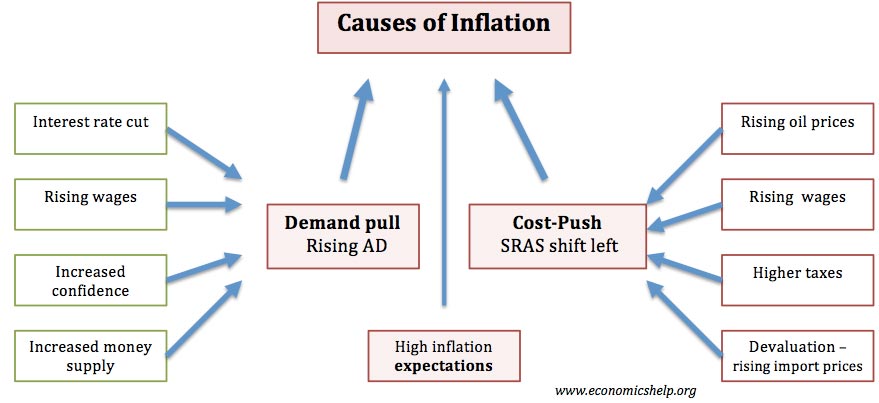
Inflation is increasing because of cost push factors. In particular the cost of living is rising because of

  • Higher oil prices - leading to higher petrol prices, and higher transport costs which affects all goods.
  • Higher food prices - caused by a combination of rising global demand and bottlenecks in supply.
  • Rising Energy prices - the price of natural gas is linked to the price of oil.
  • Rising commoditiy prices such as metals and minerals. Many blame rapid economic growth in India and China for this increased demand and higher prices
  • CPI Inflation is 4.7%, RPI is 5%.

Having said all that, I feel the prospects for inflation is that inflationary pressures will reduce in the coming year.

  • The slowing economy, rising unemployment and on going credit crunch will reduce demand pull inflation further
  • Global recession has already caused the price of oil to fall from its midsummer peak.
  • Evidence of food prices stabilising as supply bottlenecks overcome

Finding Recent Inflation RPI CPI Statistics

Readers Question: Does anyone know where I can get the latest RPI for August 2008?

  • Current Inflation CPI is 4.4%. This figure is for July.
  • RPI inflation is 5.%

To check the latest inflation rate, visit the home page of Bank of England [web page]

The August CPI inflation figure will be released on September 16th [It takes time to calculate inflation figures. The Bank of England website also gives date for next figure.

Another good page to bookmark is National Statistics Online - inflation page

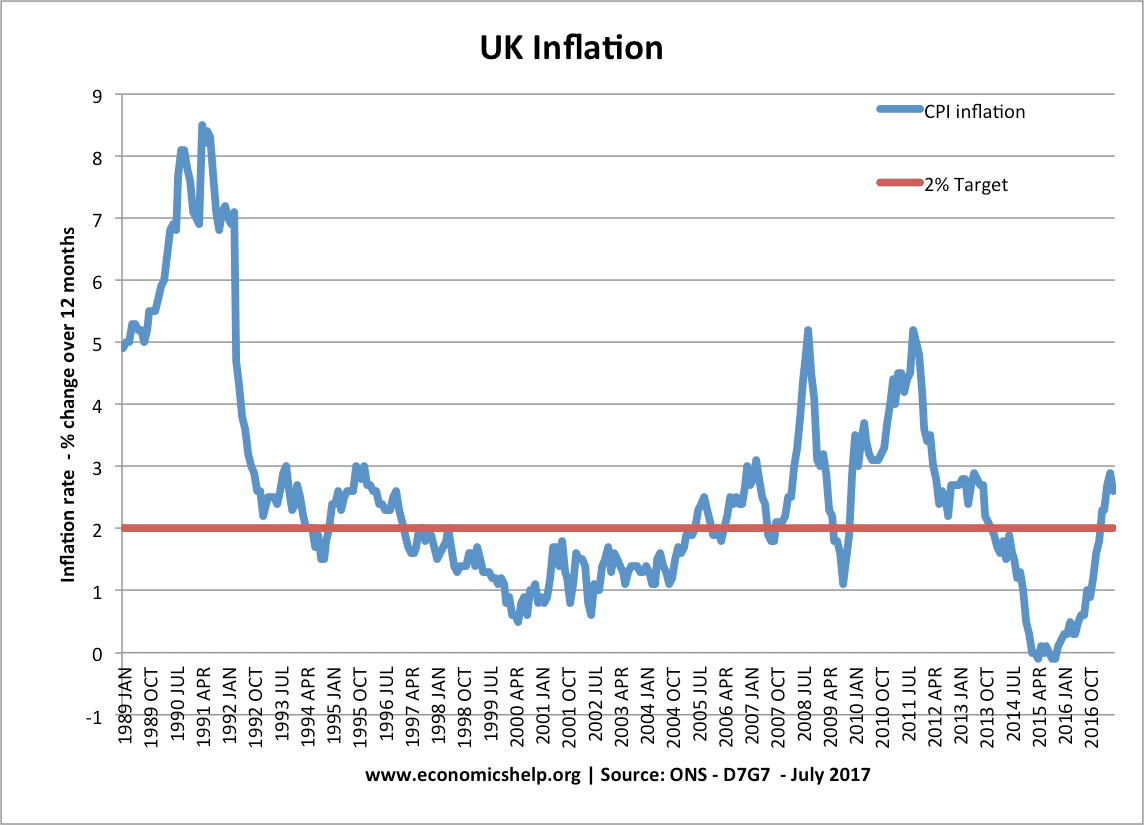
Inflation Graph for Past 2 Years

inflation

More on Inflation

Hedonics and Inflation

One of the problems with measuring inflation is that the quality of the product changes over time.

Some products become much better, with more features and more userability. For example, the features on a mobile phone have increased dramatically in the past 10 years. If we buy more expensive models of mobile phones, can we really say that is inflation? We are buying better quality products and so in a way the price is going down, because we are getting more for our money.

For example, the number of features on a top of the range vodaphone phone increases 50%, and the price is 5% higher. Is that inflation of 5% or deflation of 45% ?

Hedonics is the ’science of trying to work out how much product quality has changed and adjusting prices accordingly. It is used in the US calculation of inflation, I’m not sure about the UK.

Link Between International Competitiveness and Inflation

Readers Question: If British industry was to become uncompetitive it would have the following adverse effects on the economy : one of them is a higher level of inflation . How to explain that ?

If British industry becomes uncompetitive it means that basically, the UK’s cost of production is rising faster than our international competitors. For example, we may becoming uncompetitive because wage costs are rising and this is leading to higher inflation.

So in a way, the two are linked, we are becoming uncompetitive because of rising costs of production. Also if we become uncompetitive, there will be less demand for British goods and hence Sterling and so this would cause a devalution in the value of the Pound. Devaluation tends to cause inflation because:

  1. Rising cost of import prices
  2. Rising Aggregate demand
  3. Less incentives to cut costs

UK Inflation Worsens Despite Slower Sales

Despite a slowdown in retail sales during March (Sales fell 0.4% in the month) UK CPI inflation increased to 3%. Retail Price Index RPI (which includes more items) increased to 4.2%. This is at the upper limit of the Government’s inflation target. It is the highest UK inflation rate for quite a while.

Last month, The Bank kept interest rates stable at 5%. The Governor of the Bank of England, Mervyn King said that they had a difficult balancing act.

On the one hand they had a faltering housing market and decline in consumer spending.

On the side of the monetary policy scales, they have rising inflation. Mostly caused by higher food and energy prices.

Inflation at National Statistics

Importance of Inflation For Industry

CPI % Change

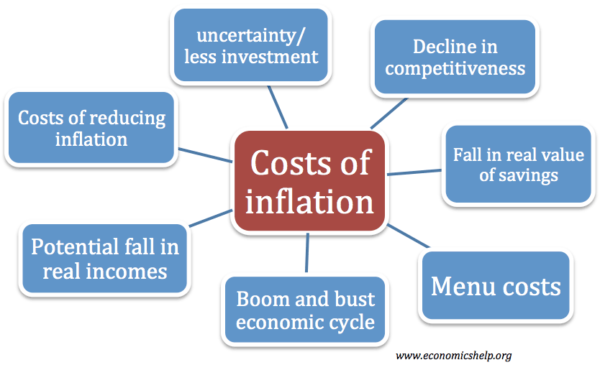
The inflation rate is a key statistic. High rates of inflation often discourage investment and lead to lower long term growth for the following reasons:

  • High and volatile inflation creates uncertainty and confusion about future prices and costs, this tends to reduce investment and lead to lower rates of growth in the economy. Therefore less demand for goods.
  • Menu costs of changing price lists. When inflation is high, prices need to be changed more frequently, which incurs a cost. Also high rates of inflation may incur frequent wage negotiations with trades unions who will be trying to maintain their real wages; this can be costly for a manufacturing firm.
  • High inflationary growth is often unsustainable. To reduce inflation often requires painful readjustment such as higher interest rates and deflationary fiscal policy; these lead to lower growth. Therefore countries with high inflation may be susceptible to a recession in the near future.
  • Less competitive. High inflation means costs will be rising and this will make the country’s exports less competitive compared to the rest of the world.
  • Less Confidence. People are suspicious of country’s with high rates of inflation, it discourages inward investment and creates lower growth.

Continue reading →

The Real Rate of Inflation

In the UK there is a strong mistrust of the government’s inflation figures. CPI inflation is currently 2.5%, but, anecdotal evidence makes people feel the ‘real’ rate of inflation is much higher.

CPI inflation is calculated using a comprehensive price survey of 1000 of the most popular goods and services. However, there are a number of reasons why people feel inflation is increasing faster than government statistics.

1. CPI excludes housing costs. The official measure for inflation used to be the RPI. RPI inflation is currently higher than CPI; RPI inflation is closer to 4%.

The CPI also excludes the council tax increases that have been rising faster than inflation.

2. There is a variance within the average basket of goods. The average inflation rate is 4%, but some goods like food, energy and petrol prices are rising by upto 15%. If you spend a high % of your income on these goods your personal inflation rate will be higher than the average inflation rate. For example, the inflation rate for many pensioners is higher than the average because they spend a high % of their income on energy and food. However, if you spend a large % of your income on electronic goods your personal inflation rate may be less than the national average.

  • Some people who may be adversely affected are those who are currently remortgaging. The cost of a fixed rate is significantly higher than 2 years ago. Their effective cost of living may be increasing very significantly at the moment. This is ignored by the CPI.

3. Psychology. You might argue that people tend to remember bad news more than good news. For example, the increasing price of petrol is well documented by the media and there are constant reminders as you drive around. However, it is easier to forget that the price of computers and mobile phones are becoming better value. Therefore, because we give more weight to ‘bad news’ rather than ‘good news’ our perceptions on inflation may be wrong.

Understanding Hyperinflation in Zimbabwe

Question related to hyperinflation in Zimbabwe 

Readers Question: I do not understand the responses. If prices are rising by 1000% and unemployment is 80% then WHO is buying the goods? It cannot be the people unemployed as they would not have the money. If the answer is ‘no-one is buying the goods, hence starvation’ then why would prices be so high as if there’s no demand….

Usually in the West, inflation is caused during periods of rapid growth; it is termed demand pull inflation. However, this particular case of inflation is not caused by an economic boom, but, a collapse in the economy where the money supply is growing despite a fall in output and number of goods available.

Although unemployment is close to 80%, there are still people with money. There are many groups of workers who have rising nominal wages because the government is printing more money, but, because the output of goods is falling, the value of money is decreasing rapidly.

Basically, even if only a small % of the population has any money that is sufficient to cause inflation, if the output is falling. The real problem is that many people have more cash / money, but have declining real incomes.

Because there is a shortage of goods and the printing of more money it is inevitable that inflation occurs.

Note printing money does nothing to increase Real output, Real GDP. It is a basic economic paradox that you can’t get richer by printing more money. But, it doesn’t stop people in desperate situations trying.

Solution to Stagflation

Readers Question: what is the solution for stagflation?

Stagflation occurs when there is an increase in inflation and an increase in unemployment and lower growth.

Typically stagflation will be caused by an increase in the cost of production which shifts the AS curve to the left.

Diagram of Stagflation

cost push inflation

The diagram shows that the stagflation causes the price level to rise from P1 to P2. Output falls from Y1 to Y2

How To Solve Stagflation?

It is not easy. For example You could use Monetary policy to reduce inflation. Higher Interest rates increase the cost of borrowing and will reduce AD. This will be effective for reducing inflation, but, it will cause a  bigger fall in GDP. Continue reading →

Information on Inflation

1) Readers Question What is inflation,

 How is inflation calculated?

 and impact on economy if it bit increases or decreases.

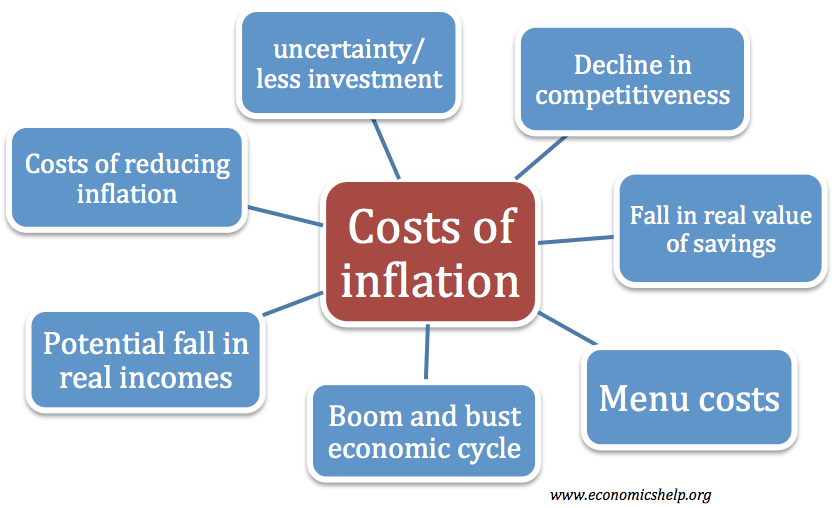
If inflation increases above the governments target of 2% it is said to have various economic costs, such as creating instability, uncertainty and lower international competitiveness. See costs of inflation 

If prices fall, then we have deflation. Deflation can be harmful if it leads to lower demand. See: impact of inflation and deflation