
- This is a list of the gross national debt of 178 countries, showing the variation in debt levels from Venezuela at 234% of GDP to Turkmenistan at 4.6% of GDP.
- National debt refers to the amount of total government debt a country has. This is also referred to as ‘public sector debt’.
- It is compiled using data from the IMF.
- Note: National debt is different to ‘External debt‘ – External debt includes all the debt a country (both private and public sector) owes to foreigners.
- Updated 19 Dec 2025
Debt of selected economies

List of National Debt by Country
Levels of general gross government debt. Debt levels as % of GDP for 2024 (accessed Dec 2025)
Full List of Countries debt share
| Debt % GDP | ||
| 1 | Japan | 236.7 |
| 2 | Venezuela | 164.3 |
| 3 | Greece | 150.9 |
| 4 | Italy | 135.3 |
| 5 | United States | 120.8 |
| 6 | France | 113.1 |
| 7 | Canada | 110.8 |
| 8 | Belgium | 104.5 |
| 9 | Spain | 101.8 |
| 10 | United Kingdom | 101.3 |
| 11 | Portugal | 94.9 |
| 14 | Egypt | 90.9 |
| 15 | Ukraine | 89.8 |
| 16 | China | 88.3 |
| 17 | El Salvador | 87.6 |
| 18 | Brazil | 87.3 |
| 19 | Finland | 82.5 |
| 20 | India | 81.3 |
| 21 | Austria | 81.2 |
| 22 | Hungary | 73.5 |
| 23 | Yemen | 70.9 |
| 24 | Malaysia | 70.4 |
| 25 | Israel | 67.8 |
| 26 | Slovenia | 67.0 |
| 27 | Cyprus | 65.3 |
| 28 | Germany | 63.9 |
| 29 | Montenegro | 62.6 |
| 30 | Colombia | 61.3 |
| 31 | Costa Rica | 60.2 |
| 32 | Iceland | 59.1 |
| 33 | Slovak Republic | 58.0 |
| 34 | Croatia | 57.6 |
| 35 | Thailand | 57.2 |
| 36 | Philippines | 57.1 |
| 37 | Panama | 56.6 |
| 38 | Albania | 55.7 |
| 39 | Poland | 55.3 |
| 40 | North Macedonia | 54.8 |
| 41 | Romania | 54.6 |
| 42 | Nigeria | 52.9 |
| 43 | Korea, Republic of | 52.5 |
| 45 | Australia | 49.8 |
| 46 | Tanzania | 48.2 |
| 47 | Malta | 47.4 |
| 48 | Latvia | 47.4 |
| 49 | Serbia | 44.5 |
| 50 | Belarus | 44.4 |
| 51 | Mongolia | 44.4 |
| 52 | Netherlands | 43.2 |
| 53 | Czech Republic | 43.0 |
| 54 | Norway | 42.7 |
| 55 | Chile | 42.0 |
| 56 | Honduras | 41.1 |
| 57 | Ireland | 41.1 |
| 58 | Indonesia | 40.2 |
| 59 | Nicaragua | 39.1 |
| 60 | Lithuania | 38.2 |
| 61 | Moldova | 38.1 |
| 62 | Georgia | 37.9 |
| 63 | Switzerland | 37.6 |
| 65 | Vietnam | 32.9 |
| 66 | Bosnia and Herzegovina | 32.8 |
| 67 | Uzbekistan | 32.6 |
| 68 | Sweden | 32.6 |
| 69 | Ethiopia | 32.3 |
| 70 | United Arab Emirates | 32.1 |
| 71 | Peru | 30.9 |
| 72 | Tajikistan | 29.5 |
| 73 | Denmark | 28.0 |
| 74 | Cambodia | 26.6 |
| 75 | Taiwan Province of China | 26.2 |
| 76 | Luxembourg | 26.0 |
| 77 | Türkiye | 26.0 |
| 78 | Kazakhstan | 24.8 |
| 79 | Bulgaria | 24.1 |
| 80 | Estonia | 23.6 |
| 81 | Russian Federation | 20.3 |
| 82 | Congo, | 19.3 |
| 83 | Nauru | 17.6 |
| 84 | Kosovo | 16.9 |
| 87 | Kiribati | 9.9 |
| 88 | Turkmenistan | 4.6 |
a
Source: IMF
Source: IMF DataSet, accessed 1 September 2021
Highest levels of Government debt in the world
The country with probably the biggest debt problem is Venezuela. Because of hyperinflation, sanctions, a collapsing economy and a failure to collect tax revenues they can’t even borrow on international markets.
The country with the highest debt to GDP ratio in 2020 was Japan (234%) – a reflection of an ageing population. The Japanese government is able to borrow from private individuals in Japan because of high saving rates. But, as Japan sees a return of inflation and higher debt, this is becoming more problematic.
Lowest levels of government debt in the world
The country with the lowest levels of debt is Turkmenistan – an reflection of its natural-gas–based economic model and political choices, rather than broad economic strength. Turkmenistan has some of the world’s largest gas reserves and gas exports (especially to China) generate large foreign-currency inflows. The government often funds spending from energy revenues, reducing the need to borrow
Some very poor countries like Afghanistan, Congo and Haiti have perhaps surprisingly low levels of debt. One reason is that the country does not have functioning bond markets. There is so much uncertainty that governments do not have the opportunity to borrow.
Problems of national debt
High levels of national debt can cause these potential problems
- Requirement of higher taxes and/or lower spending
- Higher debt interest payments
- Pressure to print money – causing inflation.
- Debt financed by overseas borrowing can lead to external pressure
- Crowding out of the private sector
See: more problems of government borrowing
How much can a government borrow?
- Japan’s national debt is 236% of GDP and has been high for a couple of decades. This reflects the ability of Japan to borrow from domestic citizens. Despite prolonged periods of high debt, interest rates are still low because markets feel the government is still solvent.
- A developing economy like Argentina has a track record of default on debt, therefore markets are less willing to lend money to the government. Therefore when debt levels in Argentina increase it has a greater effect on pushing up interest rates.
Factors that depend on how much a government can borrow include
- Default rates of government
- Inflationary pressures. High inflation will make investors less willing to buy government bonds because they will devalue due to inflation
- Can the government print its own money? If the government can print money it can avoid liquidity issues, though there is potential danger of inflation.
- What are the prospects for economic growth? Higher economic growth makes it easier to reduce debt to GDP ratios over time.
- How much can a government borrow?
Difference between debt and deficit
Government debt is the total amount of outstanding liabilities. The deficit is the annual amount by which spending exceeds income. The debt is the accumulation of past deficits.
For example in 2025, the US deficit was $1.8 trillion The US total debt is $38 trillion.
Causes of national debt
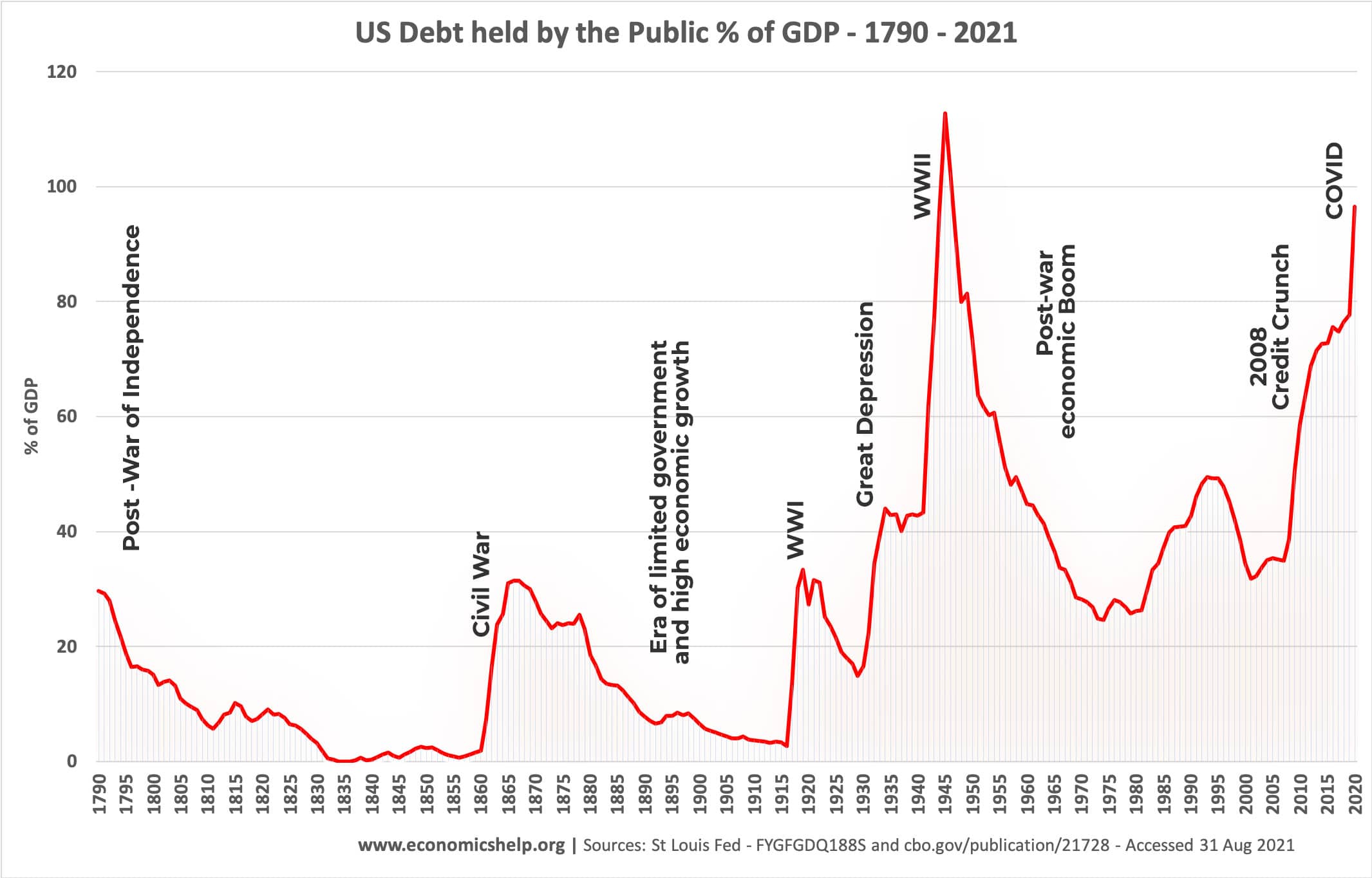
This graph for US national debt shows how national crisis leads to a rise in government borrowing. This isn’t necessarily a bad thing. Government debt enabled the US government to finance the short-term costs of the two world wars. It also enabled the government to respond to the crisis of the 2008 financial crash and the 2020 Covid crisis. Causes of national debt can include
- Recession – tax revenues fall when the economy shrinks. Also the government spend more on unemployment benefits
- Investment – Governments might borrow to build new roads, schools and hospitals.
- Finance war –
- Demographic changes and welfare spending. An ageing population tends to place more strain on government finances with older people requiring more health care spending, pensions and also they pay less income tax.
- Political decisions. Some governments may support higher spending on welfare programmes, whearas other governments may target a balanced budget.
Related
Further Reading
Readers Question
About The Author

@Wahid: It is because the government pours in money to stimulate the economy, increasing their debt, and if the japanese spent it, future tax revenue, but they save it instead, making the government continue to pour money in. Correct me if I am wrong(:
Why is Japans debt so high?
@Kendrick: As I understand it is any level of government’s debt, and that debt is usually owed to the people, but countries with high trade deificiets that money begins to be owed to people oversea’s. And why do we not pay our debt? Because then no other countries would trade with you until you payed the debt, which would be even harder then usual because you wuld have lost a massive percentage of GDP because of the losss of trade(We need oil)
I am still learning so tell me if I am wrong:)
Why is the US debt listed here as 90.8% of GDP in the opening paragraphs, and then listed as No. 66 at 39.7% of GDP? By other accounts we do seem to be closing in on 100%, and so should be listed between Nos. 11 & 12 (differences between 2008 and 2009 notwithstanding). I wonder if the U.S. could negotiate lower interest rates on its public debts without causing panic, so that it could lower its interest payments, get its economy going again, and pay down the principal over the long term. I know…not as easy as it sounds.
Ladies and gentlemen. This is crazy. How can the whole world be in debt. Who are they in debt to? What if a country just decides to not pay their debtors. What if the U.S. Says I’m not paying. Come take it if you want it. We have a military and a local populace with guns, so have fun with that. Are we in debt to bankers or to china and who is china in debt to?
I think you may have the wrong idea about ‘debt’. When a bank lends you money, it does it using deposits that people make. The government of individual contries maybe borrowing from bank deposits or it may be selling bonds. bonds are “I’ll pay this sum at a given date”. The “sum” I’ll pay you is the value of the bond now and plus yield (or interest). Banks offer term deposits to those with axcess funds in order to lend that money to others. The term deposit matures at a certain time and it is paid in full plus agreed interest. The bank has a debt with me when accepts my term deposit and uses my funds to do something with it. Banks re-lend it, governments use to pay for service and other projects in the hope that when the bonds are due they will have sufficient funds to pay. The problem arrives when the Government can’t pay because it hasn’t collected enough taxes, and it goes bankrupt. This will have a ripple effect and, depending on how big is the bankrupt. A small country going under (Iceland went down years ago) will have little effect, if a large one goes under (eg the USA) then we are in big, very big trouble with the World economy stalling and dark days ahead ….
everyone is in debt because everything we are living is created by debt. Debt is humanity big joke and we are living in a hole of shit because of this illusion.!!!
interesting stats but i fear it is not the full story and some countries who look worse off could in fact be out of trouble quicker due to exports and prudent economics.